Facts
The appellant-plaintiff sought damages from the respondent following a customs search and seizure at a tenant’s godown on 23 August 2003.
Source reference: para. 4, 9It alleged that the authorities retained possession of the premises until 2 April 2013, causing loss from its non-use.
Source reference: para. 4, 9The plaintiff sought a money decree, not a declaration of title to the property.
Source reference: para. 9–10The Single Judge held that the suit was not a “suit for land” under Clause 12 of the Letters Patent, but found that no part of the cause of action arose within the High Court’s jurisdiction and directed return of the plaint under Order VII Rule 10 CPC.
Source reference: para. 1–2The plaintiff appealed.
Source reference: no citationThe appellate judgment identifies the suit as CS/84/2014 at the outset, but refers to CS/86/2014 in its final remand order.
Source reference: para. 1, 17Issues
1. Whether the suit for damages, which did not seek a declaration of title to immovable property, was a “suit for land” under Clause 12 of the Letters Patent.
Source reference: para. 5, 8–122. Whether the High Court could entertain the suit on the basis that the plaintiff’s registered office—and, as alleged, the place where it suffered damages—was within the Original Side’s jurisdiction.
Source reference: para. 3, 9, 12–15Law Applied
Clause 12 of the Letters Patent, 1865 governs the Original Side’s jurisdiction and the requirement of leave where a suit involving land outside the jurisdiction is brought before the Court; a suit seeking declaration of tenancy rights and protection of possession in respect of land outside the jurisdiction may be a “suit for land” (*Bengal Glass & Silicate Works v. Lalit Mohan Bijlani*, AIR 1986 Cal 57).
Source reference: para. 5, 10–11Order VII Rule 10 CPC permits return of a plaint for presentation to the proper court where the court lacks jurisdiction.
Source reference: para. 2The Court also relied on *Morgan Stanley Mutual Fund v. Kartick Das*, (1994) 4 SCC 225, for the proposition that a company’s residence is where its registered office is located and that, normally, cases should be filed where that office is situated.
Source reference: para. 6–7, 14Reasoning
The Court treated the suit as a claim for damages arising from the alleged detention of the tenant’s premises, not as a claim to determine title or possession of land.
Source reference: para. 9–12It therefore held that the principles governing a “suit for land” did not apply and distinguished *Bengal Glass*, where the plaintiff had sought recognition of tenancy and protection of possession.
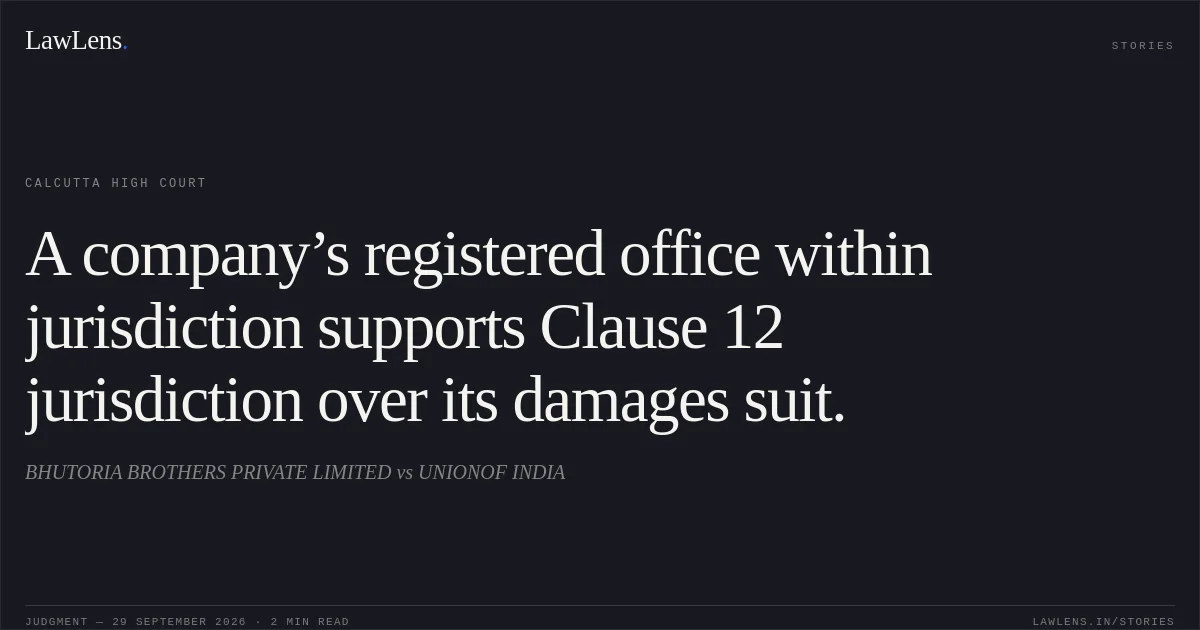
Source reference: para. 9–12Applying *Morgan Stanley*, the Court concluded that the plaintiff’s registered office was within the Original Side’s jurisdiction and that the plaint disclosed a basis for the High Court to entertain the suit; it declined to return the plaint for want of jurisdiction.
Source reference: para. 12–15The merits of the damages claim were left open for trial.
Source reference: para. 16Holding
The Court held that the suit was not a “suit for land” and could not be returned on the ground that the Original Side lacked jurisdiction.
It set aside the Single Judge’s order, dismissed GA/8/2026, and remanded the suit—identified in the final order as CS/86/2014—to the Trial Judge for decision.
Source reference: para. 17–19Pending applications were revived, and the appeal was disposed of without costs.
Source reference: para. 17–19Original Court PDF
BHUTORIA BROTHERS PRIVATE LIMITEDvsUNIONOF INDIA
Click to open original judgment
Original judgment, available to read, download and summarize on LawLens.in