Facts
The petitioner’s mother, a permanent Full-Time Safai Karamchari with the Central Bank of India, died in harness on 29 March 2024 after more than 21 years of service.
Source reference: para. 10The petitioner applied for compassionate appointment under the Central Bank’s Scheme for Compassionate Appointment on Compassionate Grounds or Payment of Lumpsum Ex-Gratia Amount dated 8 April 2015.
Source reference: no citationHis application was rejected by order dated 26 August 2025 on the ground that, being married, he could not be treated as wholly dependent on the deceased employee.
Source reference: paras. 3, 11–12The petitioner challenged the rejection, contending that Clause 2.2 of the 2015 Scheme included a “wholly dependent son” without distinguishing between a married and unmarried son.
Source reference: para. 4He also relied on his income certificate showing annual income of Rs. 1,10,000.
Source reference: paras. 5–6Issues
Whether the Central Bank’s 2015 compassionate appointment scheme excludes a married son from the category of “wholly dependent son” merely because of his marital status?
Source reference: paras. 13–14, 19–22Whether the Bank could import the requirement of being unmarried from the Officers’ Service Regulations, the Group Health Insurance Policy, the Bipartite Settlement, or the Indian Banks’ Association FAQs into the 2015 compassionate appointment scheme?
Source reference: paras. 15–21Whether the rejection of the petitioner’s application solely on the ground that he was married was legally sustainable?
Source reference: paras. 11–12, 22–24Law Applied
The Court applied the Central Bank of India’s Scheme for Compassionate Appointment on Compassionate Grounds or Payment of Lumpsum Ex-Gratia Amount dated 8 April 2015, particularly Clause 2, which defines a dependent family member to include a spouse, a “wholly dependent son,” a “wholly dependent daughter,” and, in specified circumstances, a wholly dependent brother or sister.
Source reference: para. 13The Court held that the Scheme itself does not define “wholly dependent” and does not add the qualification “unmarried” to the expressions “son” or “daughter”.
Source reference: paras. 14, 20The Central Bank of India (Officers’) Service Regulations, 1979, which refer to wholly dependent unmarried children, apply to bank officers and could not govern the petitioner’s case because his mother was a non-officer employee serving as a Full-Time Safai Karamchari.
Source reference: para. 16Similarly, the definition in the Group Health Insurance Policy was confined to that insurance policy and could not be applied to compassionate appointment.
Source reference: para. 17The Indian Banks’ Association FAQs related to an earlier 2014 scheme and could not supplement the later, self-contained 2015 Central Bank scheme.
Source reference: paras. 18–19The Court further noted that dependency was to be assessed substantively, including by reference to the applicable income threshold of Rs. 18,000 per month.
Source reference: para. 20Reasoning
The Court treated the 2015 Scheme as a complete and self-contained instrument and therefore interpreted the eligibility categories according to its express language.
Source reference: para. 19Since Clause 2.2 expressly used the term “wholly dependent son” but omitted the word “unmarried,” the Bank could not introduce that additional restriction by relying on provisions contained in unrelated regulatory or policy documents.
Source reference: paras. 14, 19, 21The Officers’ Service Regulations were inapplicable because they concerned officers, whereas the deceased employee was a Safai Karamchari.
Source reference: para. 16The Group Health Insurance Policy addressed a different subject, and the FAQs concerned an earlier compassionate appointment scheme.
Source reference: paras. 17–19The Court also reasoned that the deliberate use of “unmarried” in other instruments, but not in the 2015 Scheme, indicated that the Bank had intentionally omitted that limitation from its compassionate appointment scheme.
Source reference: para. 21Accordingly, the petitioner’s marriage could not, by itself, establish that he was not wholly dependent or disentitle him from consideration.
Source reference: no citationHolding
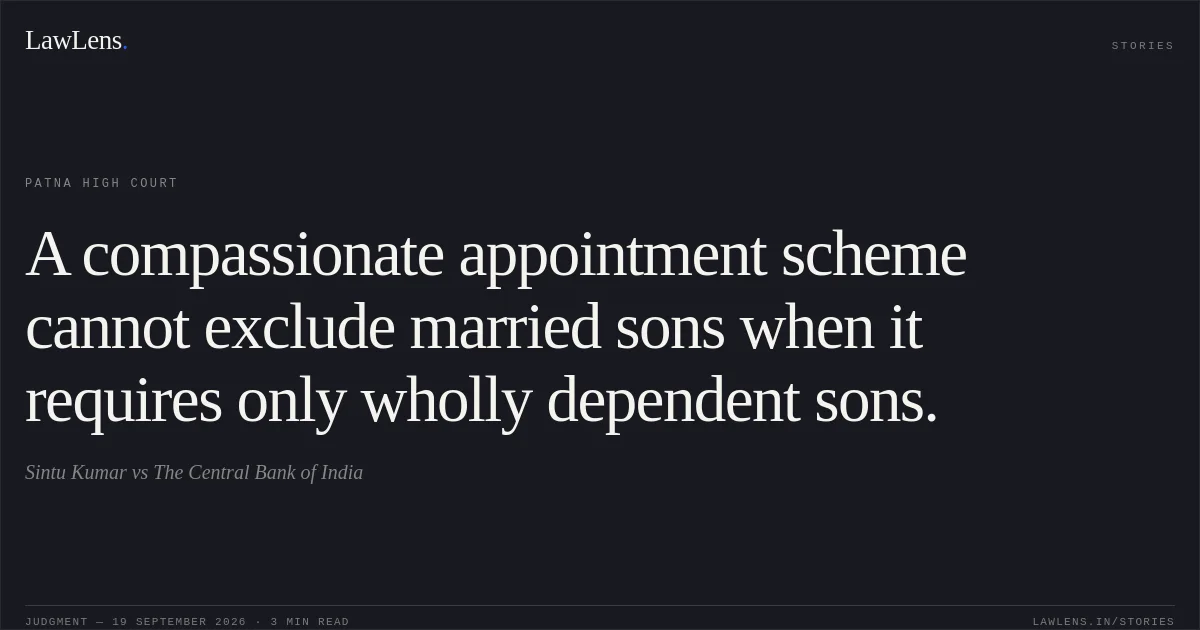
The Court held that the 2015 Scheme makes no distinction between married and unmarried sons or daughters and that the Bank erred in rejecting the petitioner’s application solely because he was married.
The rejection order dated 26 August 2025 was quashed and set aside.
Source reference: para. 23The Bank was directed to reconsider the petitioner’s claim for compassionate appointment in accordance with the Court’s observations and the applicable 2015 Scheme, and to pass an appropriate order within three months of receiving or being furnished a copy of the judgment.
Source reference: para. 24The writ application was accordingly allowed.
Source reference: para. 25Acts & Sections Cited
2 provisions across 1 statute referred to in this judgment. Each provision opens on LawLens.
Banking Companies (Acquisition and Transfer of Undertakings) Act, 19702
Original Court PDF
Sintu KumarvsThe Central Bank of India
Click to open original judgment
Original judgment, available to read, download and summarize on LawLens.in