Facts
The complainants alleged disobedience of a direction made in W.P. No. 202540/2024 on 7 November 2024.
Source reference: p. 4The writ court had directed the authorities to consider specified representations and pass appropriate orders within four weeks of receiving a copy of the order.
Source reference: p. 4The complainants submitted a further representation on 10 December 2024, acknowledged by the Deputy Commissioner’s and Assistant Commissioner’s offices that day.
Source reference: p. 6They filed the contempt petition on 12 January 2026.
Source reference: p. 4They argued that a communication dated 13 March 2025, in which the Additional Commissioner called for compliance, extended the limitation period, and also relied on a recurring cause of action.
Source reference: p. 5Issues
Whether the contempt petition, filed on 12 January 2026, was barred by the one-year limitation period under Section 20 of the Contempt of Courts Act, 1971.
Source reference: pp. 6–7, 15Whether the communication dated 13 March 2025, or the alleged continuing breach, extended or renewed the limitation period.
Source reference: pp. 7, 15Law Applied
Section 20 of the Contempt of Courts Act, 1971 bars initiation of contempt proceedings after one year from the date of the alleged contempt.
Source reference: pp. 8–15Relying on Pallav Sheth v. Custodian, (2001) 7 SCC 549, and S. Tirupathi Rao v. M. Lingamaiah, (2024) 20 SCC 188, the Court held that a contempt action must be brought within the statutory period; repeated representations do not extend limitation.
Source reference: pp. 8–15A party relying on a “continuing wrong” must plead and establish facts showing that the breach itself continues, rather than merely that its effects persist.
Source reference: pp. 8–15Reasoning
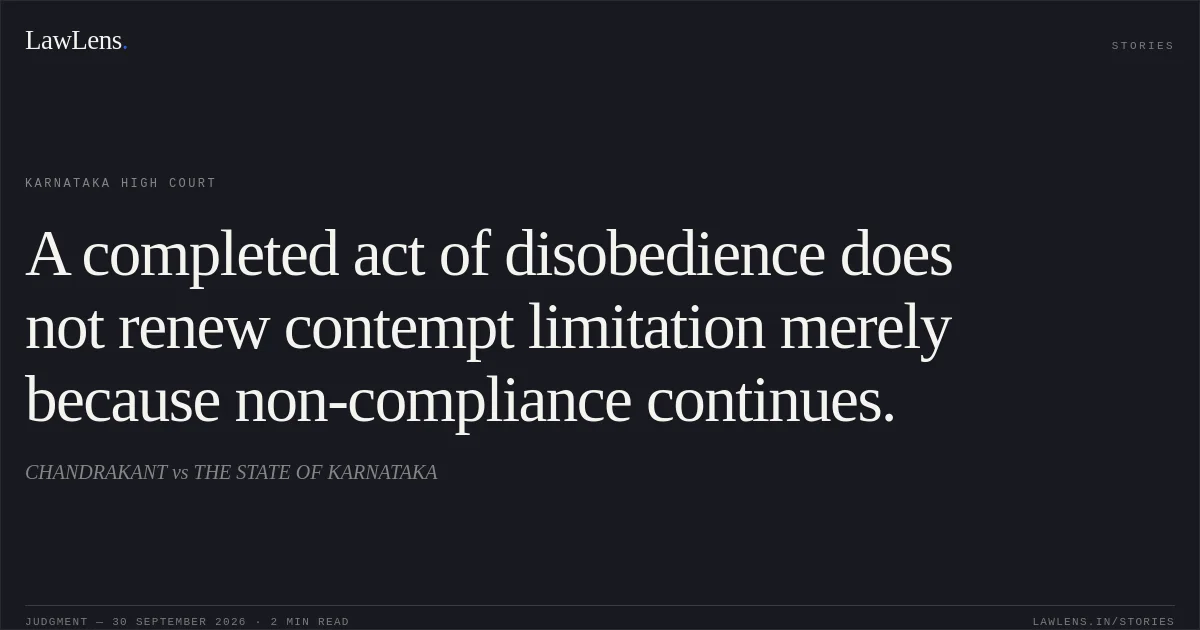
The Court treated the alleged disobedience as arising when the four-week period for compliance expired, rather than from the later communication of 13 March 2025.
Source reference: p. 7The complainants’ further representation and the authorities’ communication did not restart or extend limitation.
Source reference: pp. 6–7The contempt petition contained no pleadings establishing a continuing breach that could overcome Section 20; applying S. Tirupathi Rao, the Court concluded that the petition was filed outside the one-year period.
Source reference: pp. 7, 15Holding
The Court held that the contempt petition was barred by Section 20 of the Contempt of Courts Act, 1971 and rejected it.
The dismissal did not foreclose the complainants from pursuing other remedies available in law.
Source reference: p. 16Acts & Sections Cited
3 provisions across 1 statute referred to in this judgment. Each provision opens on LawLens.
Contempt of Courts Act, 19713
Original Court PDF
CHANDRAKANTvsTHE STATE OF KARNATAKA
Click to open original judgment
Original judgment, available to read, download and summarize on LawLens.in