Facts
The plaintiff paid ₹1.5 crore to the first defendant under a construction agreement dated 10 November 2014.
Source reference: pp. 3–7, 11–14, 19–20; paras. 2–7, 12–15, 22–25After the proposed construction was abandoned, the defendants repaid ₹15 lakh, and subsequent repayment cheques were dishonoured.
Source reference: pp. 3–7, 11–14, 19–20; paras. 2–7, 12–15, 22–25While the plaintiff’s suit for recovery was pending, the plaintiff and the first defendant entered into two memorandums of compromise on 14 September 2019: one fixed the settlement principal at ₹1.25 crore, with ₹70 lakh payable by cheque, and the other recorded ₹45 lakh as interest.
Source reference: pp. 3–7, 11–14, 19–20; paras. 2–7, 12–15, 22–25The plaintiff received ₹55 lakh toward the principal and the interest amount, but the cheque for the remaining ₹70 lakh was dishonoured.
Source reference: pp. 3–7, 11–14, 19–20; paras. 2–7, 12–15, 22–25The plaint was amended in 2023 to claim ₹1,10,24,520.54, including interest, and damages.
Source reference: pp. 3–7, 11–14, 19–20; paras. 2–7, 12–15, 22–25The defendants disputed limitation, liability and the plaintiff’s compliance with the compromise terms.
Source reference: pp. 3–7, 11–14, 19–20; paras. 2–7, 12–15, 22–25Issues
1. Whether the amended claim for recovery of money was barred by limitation
Source reference: p. 7; paras. 22–292. Whether the plaintiff was entitled to recover the claimed amount and whether defendants 2 and 3 were liable as proper or necessary parties
Source reference: pp. 7–8; paras. 31–383. Whether the plaintiff’s failure to withdraw the suit breached the compromise terms and defeated her claim
Source reference: p. 7; paras. 35–364. Whether the plaintiff was entitled to damages for alleged loss and whether that claim was time-barred
Source reference: pp. 7–8; paras. 28–30Law Applied
The Court relied on Order VI Rule 17 of the Code of Civil Procedure, under which pleadings may be amended to determine the real questions in controversy.
Source reference: p. 21; paras. 26–28It treated a cause of action as a bundle of facts and considered whether the amended recovery claim arose from the original transaction or introduced a distinct cause of action.
Source reference: p. 21; paras. 26–28The defendants invoked the three-year limitation period and the Supreme Court’s pandemic-related extension of limitation, but the judgment did not identify a specific provision or article of the Limitation Act as the basis of its decision.
Source reference: pp. 14–17, 26; paras. 16–18, 35–36The Court also considered the parties’ obligations under the memorandums of compromise, including the payment and withdrawal terms.
Source reference: pp. 14–17, 26; paras. 16–18, 35–36Reasoning
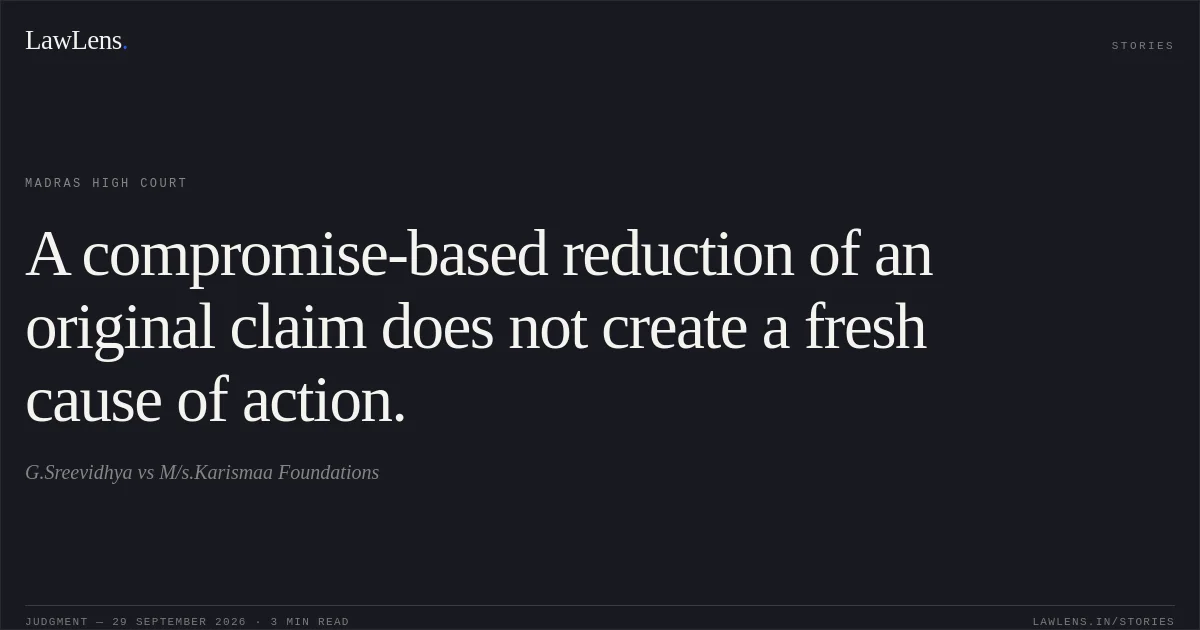
The Court found that the compromise arose from the same construction-agreement transaction underlying the original suit and reduced, rather than enlarged, the recovery claim.
Source reference: pp. 21–23; paras. 26–29It therefore treated the amended money claim as a continuation of the original cause of action, not a fresh time-barred claim; it separately held that the newly introduced damages claim was barred by limitation.
Source reference: pp. 21–23; paras. 26–29Although the plaintiff had not withdrawn the suit as required by the compromise, the Court held that the defendants could not rely on that failure after defaulting on their own obligation to pay the remaining ₹70 lakh.
Source reference: pp. 26–27; paras. 35–36It found the settlement amount and dishonoured cheque established the first defendant’s outstanding liability, held defendants 1 to 3 liable, and absolved defendant 4 because he was no longer a director when the compromise was made.
Source reference: pp. 27–28; paras. 37–38Holding
The Court decreed the suit against defendants 1 to 3 for ₹1,10,24,520.54, with interest at 12% per annum from 14 July 2023 until the date of judgment and thereafter at 9% per annum until realization.
It dismissed the damages claim and dismissed the suit against defendant 4.
Source reference: p. 29; para. 39Defendants 1 to 3 were ordered to pay the costs of the suit.
Source reference: p. 29; para. 39Acts & Sections Cited
1 provisions across 1 statute referred to in this judgment. Each provision opens on LawLens.
Insolvency and Bankruptcy Code, 2016.1
Original Court PDF
G.SreevidhyavsM/s.Karismaa Foundations
Click to open original judgment
Original judgment, available to read, download and summarize on LawLens.in