Facts
In 1993, the appellant received a penalty of censure for negligence concerning missing OL-series draft forms at the Bansda branch, which he accepted.
Source reference: p.1In 1994, the Bank initiated a separate disciplinary proceeding alleging that he had fraudulently used a missing draft for ₹30,000.
Source reference: pp.2–4, 8–10The inquiry officer found the charge proved, relying in part on handwriting-expert evidence connecting the appellant to the draft and to an account-introduction form associated with the transaction.
Source reference: pp.2–4, 8–10The disciplinary authority dismissed him in 1998; the appellate authority upheld the dismissal, and the Single Judge dismissed his writ petition.
Source reference: pp.4–6In the Letters Patent Appeal, the appellant relied, among other things, on his acquittal in the criminal case and challenged the sufficiency and credibility of the departmental evidence.
Source reference: pp.6–7Issues
Whether the appellant’s acquittal in the criminal proceedings required his exoneration in the departmental inquiry concerning the same transaction.
Source reference: pp.6–8Whether the departmental finding of guilt was supported by sufficient evidence, including the handwriting-expert opinion, notwithstanding the dispute over whether the draft forms had been received at the Bansda branch.
Source reference: pp.8–11Whether the disciplinary findings warranted interference in writ or Letters Patent Appeal jurisdiction.
Source reference: pp.7–8, 11–12Law Applied
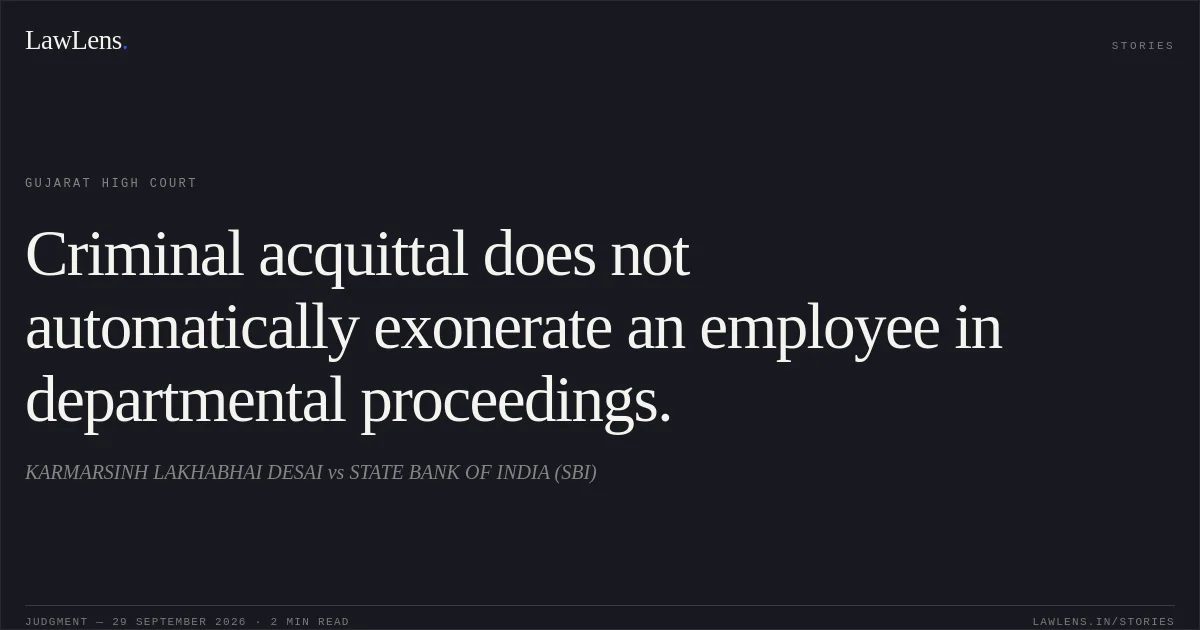
A criminal acquittal does not automatically exonerate an employee in departmental proceedings: criminal guilt must be proved beyond reasonable doubt, whereas departmental charges are determined on the balance of probabilities.
Source reference: p.8In judicial review of disciplinary proceedings, interference is limited; where adequate evidence supports the disciplinary finding, the reviewing court does not reappreciate that evidence as an appellate fact-finder.
Source reference: pp.7–8, 11–12The judgment cites no specific statute or precedent.
Source reference: no citationReasoning
The Court rejected the argument that the criminal acquittal controlled the departmental outcome because the two proceedings apply different standards of proof.
Source reference: p.8It found that the draft resurfaced and was encashed while the appellant was posted at the Prabhat Society branch, and that the purported signature of V.B. Barot on the draft was attributed by the handwriting expert to the appellant; the Court also relied on the appellant’s handwriting on the account-introduction form connected with the account receiving the proceeds.
Source reference: pp.8–11Those circumstances, in the Court’s view, sufficiently connected the appellant to the fraudulent encashment.
Source reference: pp.8–11Even assuming the Bank had not established receipt of the draft forms at Bansda, the evidence concerning the forged signature and account-introduction form supported the finding of involvement.
Source reference: p.11The Court therefore found no basis for appellate interference with the concurrent disciplinary findings.
Source reference: pp.11–12Holding
The Court held that the criminal acquittal did not automatically invalidate the departmental finding and that the record contained sufficient evidence to sustain the finding of misconduct.
It dismissed the Letters Patent Appeal.
Source reference: p.12Original Court PDF
KARMARSINH LAKHABHAI DESAIvsSTATE BANK OF INDIA (SBI)
Click to open original judgment
Original judgment, available to read, download and summarize on LawLens.in