Facts
Following violence during a mosque survey in Sambhal on 24 November 2024, in which four persons died, the appellant was arrested in January 2025 in connection with several FIRs.
Source reference: paras. 3–9A police-recorded confessional statement and alleged recovery of a pistol formed part of the material against him.
Source reference: paras. 3–9After the appellant received bail in one case, the District Magistrate ordered his preventive detention under Section 3(2) of the National Security Act, 1980 (NSA), on 13 October 2025; the State later confirmed detention for 12 months.
Source reference: paras. 3–9The appellant challenged the detention, alleging that his confession had been obtained through torture and that relevant material had not been supplied.
Source reference: paras. 3–9The High Court dismissed his petition.
Source reference: paras. 3–9By the time of the Supreme Court appeal, he had obtained bail in all the criminal cases.
Source reference: paras. 3–9Issues
1. Whether an order of preventive detention may be based on an extra-judicial confession made to a police officer, particularly where coercion is alleged
Source reference: para. 14(a); paras. 29–392. Whether the remaining grounds and material relied on by the detaining authority provided a valid and reasonable basis for detention, consistently with constitutional and statutory safeguards
Source reference: para. 14(b); paras. 40–43Law Applied
Article 20(3) of the Constitution protects against compelled self-incrimination, while Article 22(5) requires communication of relevant grounds and an effective opportunity to make a representation.
Source reference: paras. 30–36, 39Section 23 of the Bharatiya Sakshya Adhiniyam, 2023 (BSA) generally excludes a confession made to a police officer, subject to limited statutory exceptions.
Source reference: paras. 30–36, 39Such a confession cannot, by itself and without independent supporting material, form the basis for the subjective satisfaction required for preventive detention; a coerced confession is especially unreliable.
Source reference: paras. 30–36, 39Under Section 3(2) of the NSA, detention requires relevant material supporting the authority’s satisfaction that detention is necessary to prevent future prejudicial conduct.
Source reference: paras. 41–43Judicial review remains limited but includes examining whether relevant material exists, whether the authority applied its mind, and whether a rational nexus connects the material to the need for detention.
Source reference: paras. 41–43Pebam Ningol Mikoi Devi v. State of Manipur and Ameena Begum v. State of Telangana informed that review; Vijay Narain Singh v. State of Bihar and Annu @ Aniket v. Union of India caution against using preventive detention merely to continue custody when bail is likely or granted.
Source reference: paras. 54–58The Court clarified that these principles do not displace the rule in Haradhan Saha v. State of West Bengal that criminal proceedings do not, by themselves, bar preventive detention.
Source reference: paras. 54–58Reasoning
The respondents did not refute the appellant’s consistent assertion that police obtained his confession through threats and torture.
Source reference: paras. 29–36Applying Articles 20(3) and 22(5), and Section 23 BSA, the Court held that the confession could not be relied on in these circumstances; it also could not, without independent supporting material, sustain detention.
Source reference: paras. 29–36The other grounds did not supply a sufficient independent basis: the CCTV footage and videos said to identify the appellant were neither included in the relied-upon documents nor produced; the alleged communications with a “Boss” were unsupported by the phone or messages; and filing a chargesheet did not establish guilt or, by itself, disturbance of public order.
Source reference: paras. 44–50The asserted jail discussions and plans for future violence were not supported by adequate material, and the detention appeared to frustrate the appellant’s bail and continue his custody.
Source reference: paras. 52–55The prior bail order was a relevant circumstance requiring closer scrutiny.
Source reference: paras. 52–55On the record as a whole, the Court found no sufficient nexus between the material relied on and the necessity for preventive detention.
Source reference: paras. 56–59Holding
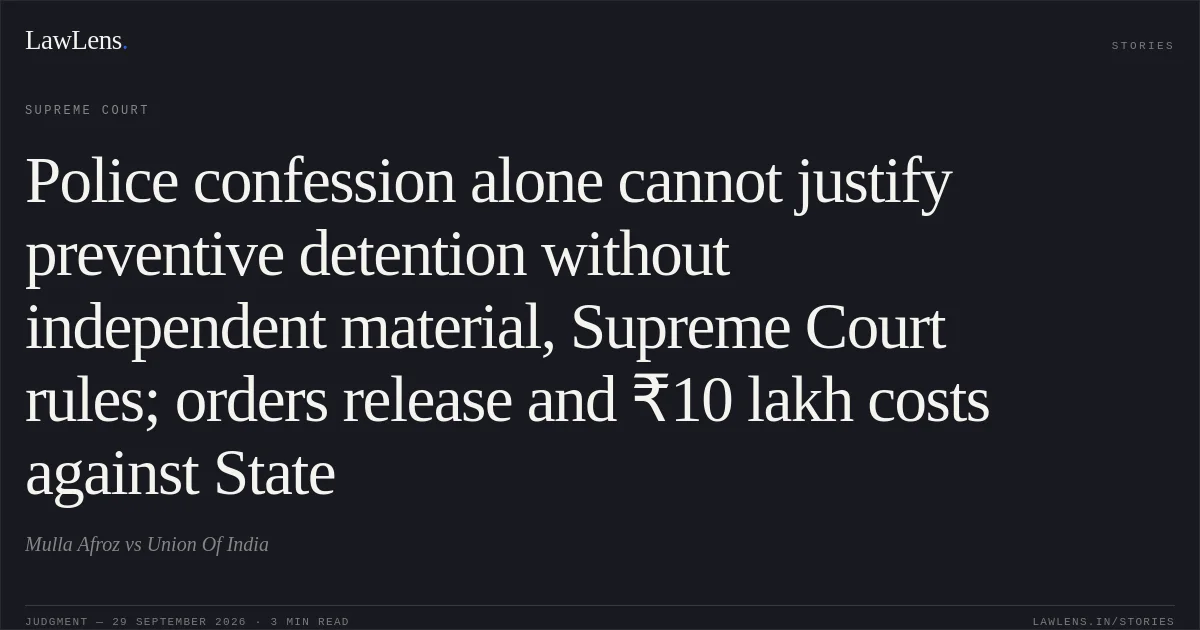
The Court held that the confession could not sustain the detention in the circumstances of this case and that the remaining material did not provide a valid basis for the detaining authority’s satisfaction.
It set aside the High Court judgment, the detention order, and the confirmation order, and directed the appellant’s release forthwith unless required in another case.
Source reference: paras. 67–70The appeal was allowed, and the State was ordered to pay the appellant costs of ₹10 lakh within one month.
Source reference: paras. 67–70Acts & Sections Cited
9 provisions across 5 statutes referred to in this judgment. Each provision opens on LawLens.
National Security Act, 19803
Prevention of Blackmarketing and Maintenance of Supplies of Essential Commodities Act, 19801
Bharatiya Sakshya Adhiniyam, 20231
Code of Criminal Procedure, 19732
Original Court PDF
Mulla AfrozvsUnion Of India
Click to open original judgment
Original judgment, available to read, download and summarize on LawLens.in