Facts
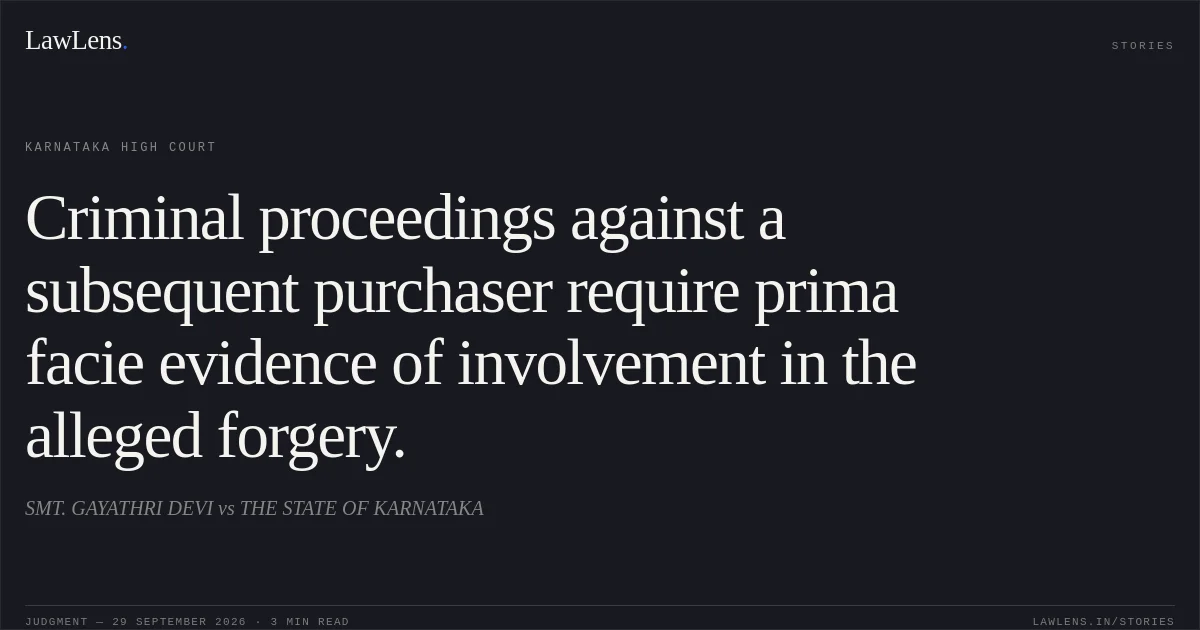
Respondents 2 and 3 alleged that accused No. 2 impersonated himself as the only son of Allalappa and sold Allalappa’s property to accused No. 1 in 1985; accused No. 1 then sold it to the petitioner and her husband in 1991.
Source reference: paras. 2–4, 9The petitioner claimed to be a bona fide purchaser and had instituted a pending civil suit concerning the property; proceedings over the revenue entries were also pending.
Source reference: paras. 3–4, 7On the respondents’ private complaint, the Magistrate referred the matter for investigation under Section 156(3) Cr.P.C. Police registered an FIR and, after investigation, filed a ‘B’ report. The Magistrate rejected that report, relied on the complainant’s sworn statement, and took cognizance against the petitioner and the other accused.
Source reference: para. 5The petitioner sought to quash the Magistrate’s order under Section 482 Cr.P.C.
Source reference: para. 1Issues
Whether the allegations and material on record disclosed a prima facie case against the petitioner for the alleged IPC offences, notwithstanding the police ‘B’ report.
Source reference: paras. 7–10, 17–21Whether the Magistrate’s rejection of the ‘B’ report and taking of cognizance against the petitioner warranted interference under Section 482 Cr.P.C.
Source reference: paras. 18, 21Law Applied
Section 482 Cr.P.C. empowers the High Court to prevent abuse of process and secure the ends of justice.
Source reference: para. 20Under the principles in State of Haryana v. Bhajan Lal, proceedings may be quashed where the allegations, even accepted at face value, do not disclose an offence, or where proceedings are manifestly mala fide and instituted to wreak vengeance.
Source reference: para. 20The Court also referred to Neeharika Infrastructure Pvt. Ltd. v. State of Maharashtra, noting that although courts ordinarily should not interfere at the investigation stage, interference is warranted where the allegations disclose no cognizable offence or the proceedings amount to an abuse of process.
Source reference: para. 19Relying on Mohammed Ali v. State of U.P. and State of Andhra Pradesh v. Golconda Linga Swamy, the Court stated that, in an apparently vexatious case, the court may consider the surrounding circumstances and investigation materials, while avoiding an assessment of evidence that is ordinarily for trial.
Source reference: para. 20The alleged offences were under Sections 415, 416, 420, 463, 468 and 471 read with Section 34 IPC.
Source reference: paras. 1, 21Reasoning
The Court noted that the alleged impersonation and 1985 sale were attributed to accused No. 2, whereas the petitioner acquired the property under a 1991 sale deed and was not alleged to have participated in the original impersonation or forgery.
Source reference: paras. 7, 14–15The petitioner had been in possession and the revenue entries had been changed in her favour; the parties’ competing claims were also being pursued in civil and revenue proceedings.
Source reference: paras. 15–16The police had examined witnesses and property documents before filing the ‘B’ report, while the sworn statement relied on by the Magistrate merely repeated the complaint’s allegations.
Source reference: paras. 17–18Considering these circumstances, the Court concluded that no prima facie case was made out against the petitioner and that continuing the prosecution against her would constitute an abuse of process.
Source reference: para. 21Holding
The Court allowed the petition and quashed, as against the petitioner (accused No. 3) only, the Magistrate’s order dated 10 June 2016 taking cognizance in C.C. No. 15505/2016.
The respondents’ contentions concerning fabrication and impersonation were left open for them to urge before the Deputy Commissioner and in the pending civil suit.
Source reference: order, clause (iii)Acts & Sections Cited
10 provisions across 2 statutes referred to in this judgment. Each provision opens on LawLens.
Code of Criminal Procedure, 19733
Indian Penal Code, 18607
Original Court PDF
SMT. GAYATHRI DEVIvsTHE STATE OF KARNATAKA
Click to open original judgment
Original judgment, available to read, download and summarize on LawLens.in