Facts
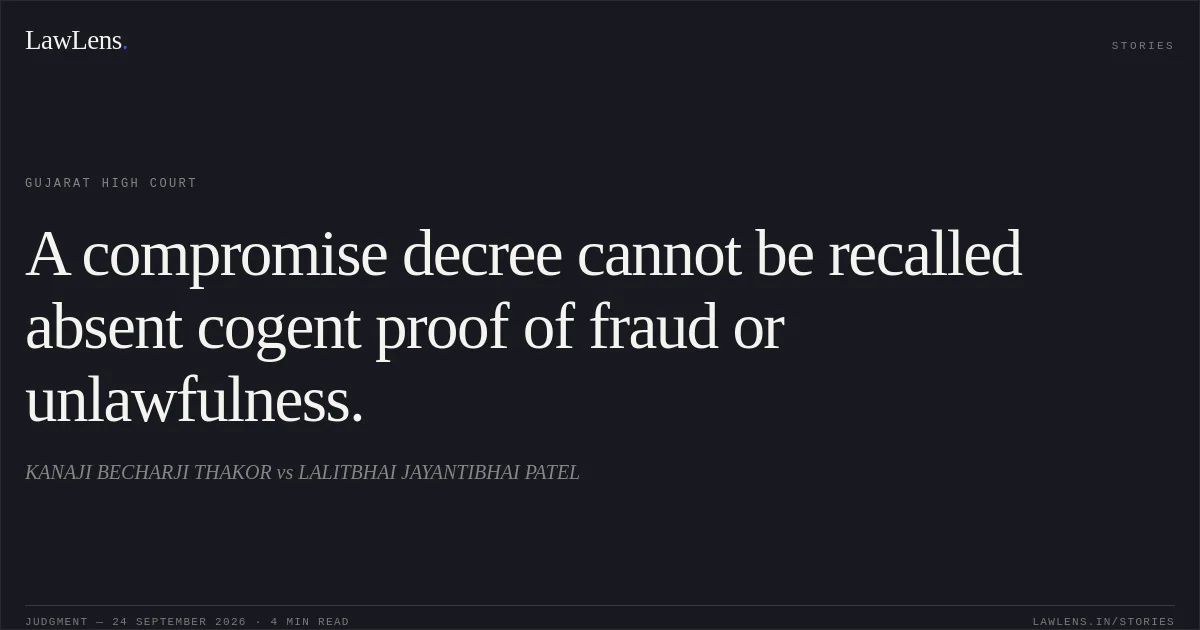
The petitioners, owners of the suit land, were defendants in Special Civil Suit No. 73 of 2022 filed by the respondent for specific performance of an agreement to sell dated 24 June 2021.
Source reference: paras. 4–4.1; pp. 2–3During the suit, the parties entered into a written compromise under which the petitioners accepted the respondent’s claim for specific performance and agreed to execute the sale deed upon receiving the balance consideration.
Source reference: para. 8; pp. 8–9The Trial Court recorded the compromise on 22 April 2022 under Order XXIII Rule 3 of the Code of Civil Procedure, 1908, and drew a consent decree on 27 May 2022.
Source reference: para. 8; pp. 8–9The petitioners subsequently filed Review Application No. 6 of 2024, asserting that they were illiterate villagers, had not understood the effect of the agreement to sell or compromise, and had been deceived by the respondent’s representations.
Source reference: paras. 4.2, 5–5.4; pp. 3–5After condonation of delay, the Trial Court rejected the review application by order dated 4 July 2026, holding that the compromise was lawful and that the allegations of fraud were unsupported by any criminal complaint or cogent material.
Source reference: para. 4.2; p. 3The petitioners challenged that order under Article 227 of the Constitution of India.
Source reference: para. 3; p. 1Issues
1. Whether the Trial Court was justified in refusing to recall or review the consent decree on the petitioners’ allegation that the compromise had been obtained through fraud, misunderstanding, or misrepresentation?
Source reference: paras. 5.3–5.4, 8–13; pp. 5, 8–132. Whether the compromise recorded under Order XXIII Rule 3 CPC was a lawful compromise binding upon the parties, notwithstanding the petitioners’ claim of illiteracy and lack of understanding?
Source reference: paras. 8–11; pp. 8–113. Whether the High Court, exercising supervisory jurisdiction under Article 227 of the Constitution, ought to interfere with the Trial Court’s rejection of the review application?
Source reference: paras. 3, 14–15; pp. 1, 13–14Law Applied
The Court applied Order XXIII Rule 3 CPC, under which a court may record a compromise if it is satisfied that the suit has been adjusted by a lawful written agreement, and recognised that a compromise decree may be recalled where fraud or other vitiating circumstances are established.
Source reference: paras. 8, 11–12; pp. 8–12The Court also applied the principle that a party alleging fraud must produce cogent and reliable material; a bare or unsupported assertion is insufficient to unsettle a judicially recorded compromise.
Source reference: para. 13; p. 13In exercising jurisdiction under Article 227 of the Constitution, the High Court does not act as a regular appellate court and interferes only in cases of illegality, gross irregularity, or jurisdictional error; the Court relied on Sameer Suresh Gupta v. Rahul Kumar Agarwal, (2013) 9 SCC 374, and Garment Craft v. Prakash Chand Goel, (2022) 4 SCC 181.
Source reference: para. 14; p. 14The Court also considered Navratan Lal Sharma v. Radha Mohan Sharma, 2024 SCC OnLine SC 3720, which recognises that a compromise may be recalled where fraud is actually established, but distinguished it on its facts.
Source reference: para. 12; pp. 12–13Reasoning
The Court found that the compromise was reduced to writing, bore the petitioners’ signatures and thumb impressions, and was expressly read over and explained to them in open court in the presence of their advocates.
Source reference: paras. 8–9; pp. 8–10The Trial Court had recorded that the parties admitted the contents and execution of the compromise and that the suit had been lawfully adjusted under Order XXIII Rule 3 CPC.
Source reference: paras. 8–9; pp. 8–10The petitioners’ prior execution of the agreement to sell and a subsequent registered agreement to sell also indicated that they had consciously agreed to sell the property, weakening their assertion that they were unaware of the transaction.
Source reference: para. 10; pp. 10–11Their plea of illiteracy was insufficient because they had been represented by advocates and the compromise had been judicially explained and recorded.
Source reference: paras. 10, 13; pp. 10–13The allegation of cheating was unsupported by any police complaint, independent evidence, or other cogent material, and was therefore treated as an afterthought.
Source reference: paras. 10, 13; pp. 10–13Unlike Navratan Lal Sharma, where the alleged compromise was affected by a specific unrecorded condition concerning dishonoured cheques, no comparable fraud or omitted condition was established here.
Source reference: para. 12; pp. 12–13Consequently, the Trial Court had committed neither illegality nor gross irregularity warranting interference under Article 227.
Source reference: para. 14; p. 14Holding
The High Court held that the compromise was lawful and validly recorded under Order XXIII Rule 3 CPC, and that the petitioners failed to substantiate their allegations of fraud, misrepresentation, or lack of understanding.
The rejection of Review Application No. 6 of 2024 disclosed no illegality, jurisdictional error, or gross irregularity warranting supervisory interference under Article 227.
Source reference: paras. 14–15; p. 14The Special Civil Application was therefore dismissed in limine, the rule was discharged, and no order as to costs was made.
Source reference: paras. 14–15; p. 14Original Court PDF
KANAJI BECHARJI THAKORvsLALITBHAI JAYANTIBHAI PATEL
Click to open original judgment
Original judgment, available to read, download and summarize on LawLens.in