Facts
The Petitioners claimed ownership of 1,721.03 sq. metres of land at Kharadi, Pune, reserved for widening an 18-metre Development Plan road.
Source reference: para. 4On 29 August 2013, the Pune Municipal Corporation (“PMC”) requested the Petitioners to hand over possession, stating that compensation would be provided through additional FSI/TDR or cash compensation under Section 126 of the Maharashtra Regional and Town Planning Act, 1966 (“MRTP Act”).
Source reference: paras. 5, 19–20On 9 June 2016, the Petitioners executed a preliminary possession receipt and handed over possession, expressly recording that admissible consideration would be granted in the form of FSI/TDR under the prevailing rules and policies.
Source reference: paras. 6, 30Nearly ten years later, by letter dated 10 February 2026, the Petitioners sought acquisition of the land and monetary compensation, stating that they were no longer interested in accepting TDR.
Source reference: para. 7During the writ proceedings, pursuant to the Court’s order dated 7 May 2026, the PMC rejected the claim for monetary compensation and held that the Petitioners were entitled to FSI/TDR in terms of the possession receipt.
Source reference: paras. 8–9, 42Issues
Whether the Petitioners were entitled to insist on monetary compensation instead of FSI/TDR for the land surrendered for the DP road widening under Section 126 of the MRTP Act?
Source reference: para. 28Whether the 29 August 2013 communication and the 9 June 2016 possession receipt constituted a concluded and legally binding agreement under which the Petitioners had elected to accept FSI/TDR as consideration?
Source reference: paras. 30–34, 38–39Whether the Petitioners could subsequently withdraw from the agreed mode of compensation and seek monetary compensation through writ jurisdiction?
Source reference: paras. 35–38Law Applied
The Court applied Section 126(1) of the MRTP Act, under which land reserved for a public purpose may be acquired by agreement for an agreed amount, through grant of FSI/TDR, or through statutory acquisition under the applicable land-acquisition legislation.
Source reference: para. 39It further applied Sections 2(a), 2(b), 2(d) and 10 of the Indian Contract Act, 1872: a proposal accepted by the other party becomes a promise, and an agreement supported by lawful consideration and free consent constitutes a contract.
Source reference: paras. 31–32Relying on Shree Vinayak Builders and Developers, Nagpur v. State of Maharashtra, the Court held that where a concluded contract exists, a landowner cannot withdraw consent or refuse to surrender land on the agreed terms; whether such a contract exists is a question of fact.
Source reference: para. 38The Court also relied on State of Haryana v. M/s. Jai Durgaa Finvest P. Ltd. and related Supreme Court authorities for the principle that courts must enforce, and not rewrite or substitute, the unambiguous terms agreed by contracting parties.
Source reference: paras. 36–37Reasoning
The Court treated the PMC’s communication dated 29 August 2013 as an offer and the Petitioners’ possession receipt dated 9 June 2016 as an unequivocal acceptance.
Source reference: paras. 29–31The receipt expressly stated that possession was being handed over subject to the grant of admissible FSI/TDR under the prevailing rules and policies.
Source reference: paras. 29–31By voluntarily surrendering possession on those terms, the Petitioners accepted FSI/TDR as the agreed consideration, thereby creating a binding contract under the Contract Act.
Source reference: paras. 31–33The Court held that the case fell within the consensual acquisition framework under Section 126(1)(b) of the MRTP Act and was not a case of unilateral compulsion by the authorities.
Source reference: para. 39The Petitioners’ subsequent demand in 2026 for monetary compensation amounted to resiling from, and seeking to rewrite, the concluded contractual arrangement nearly ten years after surrendering possession.
Source reference: paras. 35–38The authorities relied upon by the Petitioners were distinguished because they concerned situations where no concluded contract existed.
Source reference: para. 40The principles concerning continuing cause of action and delay in compensation claims were therefore held inapplicable to the present contractual dispute.
Source reference: para. 43Holding
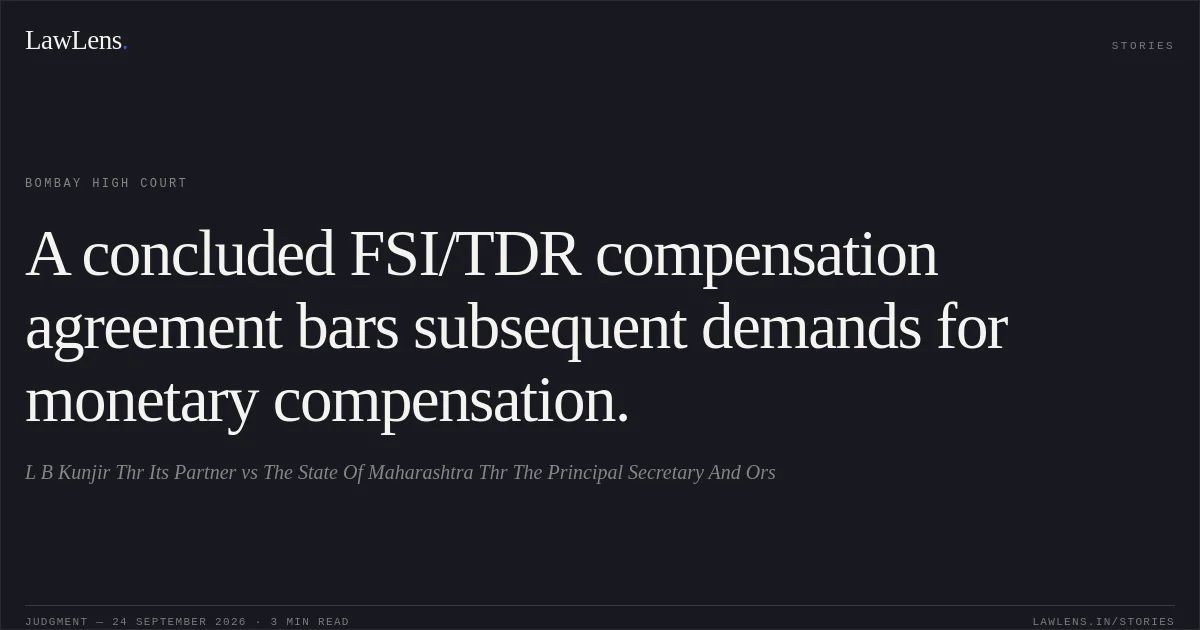
The Court held that the Petitioners had entered into a binding arrangement to receive FSI/TDR as compensation and could not subsequently insist upon monetary compensation.
The writ petition was consequently dismissed and the Rule was discharged.
Source reference: para. 44However, the Petitioners were granted liberty to submit a proposal for FSI/TDR compensation to the competent authority, which was directed to consider it expeditiously in accordance with law, subject to there being no other impediment.
Source reference: para. 45Acts & Sections Cited
3 provisions across 3 statutes referred to in this judgment. Each provision opens on LawLens.
Maharashtra Regional and Town Planning Act, 1966.1
Right to Fair Compensation and Transparency in Land Acquisition, Rehabilitation and Resettlement Act, 20131
Indian Contract Act, 18721
Original Court PDF
L B Kunjir Thr Its PartnervsThe State Of Maharashtra Thr The Principal Secretary And Ors
Click to open original judgment
Original judgment, available to read, download and summarize on LawLens.in