Facts
The petitioner sought to quash the charge sheet and proceedings in Special Case No. 598/2023, arising from allegations under Sections 376(2)(n), 506, 504, 323 and 417 IPC and Sections 3(1)(w), 3(2)(v) and 3(2)(va) of the SC/ST (Prevention of Atrocities) Act, 1989.
Source reference: p. 1; para. 1The complainant, a 32-year-old woman belonging to a Scheduled Caste, alleged that the petitioner, whom she had known since 2013 and whose office she joined in 2019, sexually exploited her after promising to divorce his wife and marry her.
Source reference: p. 3–5; para. 5She alleged that their sexual relationship continued until 24 April 2023, when she asked him to marry her; he then allegedly rejected and abused her, including referring to her caste during a later telephone conversation.
Source reference: p. 3–5; para. 5The petitioner argued that the relationship was consensual and that the charge-sheet material did not disclose the alleged offences.
Source reference: p. 3; paras. 3–4The State and complainant opposed the petition, contending that the material established a prima facie case.
Source reference: p. 3; paras. 3–4The investigation had concluded and a charge sheet had been filed.
Source reference: p. 6; para. 6Issues
1. Whether the charge-sheet allegations disclosed a prosecutable offence of rape arising from sexual relations allegedly induced by a promise to marry, despite the parties’ relationship and the complainant’s knowledge that the petitioner was married.
Source reference: p. 5–6; paras. 5–62. Whether the allegations satisfied the ingredients of the charged offences under the SC/ST (Prevention of Atrocities) Act, including the requirement that the alleged caste-related abuse occur in a place within public view.
Source reference: p. 7–9; paras. 8–113. Whether continuation of the criminal proceedings warranted quashing under Section 482 Cr.P.C.
Source reference: p. 9; para. 11Law Applied
The Court exercised its inherent jurisdiction under Section 482 Cr.P.C. to prevent abuse of process and secure the ends of justice.
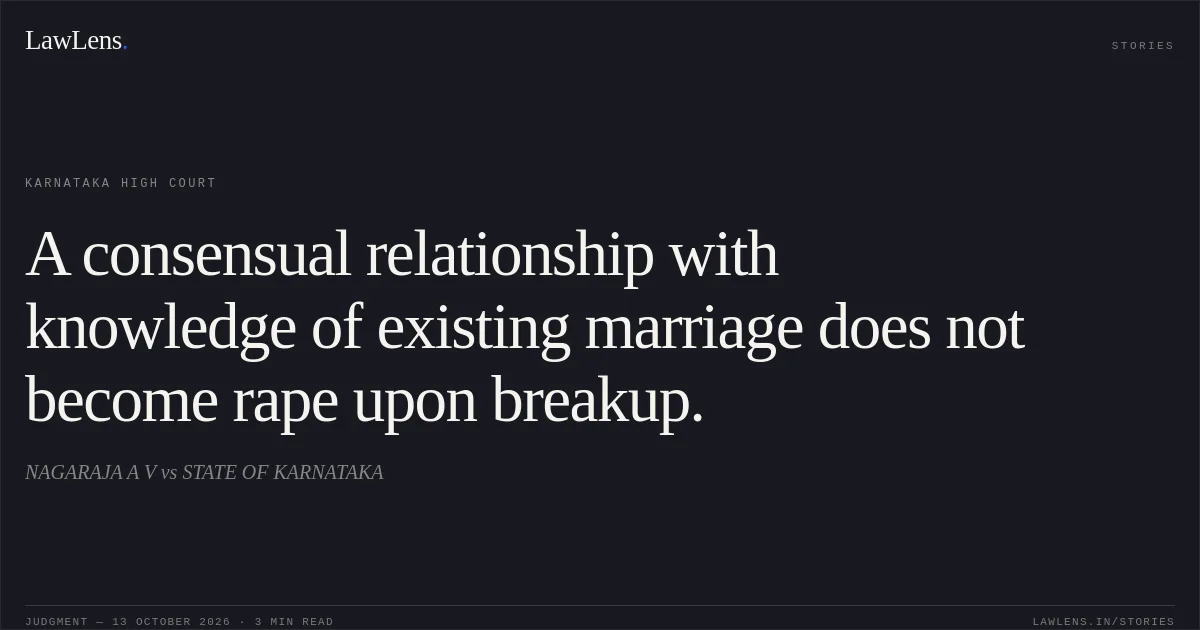
Source reference: p. 9; para. 11Relying on Kunal Chatterjee v. State of West Bengal, Prithivirajan v. State, Pramod Suryabhan Pawar v. State of Maharashtra and Maheshwar Tigga v. State of Jharkhand, it stated that a consensual physical relationship between adults, even where a promise of marriage is alleged, does not by itself amount to rape.
Source reference: p. 6; para. 7Citing Ramkrishna Chauhan v. State of Uttar Pradesh and Hitesh Verma v. State of Uttarakhand, it stated that a place is within public view when members of the public can witness or hear the utterance; an incident within a private setting, without public presence, does not meet that requirement.
Source reference: p. 8–9; para. 10Reasoning
The Court considered the complainant’s knowledge that the petitioner was married, their relationship of nearly four years, and the absence of any divorce proceedings initiated by the petitioner.
Source reference: p. 5–6; para. 6It concluded that the allegation of a promise to marry after divorce was difficult to accept in those circumstances and that the breakdown of a prolonged consensual relationship did not, without more, establish criminality.
Source reference: p. 5–6; para. 6As to the SC/ST Act charges, the Court found no allegation that the petitioner engaged in sexual conduct because of the complainant’s caste.
Source reference: p. 7–9; paras. 8–10The only caste-related allegation concerned a telephone conversation between the petitioner and the complainant; the Court held that, even if true, it did not occur in a place within public view.
Source reference: p. 7–9; paras. 8–10It consequently found the invoked SC/ST Act offences unsupported by the necessary ingredients and concluded that the proceedings should not continue.
Source reference: p. 9; para. 11Holding
The High Court allowed the petition and quashed, as against the petitioner, the entire proceedings in Special Case No. 598/2023 arising from Crime No. 54/2023, including the charges under the IPC and the SC/ST (Prevention of Atrocities) Act.
Acts & Sections Cited
7 provisions across 3 statutes referred to in this judgment. Each provision opens on LawLens.
Code of Criminal Procedure, 19731
Indian Penal Code, 18605
Scheduled Castes and the Scheduled Tribes (Prevention of Atrocities) Act, 19891
Original Court PDF
NAGARAJA A VvsSTATE OF KARNATAKA
Click to open original judgment
Original judgment, available to read, download and summarize on LawLens.in