Facts
The petitioner had filed a writ petition challenging, among other things, an order under Section 7A of the Employees’ Provident Funds and Miscellaneous Provisions Act, 1952, and related recovery proceedings.
Source reference: para. 9, 12On 11 March 2026, the writ petition was disposed of after the petitioner’s then counsel stated that the petitioner accepted the Section 7A order and sought instalments to pay the outstanding amount.
Source reference: para. 1The petitioner later applied to recall that order, asserting that its director had not instructed counsel to accept the order or seek instalments, and that the petitioner learned of the order only after instalment demands were made.
Source reference: paras. 2–7The petitioner alleged that counsel’s representation had caused serious prejudice and sought a hearing on the merits.
Source reference: paras. 7, 13–14Issues
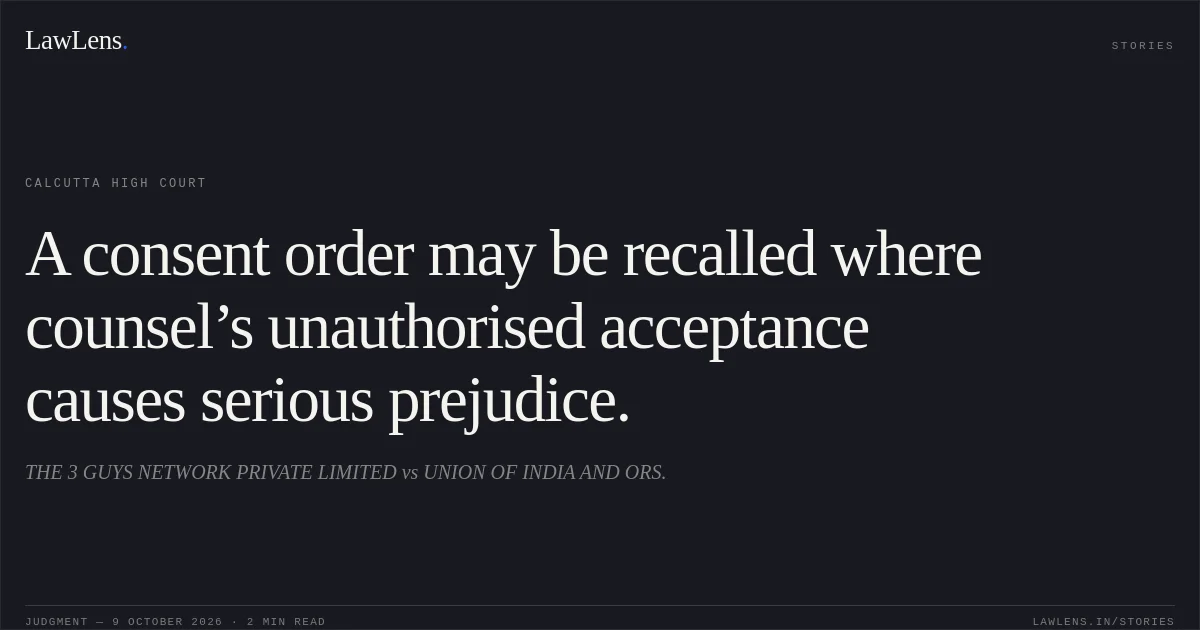
Whether the order disposing of the writ petition on the basis of counsel’s stated consent should be recalled where the petitioner alleged that counsel lacked instructions to accept the Section 7A order and seek instalments
Source reference: paras. 2–7, 13, 19Whether the writ petition should be restored for hearing on its merits notwithstanding the respondents’ objection that an appeal against the Section 7A order was time-barred
Source reference: paras. 10–11, 15–16, 21–22Law Applied
The Court identified lack of valid consent—including an unauthorised compromise or the absence of a genuine agreement—as a ground for setting aside a consent order, alongside fraud, coercion, undue influence, mistake and other specified grounds.
Source reference: para. 17It referred to Golab Koer v. Badshah Bahadur, decided on 14 April 1909, as authority for setting aside an order where consent was not conscious.
Source reference: para. 18The dispute arose under the Employees’ Provident Funds and Miscellaneous Provisions Act, 1952, including its Section 7A determination and associated recovery provisions.
Source reference: paras. 9, 12The respondents relied on Assistant Commissioner (CT) v. Glaxo Smith Kline Consumer Health Care Ltd., (2020) 19 SCC 681, in support of their limitation objection; the Court did not determine that objection on its merits at this stage.
Source reference: paras. 10–11Reasoning
The Court considered the petitioner’s account that its director was absent when the writ petition was disposed of, that counsel had not been instructed to accept the Section 7A order, and that the petitioner was not informed of the disposal until later.
Source reference: paras. 3–7, 13Against the stated ground that an order may be set aside where consent was not validly or consciously given, the Court found a prima facie case of serious prejudice arising from counsel’s allegedly incorrect representation.
Source reference: paras. 17–19It therefore recalled the disposal order to permit the writ petition to be heard on its merits. The Court did not decide the challenge to the Section 7A order or finally resolve the limitation objection.
Source reference: paras. 12, 15–16, 21–22Holding
The Court allowed CAN 2 of 2026 and recalled its order dated 11 March 2026.
WPA 5031 of 2026 was restored to its file and number and directed to be listed in the monthly list of December 2026 for hearing on the merits.
Source reference: paras. 21–22Acts & Sections Cited
2 provisions across 1 statute referred to in this judgment. Linked provisions open on LawLens.
Employees’ Provident Funds And Miscellaneous Provisions Act, 19522
Original Court PDF
THE 3 GUYS NETWORK PRIVATE LIMITEDvsUNION OF INDIA AND ORS.
Click to open original judgment
Original judgment, available to read, download and summarize on LawLens.in