Facts
The complainant had obtained a locker facility at UCO Bank, Jhajha Branch. He alleged that the locker became inoperative in December 2014 and that the petitioner, then Branch Manager, failed to take prompt action.
Source reference: p.2, para. 3According to the complaint, the locker was opened by a mechanic on 24 September 2015, the petitioner demanded ₹5,000, obtained his signature on a blank paper, and caused ₹5,792 to be debited from his bank account on 29 September 2015.
Source reference: p.2, para. 3The petitioner contended that she was posted as officiating Branch Manager only from 1 April 2015 to 7 November 2015 and, therefore, could not have been approached by the complainant in December 2014.
Source reference: pp.3–4, paras. 4The complainant had earlier pursued proceedings before the District Consumer Disputes Redressal Forum and the State Consumer Commission, both of which rejected his claim as meritless. Thereafter, he instituted the criminal complaint.
Source reference: pp.2–4, paras. 2–4On 14 September 2018, the learned S.D.J.M., Jamui found a prima facie case under Section 417 IPC against the petitioner.
Source reference: pp.2–4, paras. 2–4Issues
Whether the allegations in the complaint, even if accepted in their entirety, disclose the essential ingredients of cheating punishable under Section 417 IPC against the petitioner?
Source reference: pp.4–5, paras. 5–6Whether continuation of the criminal proceeding, arising from the same locker-related dispute already rejected by the consumer fora, would amount to abuse of the process of court warranting exercise of the High Court’s inherent jurisdiction?
Source reference: pp.4–9, paras. 5–9Law Applied
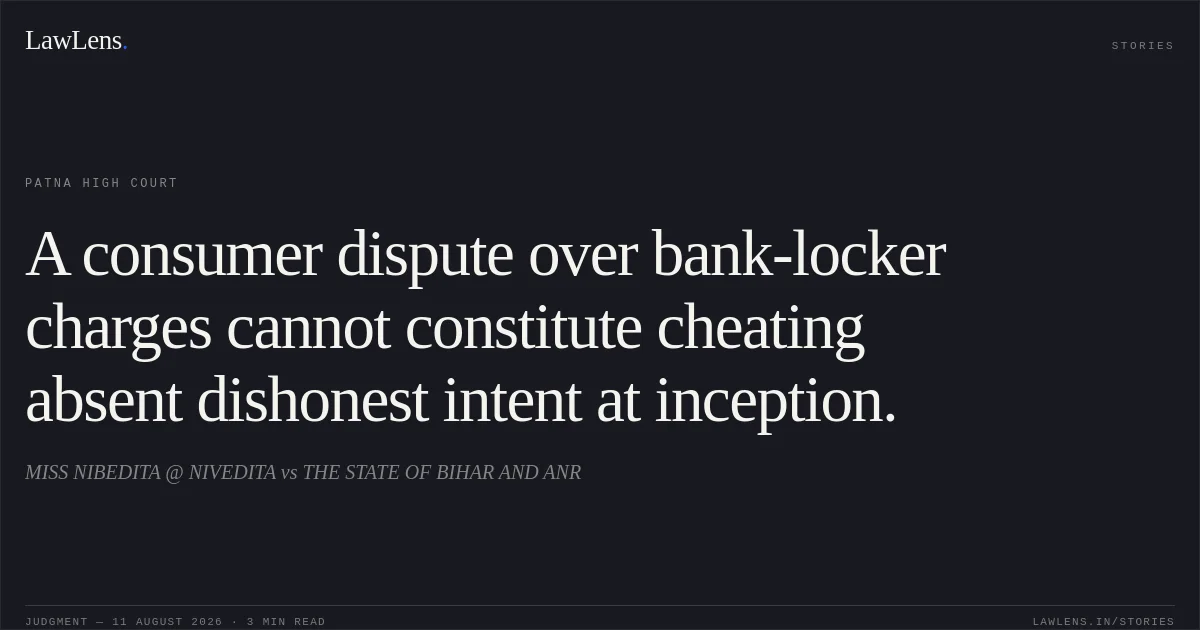
The Court applied Section 417 IPC, which penalises cheating, and held that cheating requires deception or dishonest/fraudulent intention, particularly an intention existing at the inception of the transaction; a mere financial or contractual dispute does not, without the requisite mens rea, constitute a criminal offence.
Source reference: pp.4–5, paras. 5–6The Court also exercised its inherent jurisdiction under Section 482 CrPC to prevent abuse of process and secure the ends of justice.
Source reference: pp.6–8, paras. 7–8It relied on State of Haryana v. Bhajan Lal, 1992 Supp (1) SCC 335, particularly categories 1 and 3 of paragraph 102, under which proceedings may be quashed where the allegations, even taken at face value, do not constitute an offence, or where the uncontroverted allegations and supporting material do not disclose commission of any offence.
Source reference: pp.6–8, paras. 7–8Reasoning
The Court treated the dispute as essentially arising from the operation and repair of a bank locker and the debit of repair-related charges, rather than from a criminal transaction.
Source reference: p.4, para. 5Even accepting the complainant’s allegations, there was no material showing that the petitioner possessed fraudulent or dishonest intention at the inception of the transaction, or that she had deceived, misappropriated funds, or obtained an unlawful gain.
Source reference: pp.4–5, paras. 5–6The debit of ₹5,792 was supported by the authorised engineer’s report and bill for breaking open the defective locker, fitting a lock, and supplying a new key.
Source reference: pp.3–4, para. 4The prior rejection of the complainant’s grievance by the consumer fora further indicated that the criminal complaint was an attempt to give a criminal colour to a civil/consumer dispute.
Source reference: pp.5–9, paras. 7–9Applying the principles in Bhajan Lal, the Court held that the complaint did not prima facie disclose the offence under Section 417 IPC and that the Magistrate had proceeded mechanically.
Source reference: pp.5–9, paras. 7–9Holding
The High Court answered both issues in favour of the petitioner. It held that the complaint did not disclose the essential ingredients of cheating under Section 417 IPC and that continuation of the proceedings would constitute abuse of the process of law.
Accordingly, the order dated 14 September 2018 passed by the S.D.J.M., Jamui, in Complaint Case No. 1464C/2017, corresponding to Trial No. 2561/2018, and all consequential criminal proceedings against the petitioner were quashed and set aside.
Source reference: p.9, paras. 9–11The petition was allowed, and the judgment was directed to be communicated to the trial court.
Source reference: p.9, paras. 9–11Acts & Sections Cited
4 provisions across 2 statutes referred to in this judgment. Each provision opens on LawLens.
Indian Penal Code, 18601
Code of Criminal Procedure, 19733
Original Court PDF
MISS NIBEDITA @ NIVEDITAvsTHE STATE OF BIHAR AND ANR
Click to open original judgment
Original judgment, available to read, download and summarize on LawLens.in