Facts
The petitioner worked as a Junior Training Officer on contract from 1993 and was later appointed to the same post through KPSC direct recruitment in 2003.
Source reference: pp. 3, 10In 2004, the State granted her pay protection and certain service benefits, but withdrew that order in 2010 and directed recovery of the excess payment.
Source reference: pp. 3–4, 11The petitioner challenged the withdrawal and recovery.
Source reference: no citationIn an earlier writ proceeding, the High Court directed the State to examine whether she had committed fraud or misrepresentation in obtaining pay protection; the Court did not stay the prospective withdrawal of pay protection.
Source reference: pp. 5–6, 12–14Following an inquiry, the State found no fraud or misrepresentation but nevertheless ordered recovery in 2019.
Source reference: pp. 6–7The Tribunal rejected the petitioner’s subsequent application in 2022, and she challenged that decision and the State’s recovery order in this writ petition.
Source reference: pp. 6–7Issues
Whether the petitioner, appointed by regular direct recruitment to the same post she had held on contract, was entitled to pay protection under Rule 41A(ii) of the Karnataka Civil Services Rules (KCSRs).
Source reference: pp. 10, 15–19Whether recovery of the amounts paid under the earlier pay-protection order was justified when the State found no fraud or misrepresentation and the petitioner claimed entitlement under Rule 41A.
Source reference: pp. 10–11, 20–21Law Applied
Rule 41A(ii) of the KCSRs provides that, where a Government servant is regularly appointed to another post carrying a scale of pay identical to that of the post last held, pay is to be fixed at the stage equal to the pay drawn in the previous post.
Source reference: pp. 15–18The Court considered the Karnataka Civil Services (Absorption of Persons appointed on contract basis in the category of posts of Craft Instructors/Junior Instructors (Re-designated as Junior Training Officers) in the Department of Employment and Training (Training Wing) (Special) Rules, 2002, which provided pay protection and specified service benefits to absorbed employees; those Rules did not apply to the petitioner because she entered service through direct recruitment.
Source reference: pp. 4, 11–12The Court also applied the directions in its earlier order requiring an inquiry into fraud or misrepresentation before recovery was decided.
Source reference: pp. 12–14The Tribunal had relied on Chandi Prasad Uniyal v. State of Uttarakhand, (2012) 8 SCC 117, in addressing recovery.
Source reference: p. 12Reasoning
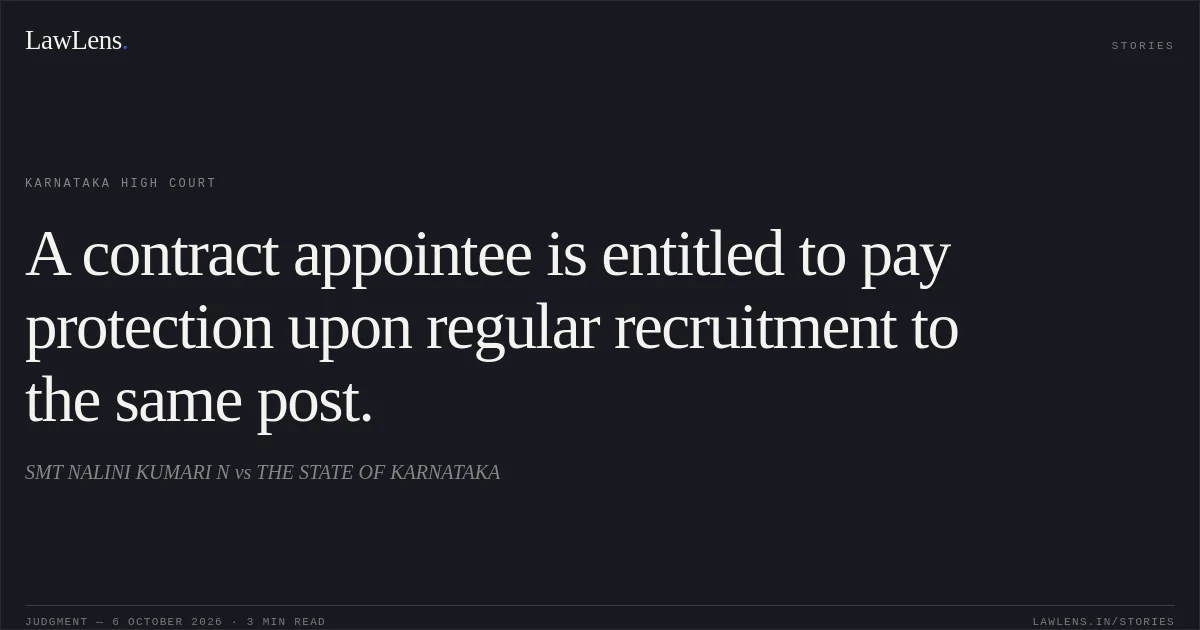
Although the petitioner was a direct recruit and therefore could not claim benefits under the 2002 Absorption Rules, she had previously held the same post and was regularly appointed to it through KPSC selection.
Source reference: pp. 11–12, 19–20The Court held that Rule 41A(ii) applied to those circumstances and entitled her to pay protection at the stage corresponding to her earlier pay.
Source reference: pp. 11–12, 19–20The State’s inquiry found no fraud or misrepresentation, yet the State ordered recovery.
Source reference: pp. 20–21The Court concluded that recovery was unwarranted; independently, its finding that the petitioner was entitled to pay protection under Rule 41A meant there was no basis to recover the amounts paid under the earlier order.
Source reference: pp. 20–21Holding
The High Court allowed the writ petition, set aside the Tribunal’s order dated 8 March 2022 and quashed the State’s order dated 25 May 2019.
It directed the respondents to consider and grant pay protection under Rule 41A(ii) on the petitioner’s direct recruitment as Junior Training Officer, together with consequential benefits, within three months.
Source reference: pp. 21–22Original Court PDF
SMT NALINI KUMARI NvsTHE STATE OF KARNATAKA
Click to open original judgment
Original judgment, available to read, download and summarize on LawLens.in