Facts
The petitioner was appointed on 30 October 2012 as an Executive Assistant in the District Mid-Day Meal Scheme Office, Buxar, on a contractual basis by the District Magistrate, Buxar.
Source reference: paras. 3, 13–15A newspaper photograph published on 30 June 2019 allegedly showed the petitioner consuming alcohol in a vehicle along with two contractors and other persons. An FIR was subsequently registered against him under Section 37(c) of the Bihar Prohibition and Excise (Amendment) Act, 2018.
Source reference: paras. 3, 16The District Programme Officer issued a show-cause notice dated 1 July 2019 requiring the petitioner to explain the allegation within 24 hours.
Source reference: paras. 3, 17–21The petitioner denied consuming alcohol and asserted that the newspaper report was false and motivated by rural politics.
Source reference: paras. 4, 22–23Without conducting any departmental enquiry, the District Magistrate terminated his contractual service on 13 July 2019, holding that alcohol consumption constituted indiscipline and violated the State’s prohibition law.
Source reference: paras. 5, 25–26The police thereafter submitted a final report finding no evidence against the petitioner, and the District Programme Officer confirmed that no replacement had been appointed to the post.
Source reference: paras. 6–7Issues
Whether a contractual employee could be terminated on the basis of a disputed allegation of misconduct without a formal departmental enquiry, merely after issuance and consideration of a show-cause notice?
Source reference: paras. 26–27Whether the principles of natural justice required an enquiry where the petitioner specifically denied the factual allegation forming the basis of termination?
Source reference: paras. 27–33Whether the impugned termination order dated 13 July 2019 was legally sustainable?
Source reference: paras. 34–35Law Applied
The Court applied the principles of natural justice, particularly the requirement of a fair opportunity to contest a factual charge of misconduct.
Source reference: no citationRelying on Hari Ram Maurya v. Union of India, (2006) 9 SCC 167, the Court held that even a temporary employee cannot be removed on a punitive charge without an enquiry.
Source reference: para. 29Under O.K. Bhardwaj v. Union of India, (2001) 9 SCC 180, even where a minor penalty is contemplated, the employee must be given an opportunity to submit an explanation; where factual charges are denied, an enquiry is required as a minimum requirement of natural justice.
Source reference: paras. 31–32The alleged conduct was also treated by the respondents as an offence under Section 37(c) of the Bihar Prohibition and Excise (Amendment) Act, 2018.
Source reference: paras. 3, 16, 21The Court further relied upon the broader enquiry requirement reflected in Sur Enamel and Stamping Works Ltd. v. Workmen, 1963 SCC OnLine SC 97, and Amit Kumar v. State of Bihar, CWJC No. 5537 of 2020.
Source reference: para. 10Reasoning
The termination was founded on the allegation that the petitioner had consumed alcohol, thereby committing misconduct and violating the prohibition law.
Source reference: paras. 5, 25Since the petitioner expressly denied the allegation, the matter involved a disputed question of fact requiring proof through an enquiry.
Source reference: no citationThe Court found that the respondents relied only on the show-cause notice, the petitioner’s reply, and forwarding communications; no witness examination, evidentiary assessment, or departmental enquiry had been conducted.
Source reference: para. 26Although the petitioner was a contractual employee and no specific disciplinary rules were shown to apply, the absence of service rules did not permit the authorities to dispense with basic procedural fairness.
Source reference: paras. 27, 33The termination was therefore punitive in substance, as it was expressly based on the petitioner’s alleged guilt and misconduct, rather than being a simple discharge in accordance with the contract.
Source reference: paras. 25–26, 33–34Holding
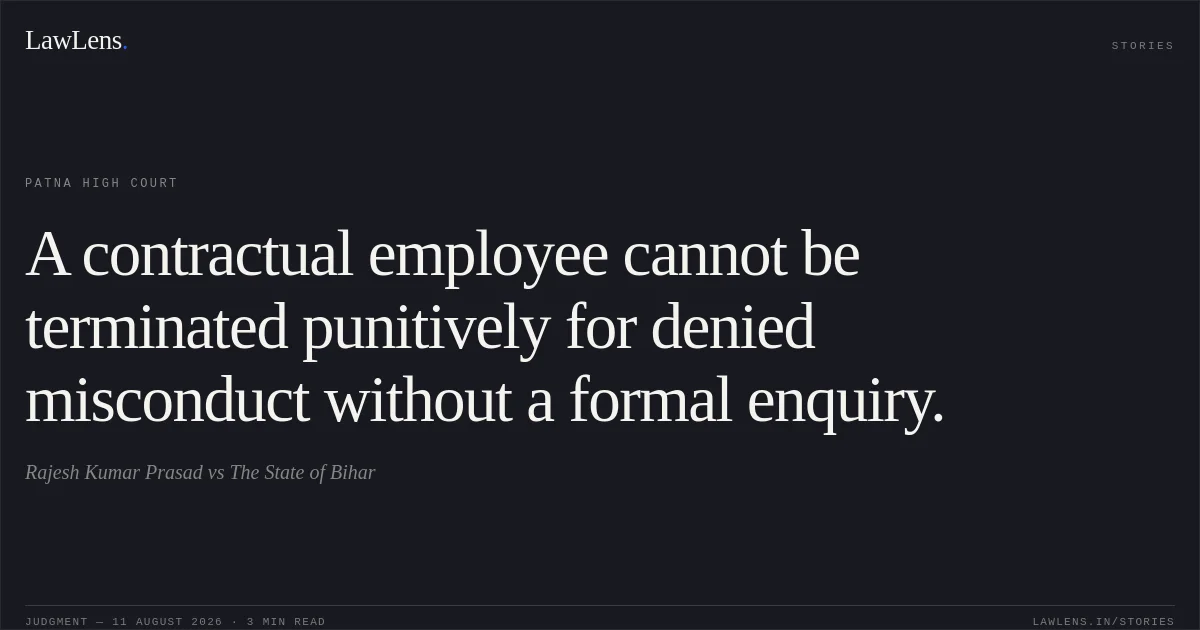
The High Court held that the petitioner’s contractual service could not be terminated on a disputed allegation of misconduct without conducting an enquiry.
The termination order dated 13 July 2019 and the show-cause notice dated 1 July 2019 were set aside and quashed.
Source reference: paras. 34–35The respondents were directed to reinstate the petitioner forthwith with all consequential benefits.
Source reference: para. 36However, the respondents were granted liberty to proceed against the petitioner afresh in accordance with due process of law.
Source reference: para. 37The writ petition was accordingly allowed.
Source reference: para. 38Acts & Sections Cited
1 provisions across 1 statute referred to in this judgment. Linked provisions open on LawLens.
Bihar Prohibition and Excise (Amendment) Act, 20181
Original Court PDF
Rajesh Kumar PrasadvsThe State of Bihar
Click to open original judgment
Original judgment, available to read, download and summarize on LawLens.in