Facts
The petitioner had worked as an Additional Programme Officer (APO), MGNREGA, at Janpad Panchayat Ater, District Bhind, since 13 December 2006.
Source reference: para. 2His contractual engagement had been extended periodically, and he relied on appreciation letters, satisfactory performance, ACRs, and the continued vacancy of the post.
Source reference: para. 2For the contractual year 2025–26, however, the competent authority declined to extend his engagement by order dated 28 January 2026, referring to the Collector’s recommendation against renewal.
Source reference: para. 2; para. 5The State contended that the petitioner’s engagement was purely contractual and that irregularities had been noticed during his tenure, including pending material payments of approximately ₹1.83 crore and allegedly impermissible payments of ₹37.85 lakh.
Source reference: para. 3The petitioner challenged the non-renewal order under Article 226 of the Constitution and sought quashing of the order and permission to continue as APO.
Source reference: para. 1Issues
Whether a contractual employee whose contractual term has expired can claim reinstatement, re-appointment, or compulsory continuation in service merely because the contract had previously been extended or the post remained vacant?
Source reference: para. 6; paras 9–10Whether the petitioner had an enforceable right to renewal of his MGNREGA contract under the 2025 service-condition instructions on the basis of his past service and alleged satisfactory performance?
Source reference: paras 11–14Whether the order declining renewal was liable to be quashed for being arbitrary, non-speaking, stigmatic, or contrary to principles of natural justice?
Source reference: paras 2–3; paras 15–16Law Applied
The Court applied the principle that expiry of a contractual term does not create a right to continuation, and that repeated extensions do not confer a vested right to further renewal.
Source reference: paras 7–9Relying on Brijendra Gupta v. State of M.P., Writ Appeal No. 617 of 2015, and Prem Chand Yadav v. Madhya Pradesh Madhya Kshetra Vidyut Vitaran Company Ltd., W.P. No. 5590 of 2017, the Court held that an employer cannot be compelled to extend or renew a contract after its expiry, since renewal remains within the employer’s discretion.
Source reference: paras 7–9The Court also relied on Secretary, State of Karnataka v. Uma Devi, (2006) 4 SCC 1, for the rule that long contractual service does not create a right to regularisation or permanent continuation in the absence of a legally enforceable statutory scheme, policy, or regulation.
Source reference: para. 12Clause 1.3 of the MGNREGA Contract Employees’ New Service Conditions Instructions, 2025, provides for renewal where annual evaluation is satisfactory and no disciplinary or prosecution proceeding is pending, but does not create an automatic or indefeasible right to renewal.
Source reference: para. 11A non-renewal order which merely brings a contractual engagement to an end, without recording misconduct or casting stigma, is simpliciter in nature.
Source reference: para. 15Reasoning
The Court held that the petitioner’s contractual term had ended and that no rule, regulation, scheme, or policy established an enforceable right to renewal or regularisation after several years of service.
Source reference: paras 10, 13Although Clause 1.3 permits renewal upon satisfaction of specified conditions, the provision does not entitle an employee to automatic continuation; renewal remains subject to assessment by the competent authority.
Source reference: paras 11, 14The petitioner’s prior extensions, length of service, appreciation letters, and the continued vacancy of the post could not override the contractual nature of his engagement or compel the State to renew it.
Source reference: para. 14The Court further found that the impugned order did not itself record misconduct or make any adverse finding against the petitioner; it simply declined to extend the contract.
Source reference: para. 15Consequently, it was not stigmatic and did not warrant interference under Article 226.
Source reference: para. 15Holding
The Court answered the issues against the petitioner.
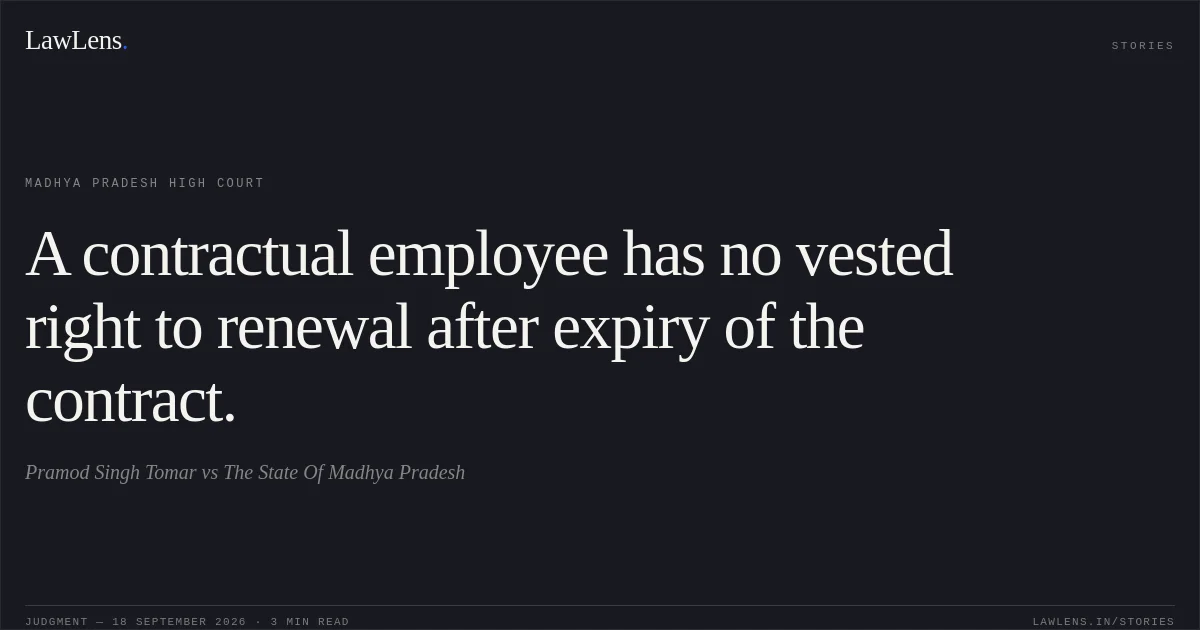
It held that a contractual employee has no vested or automatic right to renewal, reinstatement, re-appointment, or continuation after expiry of the contractual period merely because of long service, previous extensions, satisfactory work, or the existence of a vacant post.
Source reference: paras 9–10, 13–14The order dated 28 January 2026 refusing extension of the petitioner’s contract was not shown to violate any enforceable legal right and was not stigmatic.
Source reference: para. 15The writ petition was accordingly dismissed as devoid of merit, and no direction was issued permitting the petitioner to resume or continue as Additional Programme Officer.
Source reference: para. 16Original Court PDF
Pramod Singh TomarvsThe State Of Madhya Pradesh
Click to open original judgment
Original judgment, available to read, download and summarize on LawLens.in