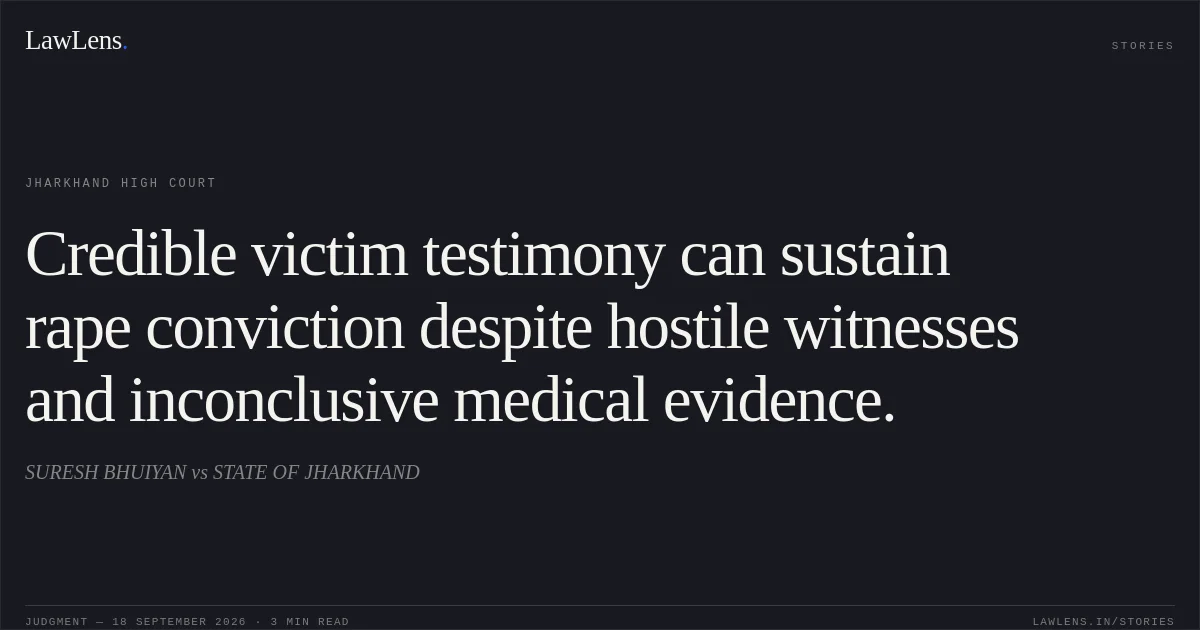
Facts
On 20 October 2006, after the appellant, allegedly the cleaner of a bus travelling from Varanasi to Nagar Untari, induced the victim to accompany him to find another bus for Gumla, he took her to an area near a bandh and hillock and allegedly committed rape by force.
Source reference: paras. 3; pp. 1–2On the victim’s cries, villagers gathered, but the appellant fled. The bus driver and conductor disclosed the cleaner’s name as Suresh Bhuiyan.
Source reference: paras. 3; pp. 1–2The victim’s fardbeyan led to registration of Nagar Untari P.S. Case No. 221 of 2006 under Section 376 IPC, followed by submission of a charge-sheet and trial in S.T. No. 27 of 2007.
Source reference: paras. 3; pp. 1–2The trial court convicted the appellant under Section 376 IPC and sentenced him to seven years’ rigorous imprisonment and a fine of Rs. 1,000.
Source reference: paras. 2; p. 1At trial, the victim and the bus driver supported the prosecution, while several other witnesses were declared hostile.
Source reference: paras. 4–5; pp. 2, 5–7The medical examination found the victim’s hymen not intact, but no internal or external injuries, no spermatozoa, and no sign of recent sexual intercourse.
Source reference: paras. 4–5, 11; pp. 2, 5–7Issues
Whether the conviction of the appellant under Section 376 IPC was sustainable despite hostile prosecution witnesses, the allegedly doubtful identification, and the absence of medical evidence showing recent sexual intercourse?
Source reference: para. 10; pp. 4–8Whether, in view of the passage of time and the period already undergone by the appellant, the sentence required modification?
Source reference: para. 13; p. 8Law Applied
The court applied Section 376 of the Indian Penal Code, which criminalises rape and prescribes punishment for the offence.
Source reference: no citationIt applied the principle that the credible and consistent testimony of the prosecutrix can, by itself, sustain a conviction and does not require corroboration as an inflexible rule; the absence of injuries or medical confirmation of recent intercourse is not determinative where the victim’s testimony is reliable.
Source reference: para. 12; pp. 7–8The court also considered the evidentiary significance of identification by the victim and corroboration regarding the appellant’s identity by the bus driver.
Source reference: para. 12; p. 7The appellant relied on P. Sasikumar v. State, (2024) 8 SCC 600, but the judgment ultimately distinguished the appellant’s contentions on the basis of the victim’s reliable testimony and the surrounding evidence.
Source reference: para. 7; p. 3Reasoning
The High Court found the victim’s testimony categorical, consistent, and unshaken in cross-examination.
Source reference: para. 11; pp. 5–6She identified the appellant and described the circumstances in which the bus cleaner took her to the isolated location and forcibly committed rape.
Source reference: para. 11; pp. 5–6Although P.Ws. 2–4 were hostile and the medical examination did not show recent sexual intercourse, those circumstances did not discredit the victim’s direct account.
Source reference: para. 12; pp. 7–8The court held that the medical findings—particularly the absence of injuries, spermatozoa, or recent signs of intercourse—were not sufficient to reject otherwise credible testimony.
Source reference: para. 12; pp. 7–8The appellant’s identity was also corroborated by the bus driver, who stated that Suresh was the bus cleaner and identified him in court.
Source reference: paras. 11–12; pp. 6–7Accordingly, the conviction was upheld.
Source reference: no citationOn sentence, the court considered that the occurrence was approximately two decades old, the appellant had undergone two years, one month, and six days of imprisonment, and no subsequent criminal conduct had been shown.
Source reference: para. 13; p. 8Holding
The appeal was dismissed on merits and the conviction under Section 376 IPC was affirmed.
However, the sentence of seven years’ rigorous imprisonment was modified and reduced to the period already undergone by the appellant, while the fine and default stipulation were not separately altered in the operative portion.
Source reference: paras. 13–14; p. 8Pending interlocutory applications, if any, were disposed of, and the trial court record was directed to be returned.
Source reference: paras. 14–16; p. 8Acts & Sections Cited
1 provisions across 1 statute referred to in this judgment. Each provision opens on LawLens.
Indian Penal Code, 18601
Original Court PDF
SURESH BHUIYANvsSTATE OF JHARKHAND
Click to open original judgment
Original judgment, available to read, download and summarize on LawLens.in
![Article 311(2)(b) cannot be invoked on presumptions; cogent reasons must establish departmental inquiry impracticability.. Gaurav Kumar vs DELHI POLICE. CAT - ['Delhi']. LawLens](/stories/thumbnails/article-311-2-b-cannot-be-invoked-on-presumptions-cogent-reasons-must-establish-department-d62b8f66fc2542b1a4a889245ee4d5ed.webp)
![Old Pension Scheme claims require reconsideration under subsequent instructions where compassionate appointment applications preceded 1 January 2004.. SMT ATLESH vs NORTH CENTRAL RAILWAY. CAT - ['Allahabad']. LawLens](/stories/thumbnails/old-pension-scheme-claims-require-reconsideration-under-subsequent-instructions-where-comp-c18c8f9a4894412ba7633c7be2188ea7.webp)