Facts
The dispute concerned agricultural land bearing old Survey No. 16/4, now Gat No. 219/4, at Village Shirdhon, Taluka Panvel, District Raigad. Respondent Nos. 2 to 13 claimed tenancy rights and sought fixation of purchase price under Section 32-G of the Bombay Tenancy and Agricultural Lands Act, 1948 (“BTAL Act”). Earlier Section 32-G proceedings had allegedly been dropped, and the Petitioners disputed the subsequent tenancy claim and the authority of certain persons who appeared under Powers of Attorney
Source reference: paras. 4–8On 22 February 2011, the Additional Tahasildar and Agricultural Lands Tribunal (“ALT”), Panvel, fixed the purchase price in favour of Respondent Nos. 2 to 13. The Sub-Divisional Officer dismissed the appeal against that order on 24 May 2012
Source reference: para. 7A revision filed by Respondent No. 1 before the Maharashtra Revenue Tribunal (“MRT”) was later withdrawn through a pursis filed by an alleged Power of Attorney holder. The Petitioners, who relied on a registered Agreement for Sale dated 29 May 2007, an irrevocable Power of Attorney and payment of the entire consideration, thereafter filed Revision Application No. 147 of 2014 challenging the ALT and SDO orders
Source reference: paras. 9–16The MRT dismissed Revision Application No. 147 of 2014 on 29 March 2016. In connected Writ Petition No. 6409 of 2018, the Petitioners challenged the MRT’s order dated 7 March 2017 dismissing their application for continuation of a status quo order, as well as the Collector’s order dated 12 May 2014.
Source reference: paras. 1–2, 24Issues
Whether the Petitioners, though not parties to the original tenancy proceedings and possessing only a registered Agreement for Sale, had sufficient legally recognisable interest and locus standi to challenge the orders passed under Section 32-G of the BTAL Act?
Source reference: paras. 29–31, 37–39Whether Section 64 of the BTAL Act, which regulates the sale of agricultural land, precluded the Petitioners from claiming an interest in the property or challenging the tenancy orders?
Source reference: paras. 40–42, 54–56Whether the ALT and SDO orders could be sustained despite the alleged earlier dropped Section 32-G proceedings, disputed revenue entries, alleged revocation of Powers of Attorney, and failure to afford an effective hearing and properly examine the relevant record?
Source reference: paras. 47–50, 57–60Whether the MRT erred in dismissing the connected proceedings concerning continuation of status quo on the ground that permission under Section 43 had been granted, a Sale Deed had been executed, and the principal revision had been disposed of?
Source reference: paras. 2, 24, 62(b)–(c)Law Applied
The Court applied Sections 32-G, 43, 64 and 70(b) of the BTAL Act. Section 32-G governs determination of the purchase price and recognition of the tenant’s right to purchase; Section 64 prescribes the procedure for sale of agricultural land and renders a sale made in contravention of the provision invalid
Source reference: paras. 40–42The Court relied on Adi Pherozshah Gandhi v. H.M. Seervai, (1970) 2 SCC 484, holding that a person is aggrieved where an order causes detriment, prejudice or injury
Source reference: para. 32Baldev Singh v. Surinder Mohan Sharma, (2003) 1 SCC 34, stating that the person’s right must be affected by the impugned judgment or decree
Source reference: para. 34A. Subash Babu v. State of A.P., (2011) 7 SCC 616, recognising that “aggrieved person” is an elastic expression dependent on the nature of the interest and prejudice suffered
Source reference: para. 36Smt. Jatan Kumar Golcha v. Golcha Properties Pvt. Ltd., (1970) 3 SCC 573, and State of Punjab v. Amar Singh, (1974) 2 SCC 70, recognising that a non-party may challenge an order with leave where it is prejudicially affected
Source reference: paras. 43–44The Court also applied the principle that tenancy authorities must consider relevant prior proceedings, revenue records, authority of representatives and procedural fairness before fixing purchase price
Source reference: paras. 48–50, 57Reasoning
The Court held that ownership was not the sole test for determining whether a person was aggrieved.
Source reference: para. 31Although the Petitioners’ Agreement for Sale did not confer ownership or establish enforceable title, the registered agreement, alleged payment of the entire consideration, Power of Attorney, pending civil suit for enforcement and subsisting status quo order demonstrated a real and substantial connection with the same property
Source reference: paras. 31, 37–39, 45, 55The Court rejected the argument that the Petitioners were required to first obtain a decree for specific performance, since the tenancy orders themselves could prejudice the subject matter of the pending civil suit
Source reference: paras. 38, 54Section 64 regulated the manner and validity of a sale but did not state that a person holding an Agreement for Sale was deprived of locus to challenge a tenancy order affecting the same land.
Source reference: paras. 40–42, 56The validity and enforceability of the Petitioners’ transaction were left open for determination by the competent Civil Court
Source reference: paras. 40–42, 56, 63The Court further found that the authorities had not adequately examined the earlier Section 32-G proceedings, Mutation Entry No. 770, the alleged revocation and scope of the Powers of Attorney, the relevant notices, or the manner in which the purchase price was fixed.
Source reference: paras. 47–50, 57–60These matters were fundamental and could not be treated as minor procedural defects
Source reference: paras. 47–50, 57–60Consequently, the MRT could not dismiss the challenge merely because the Petitioners were not original parties or had not perfected title
Source reference: paras. 58–60Holding
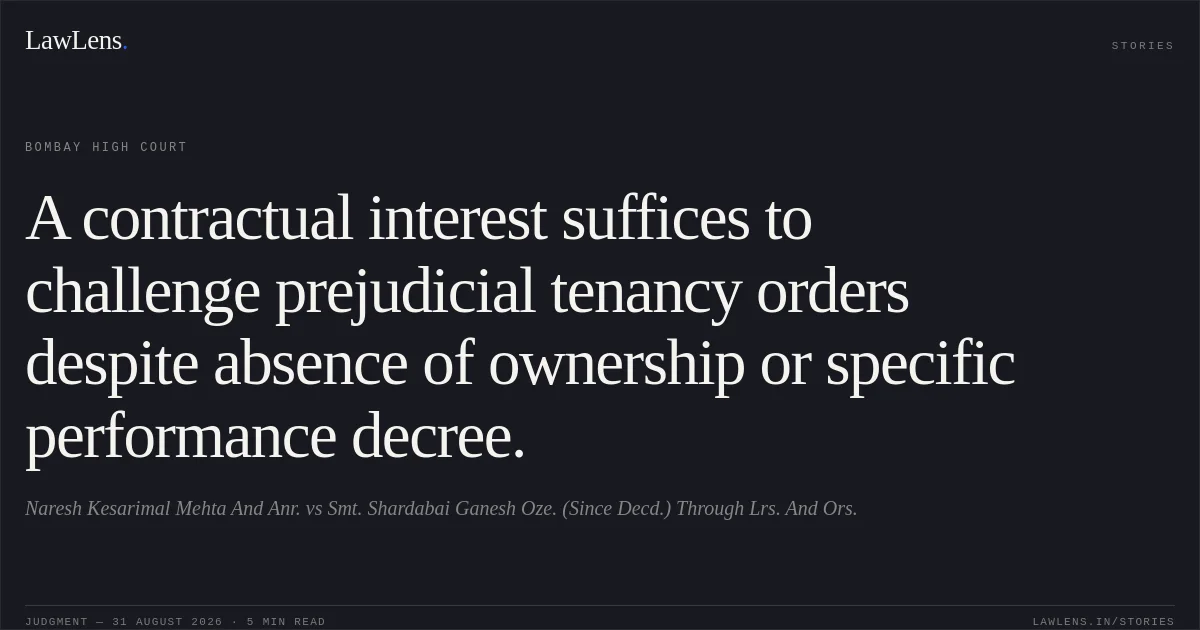
The Court held that the Petitioners had sufficient legally recognisable interest and were persons aggrieved by the tenancy orders, notwithstanding that they were not owners and had not obtained a decree for specific performance
Both writ petitions were allowed.
Source reference: para. 62The MRT orders dated 29 March 2016 and 7 March 2017 were quashed and set aside, along with the consequential ALT and SDO orders.
Source reference: para. 62Revision Application Nos. 147 and 223 of 2014 were restored to the MRT for fresh consideration after giving an effective hearing to the Petitioners, Respondent Nos. 1 to 15 and all necessary parties
Source reference: para. 62The MRT was directed to decide the revisions on their merits, uninfluenced by the observations in the judgment except on the issue of the Petitioners’ locus, preferably within six months of the parties’ appearance
Source reference: paras. 62(e), 65–66The Court expressly left open questions concerning ownership, validity or enforceability of the Agreement for Sale and entitlement to specific performance for determination by the competent Civil Court
Source reference: paras. 63–64Acts & Sections Cited
3 provisions across 1 statute referred to in this judgment. Each provision opens on LawLens.
Bombay Tenancy and Agricultural Lands Act-19483
Original Court PDF
Naresh Kesarimal Mehta And Anr.vsSmt. Shardabai Ganesh Oze. (Since Decd.) Through Lrs. And Ors.
Click to open original judgment
Original judgment, available to read, download and summarize on LawLens.in