Facts
The petitioner, Gurpreet Singh @ Latti, was alleged to have attacked his neighbour, Asha Rani, with a dagger on 5 September 2000, causing three injuries, including a grievous fracture of her right forearm.
Source reference: p.2–3The Trial Court convicted him under Sections 326 and 324 IPC and sentenced him to rigorous imprisonment for two years and one year respectively, with concurrent sentences and fines; the appellate court dismissed his appeal.
Source reference: p.1–2The criminal revision petition was admitted on 27 September 2010, and the petitioner’s sentence was suspended; he thereafter remained on bail without any allegation of misuse.
Source reference: p.4–5During the pendency of the revision, Asha Rani died on 16 July 2023. Her legal representative, Inder Mohan, was impleaded and supported a compromise dated 1 May 2026, stating that he had no objection to the petitioner’s acquittal.
Source reference: p.3–4The record also disclosed investigative deficiencies, including non-examination of the Investigating Officer, non-proof of the MLR and weapon-related documents, and an unexplained delay of approximately 22 hours in registration of the FIR.
Source reference: p.4–5Issues
Whether the legal representative of the deceased complainant could be impleaded and permitted to pursue the compromise during the pendency of the criminal revision petition?
Source reference: p.1, p.3–4Whether the High Court could permit or give effect to a compromise in respect of the convictions under Sections 324 and 326 IPC at the revision stage, notwithstanding the petitioner’s conviction by the Trial Court and dismissal of his appeal?
Source reference: p.5–10Whether, in view of the compromise, the protracted litigation, and the deficiencies in the prosecution evidence, continuation of the criminal proceedings would defeat the ends of justice?
Source reference: p.4–5, p.10–11Law Applied
The Court considered Section 320(6) Cr.P.C., which permits the High Court or Court of Session, while exercising revisional jurisdiction under Section 401 Cr.P.C., to allow compounding by a person competent to compound the offence.
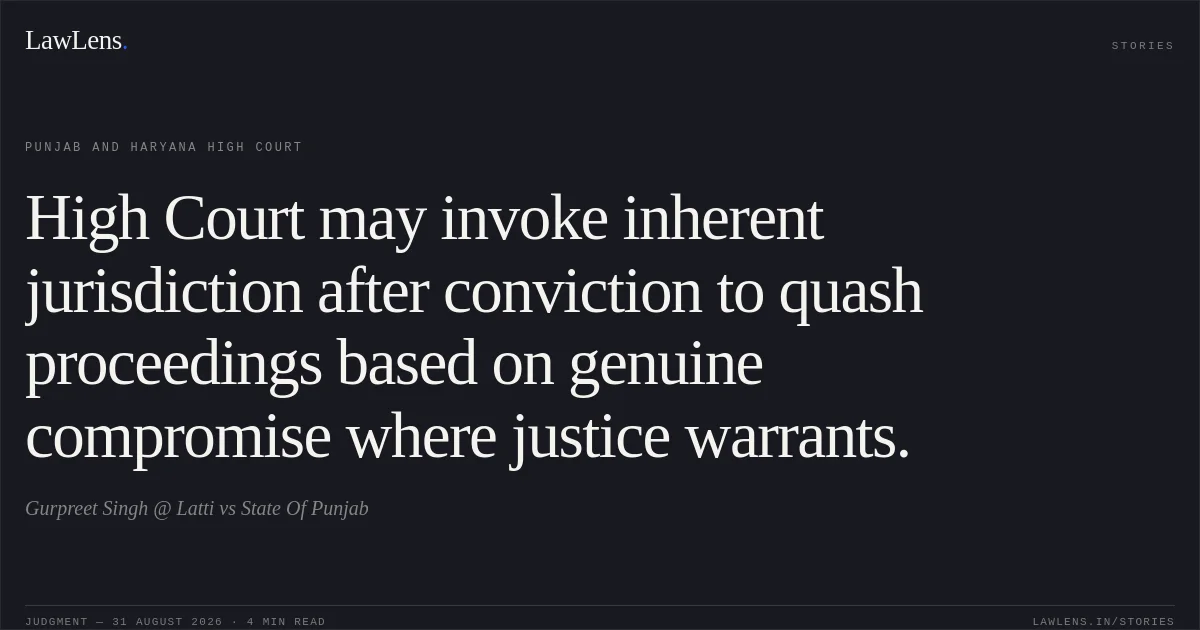
Source reference: p.6It further held that the inherent jurisdiction under Section 482 Cr.P.C. may be invoked even where the offence is non-compoundable and even after conviction, provided that such exercise is necessary to secure the ends of justice and is not barred by law.
Source reference: p.6–10Relying on Gian Singh v. State of Punjab, the Court distinguished statutory compounding under Section 320 from quashing proceedings under Section 482, holding that settlement-based quashing may be permitted in appropriate cases, but ordinarily not for heinous offences, offences involving mental depravity, or crimes such as murder, rape and dacoity.
Source reference: p.7–9The Court also relied on Sube Singh v. State of Haryana, which recognised that inherent powers may be exercised at any stage, including after conviction during the pendency of an appeal or revision, where continuation of proceedings would be an abuse of process.
Source reference: p.6–10The principles in Kulwinder Singh v. State of Punjab, Dr. Arvind Barsaul v. State of Madhya Pradesh, and Shakuntla Sawhney v. Kaushalya Sawhney were relied upon concerning compromise, consensual justice, reconciliation, and securing the ends of justice.
Source reference: p.7–11Reasoning
The Court accepted the impleadment of the deceased complainant’s legal representative because the application was supported by an affidavit and the representative was required for pursuing the revision and compromise.
Source reference: p.1Although the injuries involved a sharp-edged weapon and one injury was grievous, the Court found that the matter concerned a single accused and a single victim, arose from an occurrence dating back to 2000, and had remained pending for a prolonged period; the petitioner had already undergone approximately two months and twenty days of custody and had no other criminal case pending.
Source reference: p.4–5, p.10–11The complainant’s legal representative voluntarily supported the compromise and raised no objection to the petitioner’s acquittal.
Source reference: p.3–4In addition, the prosecution case was affected by substantial evidentiary and investigative deficiencies: the Investigating Officer was not examined, the MLR and material recovery documents were not proved, and the FIR was lodged after an unexplained delay of about 22 hours.
Source reference: p.4–5Applying the principles governing Section 482 Cr.P.C. and post-conviction compromise, the Court concluded that insisting on continuation of the proceedings would serve little purpose and that the ends of justice would be better served by bringing the long-standing dispute to an end.
Source reference: p.5–11Holding
The Court allowed the impleadment application and took the amended memo of parties on record.
It accepted the compromise in the circumstances of the case and exercised its revisional and inherent jurisdiction to terminate the criminal proceedings.
Source reference: p.10–11The petitioner, Gurpreet Singh @ Latti, was consequently acquitted of the charges under Sections 326 and 324 IPC, and the criminal revision petition was allowed.
Source reference: p.10–11All pending applications were disposed of.
Source reference: p.11Acts & Sections Cited
6 provisions across 3 statutes referred to in this judgment. Each provision opens on LawLens.
Indian Penal Code, 18602
Code of Criminal Procedure, 19733
Bharatiya Nagarik Suraksha Sanhita, 20231
Original Court PDF
Gurpreet Singh @ LattivsState Of Punjab
Click to open original judgment
Original judgment, available to read, download and summarize on LawLens.in