01Facts
The petitioners engaged the opposite party no. 2 and her husband to undertake interior decoration work at the petitioners’ flat.
¶ 2The complainant alleged that the work was initially estimated at ₹23,49,033 and was subsequently enhanced to ₹29,17,274 and ultimately ₹38,91,961.
¶ 2Although ₹23,40,000 was paid, the complainant alleged that ₹15,42,928 remained due and that the petitioners had dishonestly induced her to execute the work on credit and thereafter refused to pay the balance.
¶ 2Allegations of abuse, assault, humiliation during the housewarming ceremony, and criminal intimidation were also made against the petitioners.
¶ 2The petitioners contended that the agreed all-inclusive budget was approximately ₹25,00,000, that ₹23,40,000 had been paid, and that the dispute concerned incomplete or defective work and the complainant’s subsequent demand for an additional amount.
¶ 3–5On the basis of the complaint, Sonarpur P.S. Case No. 874 of 2025 was registered under Sections 318(4), 316(2), 351(2) and 74 of the Bharatiya Nyaya Sanhita, corresponding to G.R. Case No. 4367 of 2025.
¶ 1The petitioners sought quashing of the criminal proceeding under Section 528 of the Bharatiya Nagarik Suraksha Sanhita.
¶ 102Issues
i.Whether the allegations disclosed the ingredients of cheating under Section 318(4) of the BNS, particularly dishonest or fraudulent intention at the inception of the transaction.
¶ 13–14ii.Whether the allegations disclosed criminal breach of trust under Section 316(2) of the BNS in the absence of entrustment or dominion over property.
¶ 15iii.Whether the allegations of threats and reference to political or criminal influence constituted criminal intimidation under Section 351(2) of the BNS.
¶ 16–17iv.Whether the allegations disclosed assault or use of criminal force against a woman with intent or knowledge to outrage her modesty under Section 74 of the BNS.
¶ 18–19v.Whether continuation of the criminal proceeding, arising primarily from a contractual dispute concerning interior decoration work and payment, amounted to abuse of the process of court warranting exercise of inherent jurisdiction under Section 528 of the BNSS.
¶ 20–2203Law Applied
The Court applied Section 318(4) of the BNS, holding that cheating requires fraudulent or dishonest intention from the inception of the transaction; a mere subsequent breach of contract or failure to perform a promise does not constitute cheating.
¶ 13–14, 20Section 316(2) of the BNS requires entrustment of property or dominion over it, followed by dishonest misappropriation or conversion.
¶ 15Section 351(2) requires a specific threat intended to cause alarm or to compel or prevent legally permissible conduct; vague abuse or threats during a contractual dispute are insufficient.
¶ 16–17Section 74 requires assault or use of criminal force against a woman coupled with intent or knowledge that the act would outrage her modesty.
¶ 18–19The Court relied on State of Haryana v. Bhajan Lal, 1992 Supp (1) SCC 335, regarding quashing of proceedings in appropriate cases; Indian Oil Corporation v. NEPC India Ltd., (2006) 6 SCC 736, on the principle that the existence of a civil remedy does not bar criminal proceedings where criminal ingredients are disclosed; Inder Mohan Goswami v. State of Uttaranchal, (2007) 12 SCC 1, and Mohammad Ibrahim v. State of Bihar, (2009) 8 SCC 751, on preventing criminal proceedings from being used to settle civil disputes; and Delhi Race Club Ltd. v. State of Uttar Pradesh, (2024) 10 SCC 690, as cited by the Court concerning the distinction between cheating and criminal breach of trust.
¶ 9–10, 15, 20–21Section 528 of the BNSS empowers the High Court to quash proceedings to prevent abuse of process and secure the ends of justice.
¶ 22Provisions in the judgment · 9 · Linked ones open on LawLens
Bharatiya Nyaya Sanhita, 2023 Section 74Section 316Section 318Section 351
Bharatiya Nagarik Suraksha Sanhita, 2023 Section 528
Indian Penal Code, 1860 Section 405Section 406Section 415Section 420
04Reasoning
The Court found no credible material indicating that the petitioners possessed a dishonest or fraudulent intention when the interior work was undertaken.
¶ 13–14The parties had entered into an oral agreement, the work had commenced, and the petitioners had paid ₹23,40,000.
¶ 13–14The alleged dispute arose subsequently regarding expansion of the work, the total project cost, completion of pending work, and the balance payable; these matters were contractual and therefore primarily civil in nature.
¶ 13–14The materials did not establish that the payments were part of a pre-existing fraudulent strategy to induce continued performance on credit.
¶ 14Criminal breach of trust was also not made out because the materials brought to the site for execution of the work were not shown to have been entrusted to the petitioners in a fiduciary capacity or dishonestly misappropriated.
¶ 15The intimidation allegations were vague, lacking particulars of the exact threats, surrounding circumstances, or any conduct demonstrating that the complainant was put in genuine alarm.
¶ 17Similarly, the complaint alleged no specific assault, use of criminal force, or intention to outrage the complainant’s modesty; at most, it described a heated verbal altercation connected with the commercial dispute.
¶ 19Accordingly, the Court held that continuation of the prosecution would constitute abuse of the process of court.
¶ 2205Holding
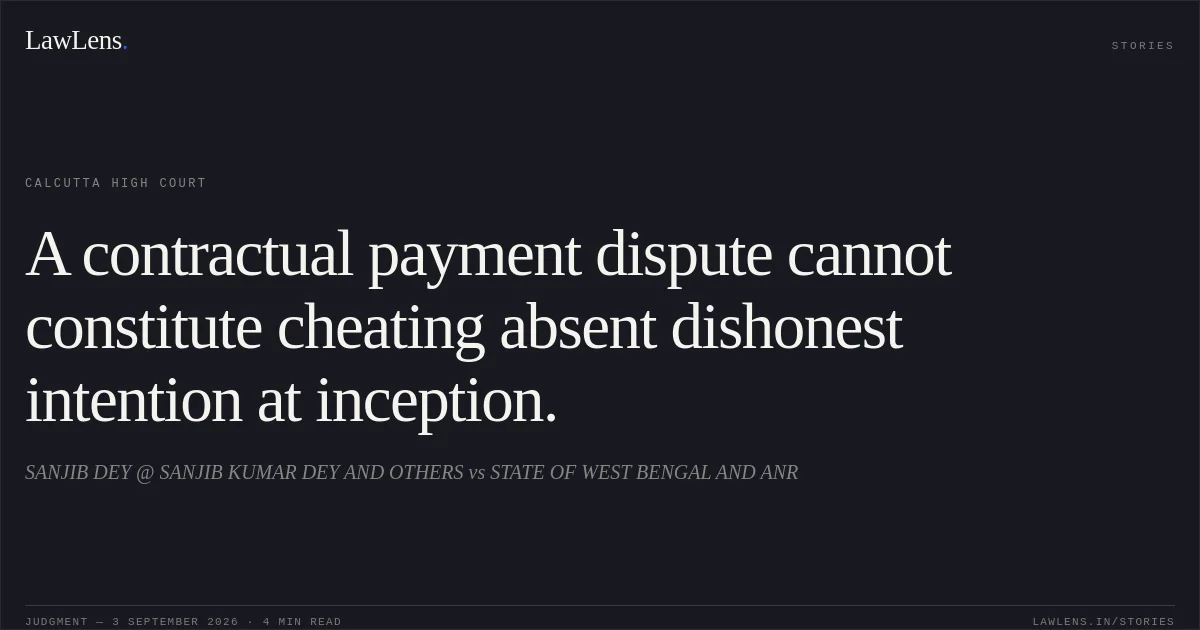
The Court held that the allegations, even if accepted in their entirety, did not establish cheating, criminal breach of trust, criminal intimidation, or assault/use of criminal force with intent to outrage modesty under the cited provisions of the BNS.
¶ 14–19CRR 2771 of 2025 was allowed, and G.R. Case No. 4367 of 2025 pending before the Additional Chief Judicial Magistrate, Baruipur, along with the connected proceedings, was quashed under Section 528 of the BNSS.
¶ 22–24Original Court PDF
SANJIB DEY @ SANJIB KUMAR DEY AND OTHERSvsSTATE OF WEST BENGAL AND ANR
Click to open original judgment
Original judgment, available to read, download and summarize on LawLens.in