Facts
The informant alleged that Petitioner No. 1 paid him an advance of ₹10,000 and a further ₹2,50,000 for construction work on the foundation and pillars of Sunagi Bridge.
Source reference: para. 4, p. 3The informant claimed to have spent ₹12,20,010 on the work, but alleged that the remaining amount was not paid.
Source reference: para. 4, p. 3He also alleged that Petitioner No. 1 abused and threatened him, and that he had paid ₹10,000 into Petitioner No. 2’s account to help secure the work.
Source reference: para. 4, p. 3The Magistrate took cognizance of offences under Sections 420 and 406 read with Section 34 IPC; charges were later framed under Sections 420/34, 406/34 and 506/34 IPC.
Source reference: para. 3, p. 2No witnesses had been examined when the petition was heard.
Source reference: para. 3, p. 2The petitioners sought quashing of the proceedings under Section 528 of the Bharatiya Nagarik Suraksha Sanhita, 2023.
Source reference: para. 3, p. 2Issues
1. Whether the allegations, taken at their highest, disclosed cheating under Section 420 read with Section 34 IPC, including deception at the inception of the transaction.
Source reference: paras. 10–11, pp. 7–82. Whether the allegations disclosed criminal breach of trust under Section 406 read with Section 34 IPC, including entrustment and dishonest misappropriation or conversion.
Source reference: paras. 12–14, pp. 8–93. Whether the alleged threat disclosed criminal intimidation under Section 506 read with Section 34 IPC.
Source reference: paras. 15–16, pp. 9–104. Whether continuation of the criminal proceedings amounted to an abuse of process warranting quashing under Section 528 BNSS.
Source reference: para. 17, p. 10Law Applied
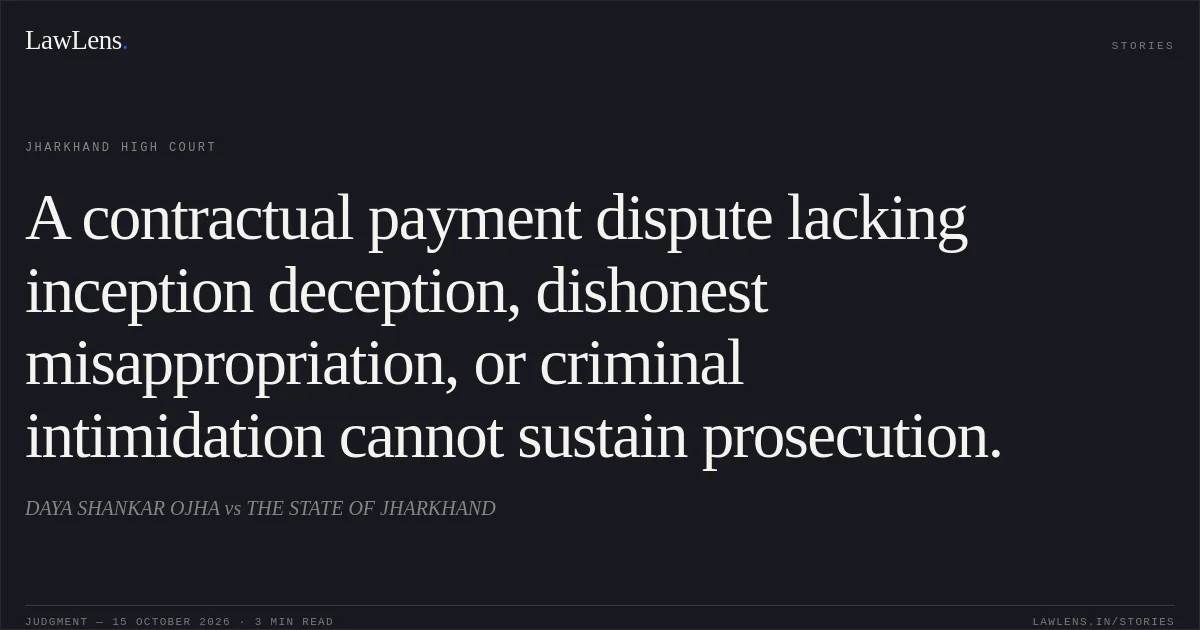
The Court considered its inherent jurisdiction under Section 528 of the BNSS to quash criminal proceedings, and the charged offences under Sections 420, 406 and 506, read with Section 34, IPC.
Source reference: para. 3, p. 2Relying on Uma Shankar Gopalika v. State of Bihar, (2005) 10 SCC 336, it applied the rule that a breach of contract constitutes cheating only where deception and the intention to cheat existed at the inception of the transaction.
Source reference: paras. 5, 10, pp. 3, 7Under Section 405 IPC, criminal breach of trust requires entrustment and dishonest misappropriation, conversion, use or disposal of the entrusted property; mere non-payment is insufficient (Binod Kumar v. State of Bihar, (2014) 10 SCC 663; Ram Narayan Popli v. CBI, (2003) 3 SCC 641; Vir Prakash Sharma v. Anil Kumar Agarwal, (2007) 7 SCC 373).
Source reference: paras. 6, 9, 12, pp. 4–8For Section 506 IPC, the prosecution must establish a threat of the specified injury made with the requisite intent to cause alarm or to compel or prevent an act; an allegation of abuse alone does not satisfy the offence (Vikram Johar v. State of Uttar Pradesh, (2019) 14 SCC 207).
Source reference: para. 15, p. 9Reasoning
The Court treated the dispute as one concerning payment for construction work and found no allegation that the petitioners had intended to deceive the informant when the transaction began; it therefore held that the ingredients of cheating were absent.
Source reference: paras. 10–11, pp. 7–8It found no allegation of entrustment of property to the petitioners or of dishonest misappropriation or conversion, so non-payment of the claimed balance did not establish criminal breach of trust.
Source reference: paras. 12–14, pp. 8–9As to criminal intimidation, the allegations did not state that the threat was intended to cause alarm or to compel the informant to act, or refrain from acting, as described by the law.
Source reference: paras. 15–16, pp. 9–10The Court concluded that none of the charged offences was made out even if the allegations were accepted in their entirety.
Source reference: para. 17, p. 10Holding
The High Court allowed the petition, holding that continuation of the proceedings would amount to an abuse of process.
It quashed, as against the petitioners, the proceedings in Karra P.S. Case No. 82 of 2015, corresponding to G.R. Case No. 518 of 2015, including the cognizance order dated 28 February 2025 and the charge-framing order dated 29 June 2026.
Source reference: paras. 17–19, pp. 10–11Acts & Sections Cited
6 provisions across 2 statutes referred to in this judgment. Each provision opens on LawLens.
Bharatiya Nagarik Suraksha Sanhita, 20231
Indian Penal Code, 18605
Original Court PDF
DAYA SHANKAR OJHAvsTHE STATE OF JHARKHAND
Click to open original judgment
Original judgment, available to read, download and summarize on LawLens.in