Facts
Respondent No. 2 alleged that land bearing CTS No. 1041-A, Survey No. 45, Hissa No. 1, at Dahisar, Mumbai, was ancestral property of his family.
Source reference: paras 8–9A development agreement dated 29 September 1998 and a registered conveyance deed dated 29 December 2001 were executed in favour of Girnar Constructions, under which the developers were to construct flats for Respondent No. 2 and his family in consideration of the land and certain payments towards construction costs.
Source reference: para. 3.1–3.2; paras 8–9After the death of Shamji Shah, a partner of Girnar Constructions, his widow and son—the Petitioners—allegedly assumed responsibility for the construction.
Source reference: para. 3.3–3.6Respondent No. 2 alleged that possession of the promised flat was withheld, labour huts were converted into shops, and forged documents were submitted to public authorities in respect of land reserved for a recreational ground.
Source reference: para. 3.3–3.6On 13 March 2013, Respondent No. 2 lodged FIR No. 117 of 2013 at Dahisar Police Station for cheating under Section 420 of the IPC and offences under Sections 3(1)(iv) and 3(1)(v) of the SC/ST Act.
Source reference: para. 1; para. 3The Petitioners sought quashing of the FIR under Article 226 of the Constitution and Section 482 CrPC, contending that they were not parties to the original agreements and that the dispute was civil and contractual in nature.
Source reference: paras 4.1–4.8The record also disclosed that the parties had subsequently settled their dispute and that Respondent No. 2 had stated that he had no complaint against the Petitioners.
Source reference: para. 13Issues
Whether the allegations in the FIR prima facie disclosed the offence of cheating under Section 420 IPC against the Petitioners, who were not parties to the development agreement or conveyance deed?
Source reference: paras 4.1–4.2, 7.1–7.2, 8–10Whether the allegations disclosed wrongful occupation, cultivation, dispossession, or interference with land rights so as to attract Sections 3(1)(iv) and 3(1)(v) of the SC/ST Act?
Source reference: paras 4.3–4.6, 11Whether the High Court should exercise its inherent jurisdiction under Section 482 CrPC to quash the FIR where the dispute was primarily contractual or civil in nature and had subsequently been settled?
Source reference: paras 7.3–7.4, 12–15Law Applied
Section 420 IPC requires fraudulent or dishonest intention and inducement at the inception of the transaction; a subsequent failure to perform a promise or breach of contract does not, by itself, constitute cheating, as held in Hira Lal Hari Lal Bhagwati v. CBI , (2003) 5 SCC 257, and Uma Shankar Gopalika v. State of Bihar , (2005) 10 SCC 336.
Source reference: paras 7.1–7.2Sections 3(1)(iv) and 3(1)(v) of the SC/ST Act require, respectively, wrongful occupation or cultivation of land and wrongful dispossession or interference with the rights of a member of a Scheduled Caste or Scheduled Tribe.
Source reference: para. 11Although courts must exercise caution while quashing proceedings under the SC/ST Act, Section 482 CrPC remains available where the allegations do not constitute an offence, the dispute is essentially civil or private, or continuation of proceedings would amount to abuse of process, as recognised in Ramawatar v. State of Madhya Pradesh , (2022) 13 SCC 635, and Gulam Mustafa v. State of Karnataka , (2023) 18 SCC 265.
Source reference: para. 7.3The Court also relied on the principles in State of Haryana v. Bhajan Lal , 1992 Supp (1) SCC 335, particularly the category where the allegations, even if accepted in their entirety, do not disclose a cognizable offence.
Source reference: para. 15Reasoning
The Court found that the development agreement and conveyance deed were registered documents under which possession of the land had been voluntarily handed over to Girnar Constructions for development.
Source reference: paras 8–10, 12The Petitioners were not parties to either document and entered the picture only after the death of Shamji Shah in 2011; consequently, the FIR did not attribute to them any inducement or dishonest intention at the inception of the transaction, which was essential for Section 420 IPC.
Source reference: paras 8–10, 12The Court further held that the registered conveyance deed and the admitted transfer of possession negated any prima facie case of wrongful dispossession or wrongful occupation under Sections 3(1)(iv) and 3(1)(v) of the SC/ST Act.
Source reference: para. 11The labour huts were also allegedly permitted to be constructed, indicating permissive use rather than wrongful occupation.
Source reference: para. 11At its highest, the dispute concerned delayed performance or breach of contractual obligations relating to flats and development of the property.
Source reference: paras 12–15The subsequent settlement and Respondent No. 2’s statement that he had no complaint against the Petitioners further supported the conclusion that continuation of the criminal proceedings would constitute an abuse of process.
Source reference: paras 12–15Holding
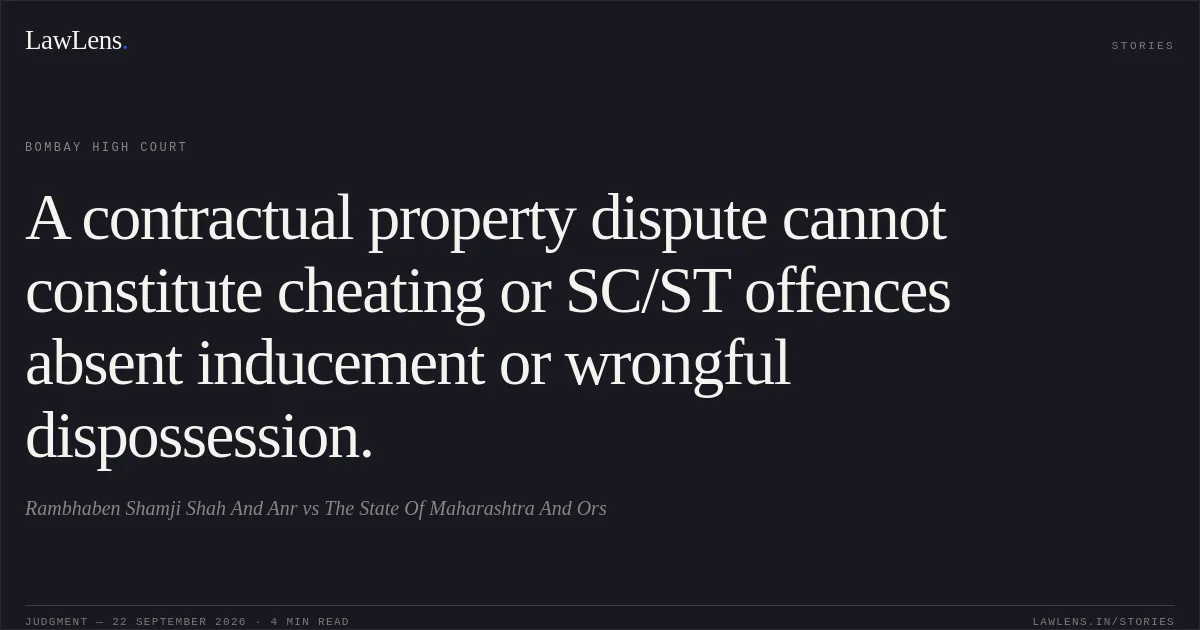
The High Court held that the FIR did not prima facie establish cheating under Section 420 IPC or wrongful occupation, dispossession, or interference under Sections 3(1)(iv) and 3(1)(v) of the SC/ST Act.
The dispute was essentially commercial and contractual, and the Petitioners were not parties to the underlying transactions.
Source reference: paras 10–14Exercising jurisdiction under Article 226 of the Constitution and Section 482 CrPC, the Court allowed the petition and quashed the impugned FIR in terms of prayer clause (b), thereby preventing abuse of the process of law and securing the ends of justice.
Source reference: paras 14–15Acts & Sections Cited
3 provisions across 3 statutes referred to in this judgment. Each provision opens on LawLens.
Code of Criminal Procedure, 19731
Indian Penal Code, 18601
Scheduled Castes and the Scheduled Tribes (Prevention of Atrocities) Act, 19891
Original Court PDF
Rambhaben Shamji Shah And AnrvsThe State Of Maharashtra And Ors
Click to open original judgment
Original judgment, available to read, download and summarize on LawLens.in