Facts
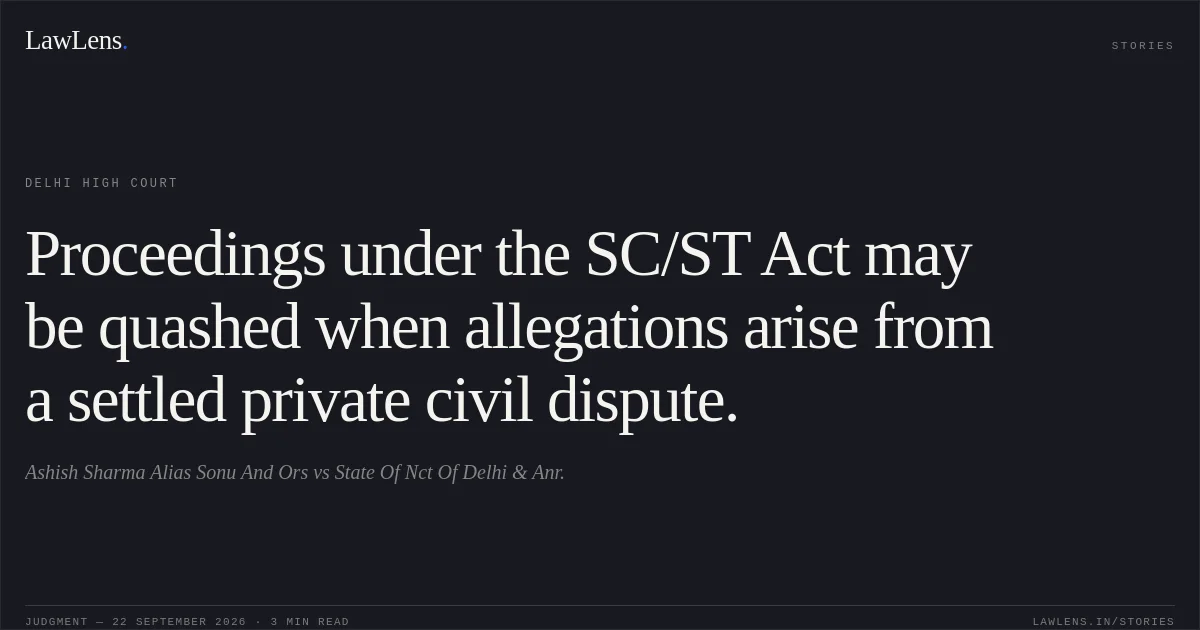
The petitioners and respondent no. 2 were property dealers operating in the same locality and had a pre-existing dispute concerning a property in Sharma Enclave.
Source reference: pp. 1–3, paras. 1, 4.1–4.4During the dispute, the petitioners allegedly abused respondent no. 2 using caste-related remarks on 17 October 2024.
Source reference: pp. 1–3, paras. 1, 4.1–4.4On the basis of information allegedly received from other persons, respondent no. 2 lodged FIR No. 0562/2024 dated 28 October 2024 at P.S. Prem Nagar, Delhi, under Section 351(3) of the Bharatiya Nyaya Sanhita, 2023 and Sections 3(1)(r) and 3(1)(s) of the Scheduled Castes and the Scheduled Tribes (Prevention of Atrocities) Act, 1989 (“SC/ST Act”).
Source reference: pp. 1–3, paras. 1, 4.1–4.4Investigation was completed and a chargesheet had been filed.
Source reference: pp. 2–3, paras. 5–10During the proceedings, the parties entered into a Deed of Compromise/Memorandum of Understanding dated 1 September 2026.
Source reference: pp. 2–3, paras. 5–10Respondent no. 2 stated that he had not personally heard any caste-related slurs and that the FIR was based on hearsay information; he also consented to quashing of the proceedings.
Source reference: pp. 2–3, paras. 5–10Issues
Whether the High Court could exercise its inherent jurisdiction under Section 528 of the Bharatiya Nagarik Suraksha Sanhita, 2023, corresponding to Section 482 of the Code of Criminal Procedure, 1973, to quash the FIR and consequential proceedings on the basis of a settlement between the parties.
Source reference: p. 1, para. 1; p. 7, paras. 20–21Whether proceedings involving Sections 3(1)(r) and 3(1)(s) of the SC/ST Act could be quashed where the dispute was essentially private and property-related, the alleged caste remarks were not directly heard by the complainant, and continuation of the prosecution would not advance the object of the SC/ST Act.
Source reference: pp. 3–5, paras. 11–15Whether the parties’ settlement made the possibility of conviction remote and rendered continuation of the criminal proceedings an abuse of the process of law.
Source reference: pp. 5–8, paras. 16–20Law Applied
The Court applied Section 528 of the BNSS, corresponding to Section 482 CrPC, which preserves the High Court’s inherent power to prevent abuse of process and secure the ends of justice.
Source reference: p. 1, para. 1It relied on Gian Singh v. State of Punjab, (2012) 10 SCC 303, for the principle that criminal proceedings involving offences with an overwhelmingly civil or private character may be quashed following settlement where continuation would be futile and defeat the ends of justice.
Source reference: pp. 5–6, para. 16It further relied on Narinder Singh v. State of Punjab, (2014) 6 SCC 466, which holds that such power must be exercised sparingly, but may be used where the dispute is personal, the possibility of conviction is remote, and continuation would cause oppression or injustice; the power ordinarily should not be exercised for heinous offences or offences having a serious impact on society.
Source reference: pp. 7–8, para. 20The Court also applied Ramavatar v. State of Madhya Pradesh, Criminal Appeal No. 1393/2011, decided on 25 October 2024, which recognises that proceedings under the SC/ST Act may be quashed where the dispute is primarily private or civil, the offence was not committed on account of the victim’s caste, and quashing would not undermine the statute’s underlying purpose.
Source reference: pp. 4–5, paras. 13–14Reasoning
The Court found that the genesis of the dispute was a property-related disagreement between persons engaged in the same business and living in the same vicinity, making the controversy predominantly civil and private in character.
Source reference: p. 4, para. 15Respondent no. 2 confirmed that he had not directly heard the alleged casteist remarks and that the FIR was based on information supplied by other persons.
Source reference: pp. 3–5, paras. 11–15In view of this statement, the settlement, and respondent no. 2’s lack of objection to quashing, the Court considered the likelihood of conviction remote.
Source reference: pp. 3–5, paras. 11–15It further held that the alleged conduct did not constitute a heinous offence and that quashing would not defeat the object of the SC/ST Act because the alleged remarks were not shown to have been made on account of the complainant’s caste.
Source reference: pp. 3–5, paras. 11–15Applying the principles in Gian Singh, Narinder Singh, and Ramavatar, the Court concluded that continuation of the prosecution would serve no public interest and would amount to an abuse of process.
Source reference: pp. 6–8, paras. 17–20Holding
The Court allowed the petition and quashed FIR No. 0562/2024 dated 28 October 2024, registered at P.S. Prem Nagar under Section 351(3) BNS and Sections 3(1)(r) and 3(1)(s) of the SC/ST Act, together with all consequential proceedings.
The parties were directed to remain bound by the settlement terms.
Source reference: p. 8, para. 23The petitioners were further directed to deposit ₹15,000 as costs with the Delhi High Court Bar Association Fund.
Source reference: pp. 8–9, para. 24The petition and pending application were accordingly disposed of.
Source reference: p. 9, para. 25Acts & Sections Cited
6 provisions across 4 statutes referred to in this judgment. Each provision opens on LawLens.
Bharatiya Nagarik Suraksha Sanhita, 20231
Code of Criminal Procedure, 19733
Bharatiya Nyaya Sanhita, 20231
Scheduled Castes and the Scheduled Tribes (Prevention of Atrocities) Act, 19891
Original Court PDF
Ashish Sharma Alias Sonu And OrsvsState Of Nct Of Delhi & Anr.
Click to open original judgment
Original judgment, available to read, download and summarize on LawLens.in