Facts
Applicants, the original Defendant Nos. 4 to 6, claimed rights under a 999-year lease and subsequent assignments concerning land at Pali Road, Bandra, including the right to utilise balance FSI.
Source reference: paras. 2–3, pp. 3–4A twelve-storey building, “White Orchid,” was constructed on the leased portion after development permissions were granted by the Municipal Corporation.
Source reference: paras. 2–3, pp. 3–4Kakad Co-operative Housing Society Ltd. filed LC Suit No. 2591 of 2000 seeking, inter alia, declarations that the building plans, development permissions, commencement certificate and other sanctions were illegal, their cancellation, and demolition of the building.
Source reference: paras. 4, 13–15, pp. 4, 9–12The Applicants sought rejection of the plaint under Order VII Rule 11 of the Code of Civil Procedure, 1908, contending that the suit was barred by Section 149 of the Maharashtra Regional and Town Planning Act, 1966 (“MRTP Act”).
Source reference: paras. 1, 4, 34–38, pp. 2, 4, 25–27The City Civil Court rejected the application on 14 July 2009, principally treating it as belated and considering the title-related allegations in the plaint; the Applicants thereafter invoked revisional jurisdiction.
Source reference: paras. 1, 4, 34–38, pp. 2, 4, 25–27Issues
Whether a suit seeking cancellation of municipal development permissions, sanctioned building plans, commencement certificates and consequential demolition of a structure is barred by Section 149 of the MRTP Act and liable to rejection under Order VII Rule 11(d) CPC?
Source reference: paras. 15–17, 20–25, pp. 12–20Whether references to the Plaintiff-Society’s alleged title in the plaint, without seeking a declaration of title or possession, prevent application of the statutory bar under Section 149 of the MRTP Act?
Source reference: paras. 26–29, pp. 20–22Whether the application under Order VII Rule 11 CPC could be considered after framing of issues and despite the Applicants’ failure to raise the statutory bar in their written statement?
Source reference: paras. 34–38, pp. 25–27Whether the challenge to the ULC permission survived after repeal of the Urban Land (Ceiling and Regulation) Act, 1976?
Source reference: paras. 32–33, pp. 24–25Law Applied
The Court applied Section 149 of the MRTP Act, which gives finality to orders, directions and notices issued by the State Government, Regional Board, Planning Authority or Development Authority under the Act and expressly bars their challenge in a civil suit.
Source reference: para. 16, p. 12It applied Order VII Rule 11(d) CPC, under which a plaint must be rejected where the suit appears from its statements to be barred by law.
Source reference: no citationThe Court relied on Arihant Construction v. Subhash Kesharmal Barlota, holding that a suit which merely challenges development permission and seeks consequential relief, without seeking declaration of title or possession, is barred by Section 149.
Source reference: paras. 18–20, pp. 13–15Sujala Yashwant Nitsure v. Municipal Corporation of City of Pune establishes that development permission constitutes an order under the MRTP Act and that Section 149 creates a general bar against civil suits challenging such orders.
Source reference: paras. 21–22, pp. 15–16Roha Municipal Council v. Shahin Mohamed Akbar Alekar and Juhi Infra Build LLP v. Yasin Mahamudiya Patel require a meaningful reading of the plaint and prevent clever drafting from disguising a barred challenge to statutory orders.
Source reference: paras. 23–24, pp. 17–19Consequential relief cannot survive when the principal relief is barred, as recognised in Prashant Dattatraya Wazalwar v. Sudha Baburao Lokhande.
Source reference: para. 30, pp. 22–23Under Church of Christ Charitable Trust v. Ponniamman Educational Trust and ITC Ltd. v. DRAT, an application under Order VII Rule 11 may be considered at any stage before conclusion of trial, and framing of issues does not prevent its determination.
Source reference: paras. 34–35, p. 25The Court also applied Section 4 of the Urban Land (Ceiling and Regulation) Repeal Act, under which pending proceedings relating to orders under the repealed ULC Act abate.
Source reference: paras. 32–33, p. 24Reasoning
The Court found that the substance of the suit was a direct challenge to the development permissions, sanctioned plans, commencement certificate and other municipal approvals for White Orchid.
Source reference: paras. 14–17, 30–31, pp. 11–12, 22–23Prayers seeking demolition, removal of the paved platform and disconnection of water supply were merely consequential to the principal challenge and therefore could not independently survive once the principal relief was barred.
Source reference: paras. 14–17, 30–31, pp. 11–12, 22–23Although the plaint referred to the Society’s title and ownership history, it sought neither a declaration of title nor recovery of possession; such averments could not transform a “plain vanilla” challenge to statutory permissions into a title suit.
Source reference: paras. 26–29, pp. 20–22The Court further held that the bar under Section 149 concerned subject-matter jurisdiction and could not be waived by failure to plead it in the written statement.
Source reference: paras. 34–38, pp. 25–27The application was not belated because Order VII Rule 11 could be invoked at any stage before decree, including after framing of issues.
Source reference: paras. 34–38, pp. 25–27The pending amendment application also did not require postponement of the Order VII Rule 11 determination, since the plaint had to be assessed on its existing averments and reliefs.
Source reference: paras. 40–41, pp. 28–29Finally, the ULC-related relief had abated because the ULC Act had been repealed and the repeal had been adopted in Maharashtra.
Source reference: paras. 32–33, p. 24Holding
The Bombay High Court allowed the Civil Revision Application and set aside the City Civil Court’s order dated 14 July 2009.
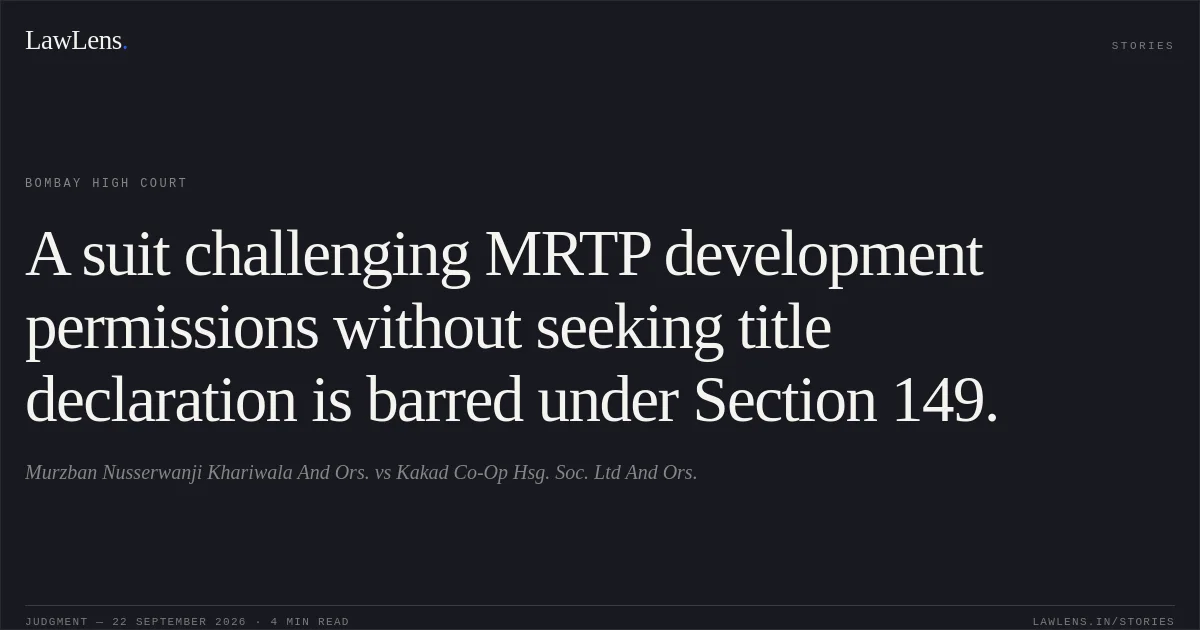
It held that the suit, being a direct challenge to development permissions and related statutory orders without any prayer for declaration of title or possession, was expressly barred by Section 149 of the MRTP Act.
Source reference: paras. 42–44, pp. 29–31The application under Order VII Rule 11 CPC was consequently allowed, and the plaint in LC Suit No. 2591 of 2000 was rejected; the suit was dismissed, with no order as to costs.
Source reference: paras. 42–44, pp. 29–31The Interim Applications were disposed of as infructuous.
Source reference: para. 45, p. 31Acts & Sections Cited
13 provisions across 3 statutes referred to in this judgment. Each provision opens on LawLens.
Maharashtra Regional and Town Planning Act, 1966.
Code of Civil Procedure, 19081
Maharashtra Municipal Corporations Act.1
Original Court PDF
Murzban Nusserwanji Khariwala And Ors.vsKakad Co-Op Hsg. Soc. Ltd And Ors.
Click to open original judgment
Original judgment, available to read, download and summarize on LawLens.in