Facts
The Respondent/Plaintiff instituted Special Civil Suit No. 501 of 2016 seeking a 1/5th share in properties allegedly owned by late Anand Dhondiram Gadekar, asserting that he was Anand’s biological/illegitimate son.
Source reference: p.3–5, paras. 6–9The Plaintiff alleged that his mother, Manisha, developed an extra-marital relationship with Anand while her marriage with Laxman Lagade continued, and that the Plaintiff was born from that relationship on 20 February 2007.
Source reference: p.3–5, paras. 6–9Anand’s wife and children denied the Plaintiff’s alleged relationship with Anand.
Source reference: p.4, paras. 7–9Before leading evidence on the pleaded facts concerning the alleged relationship, the Plaintiff filed an application seeking DNA testing of himself and one of Anand’s acknowledged children.
Source reference: p.4, paras. 7–9The Trial Court allowed the application and directed DNA examination by order dated 4 September 2018.
Source reference: p.1–3, paras. 1–2Anand’s legal heirs challenged that order in the present writ petition.
Source reference: no citationIssues
Whether a court may direct DNA testing merely because the Plaintiff asserts paternity and the Defendants deny it, without the Plaintiff first leading evidence in support of the foundational facts pleaded by him?
Source reference: p.14–15, paras. 18–20Whether the facts of the case satisfied the requirements of insufficiency of evidence, eminent need, and balancing of interests necessary to justify a DNA test?
Source reference: p.8–11, paras. 11–15; p.13–15, paras. 17–21Whether the Trial Court’s order directing DNA testing was legally sustainable?
Source reference: p.14–16, paras. 19–23Law Applied
The Court applied Section 112 of the Indian Evidence Act, 1872—which creates a conclusive presumption of legitimacy where a child is born during the subsistence of a valid marriage, subject to proof of non-access—and noted its corresponding provision, Section 116 of the Bharatiya Sakshya Adhiniyam, 2023.
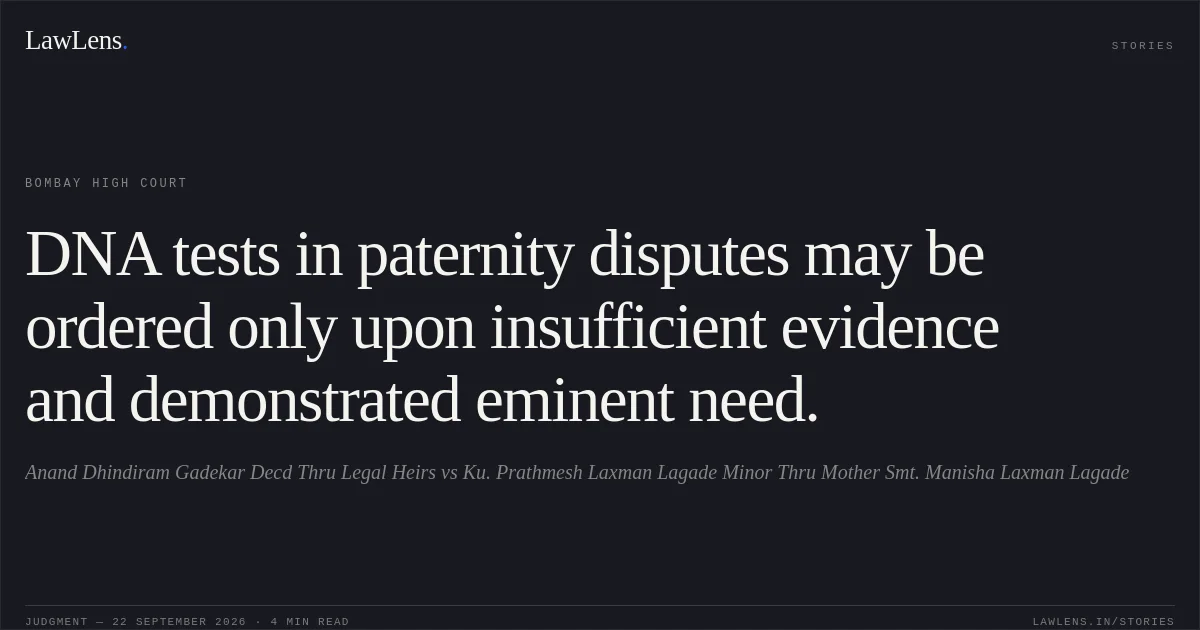
Source reference: p.15, para. 21Relying on Goutam Kundu v. State of West Bengal, Banarsi Dass v. Teeku Dutta, and Bhabani Prasad Jena v. Convenor, Secretary, Orissa State Commission for Women, the Court held that DNA testing is not to be ordered routinely, for a fishing or roving enquiry, or merely because paternity is disputed; there must be a strong prima facie case and an eminent need for the test.
Source reference: p.6–8, paras. 10–11Under Ashok Kumar v. Raj Gupta, the court must balance the search for truth against privacy, dignity, stigma, and personal autonomy, applying proportionality.
Source reference: p.9, para. 12Aparna Ajinkya Firodia v. Ajinkya Arun Firodia requires existing evidence to be considered first and permits DNA testing only in exceptional cases where the controversy cannot otherwise be resolved.
Source reference: p.9–10, para. 13Evan Rathinam v. Milan Joseph identifies two necessary safeguards: insufficiency of existing evidence and a positive balance of interests showing that DNA testing will not cause undue harm.
Source reference: p.11, para. 14The Court also relied on Sumayya Kaira Bairagdar v. Raju @ Yusuf Bashik Ahmad Kulkarni, and distinguished Chaturbhuj Pradhan v. Amar Pradhan & Anr., where paternity was directly in issue and no other evidence could provide a categorical answer.
Source reference: p.11–13, paras. 15–16Reasoning
The Court held that the Plaintiff had not yet attempted to prove the basic facts underlying his claim—such as his mother’s dairy business, her alleged dealings with Anand, the development of an intimate relationship, and the circumstances connecting his birth to Anand.
Source reference: p.5, para. 9; p.15, para. 21The Trial Court had treated the mere assertion of paternity and its denial as sufficient justification for DNA testing, but that approach improperly used scientific testing to collect evidence before the Plaintiff established a factual foundation.
Source reference: p.14, para. 19Since the Plaintiff’s mother was married to Laxman at the time of the Plaintiff’s birth and Laxman was alive, the Court noted the relevance of the statutory presumption under Section 112 and the need to consider whether the presumption had been rebutted.
Source reference: p.5, para. 9; p.15, para. 21The Court further observed that the Plaintiff had sought partition without seeking a declaration of his status as Anand’s son, although it left the legal consequences of that omission open.
Source reference: p.15, para. 20Applying the principles of insufficiency of evidence and balancing of interests, the Court concluded that the case was premature and did not disclose the exceptional circumstances required for DNA testing.
Source reference: p.13–15, paras. 17–22It nevertheless clarified that a fresh application could be made after completion of evidence if the Trial Court found that the controversy could not otherwise be resolved.
Source reference: p.16, paras. 22–23Holding
The High Court held that the Trial Court erred in directing DNA testing as a matter of course, before the Plaintiff led evidence supporting his pleaded case.
The order dated 4 September 2018 passed on Exhibit-25 in Special Civil Suit No. 501 of 2016 was set aside.
Source reference: p.16, para. 23(i)The Plaintiff was granted liberty to apply afresh for DNA testing after completion of evidence, provided he demonstrates that the evidence on record makes it impossible for the Trial Court to decide the controversy without scientific evidence.
Source reference: p.16, para. 23(ii)The writ petition was accordingly allowed and disposed of without an order as to costs.
Source reference: p.16–17, paras. 23–24Acts & Sections Cited
1 provisions across 1 statute referred to in this judgment. Each provision opens on LawLens.
Bharatiya Sakshya Adhiniyam, 20231
Original Court PDF
Anand Dhindiram Gadekar Decd Thru Legal HeirsvsKu. Prathmesh Laxman Lagade Minor Thru Mother Smt. Manisha Laxman Lagade
Click to open original judgment
Original judgment, available to read, download and summarize on LawLens.in