Facts
The petitioner joined the Life Insurance Corporation of India (LIC) as an Assistant on 04.07.1981 and was subsequently promoted as an Administrative Officer.
Source reference: p.3–5After completing more than 20 years of qualifying service, he applied for voluntary retirement on 06.10.2003 under Rule 31 of the LIC (Employees) Pension Rules, 1995, and sought early relieving.
Source reference: p.3–5He thereafter remitted an amount equivalent to 34 days’ salary towards the unserved portion of the 90-day notice period and remained absent from duty from 02.12.2003.
Source reference: p.8–9A charge memorandum was issued in May 2005 alleging unauthorised absence and abandonment of duty under Regulation 39(4)(iii) of the LIC Staff Rules, 1960.
Source reference: p.2–3The petitioner was removed from service on 15.06.2006.
Source reference: p.6–7Issues
Whether the petitioner’s absence from duty after 02.12.2003 constituted unauthorised absence and abandonment of service, notwithstanding his pending application for voluntary retirement under Rule 31 of the LIC Pension Rules.
Source reference: p.7–10, 15Whether the petitioner’s voluntary-retirement application became effective upon expiry of the 90-day notice period, or whether the alleged communication dated 27.12.2003 validly withheld permission for retirement.
Source reference: p.10–14Whether the alleged service of the letter dated 27.12.2003 was proved, and whether the disciplinary proceedings and removal order could be sustained in the circumstances.
Source reference: p.12–17Law Applied
The Court applied Rule 31(1)–(2) of the LIC (Employees) Pension Rules, 1995, under which an employee with the requisite qualifying service may retire by giving 90 days’ notice, subject to acceptance by the appointing authority; however, retirement becomes effective on expiry of the notice period if the appointing authority does not refuse permission before then.
Source reference: p.10–12The Court also considered Regulation 39(4)(iii) of the LIC Staff Rules, 1960, concerning abandonment of duty.
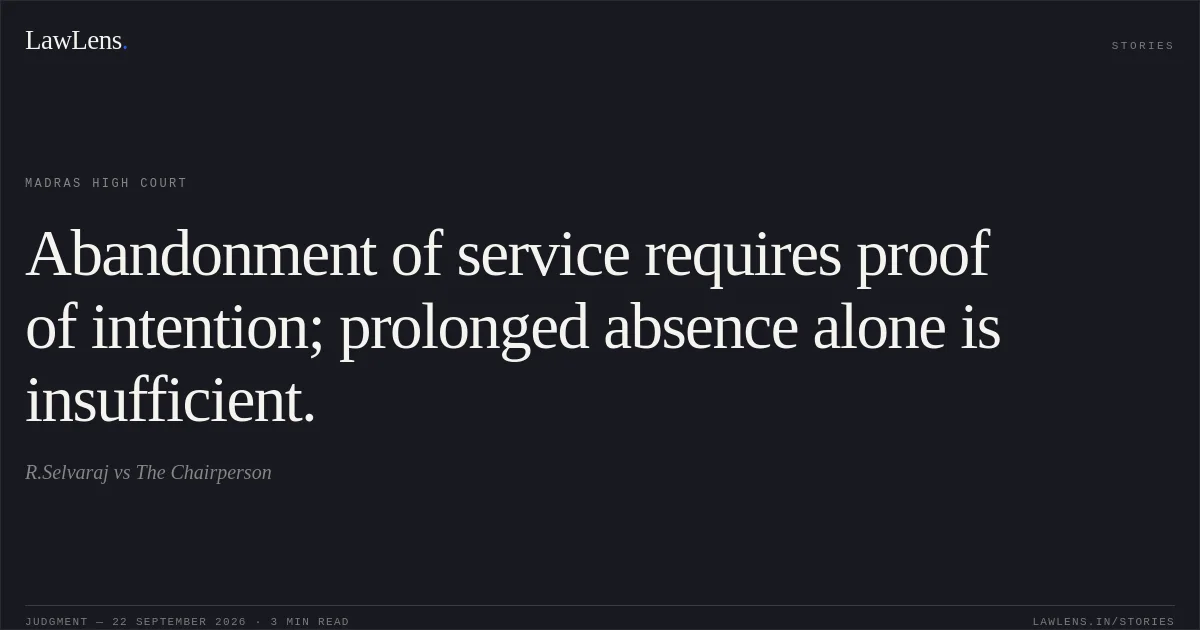
Source reference: p.7Relying on G.T. Lad v. Chemical and Fibres of India Ltd., (1979) 1 SCC 590, the Court held that abandonment is not established by absence alone; it requires a complete giving up of duties accompanied by an intention not to resume service, and intention must be inferred from the surrounding circumstances.
Source reference: p.8The petitioner also relied on Union of India v. Dinanath Shantaram Karekar, (1998) 7 SCC 569, concerning proof of actual service of a communication.
Source reference: p.5Reasoning
The Court found that the petitioner’s remittance of 34 days’ salary, by itself, did not establish acceptance of voluntary retirement or authorise him to discontinue duty before the notice period expired.
Source reference: p.8–10Nevertheless, the Court held that abandonment could not be inferred merely from his absence because the petitioner had submitted a formal retirement application, sought early relieving and acted on the apparent understanding that the retirement process was underway.
Source reference: p.8–9, 15Although LIC relied on the letter dated 27.12.2003, the letter was sent to the office address even though the petitioner had supplied a specific residential correspondence address and had already ceased attending work.
Source reference: p.12–14The alleged recipient, J. Parthasarathy, was not identified and his relationship with the petitioner was not explained.
Source reference: p.12–14The Court further considered LIC’s prolonged silence for approximately 17 months after the alleged communication and its failure to insist promptly upon the petitioner’s resumption of duty.
Source reference: p.14–17These circumstances created serious doubt about actual service of the letter and about the allegation that the petitioner had intentionally abandoned service.
Source reference: p.14–17The finding that the letter had been served was therefore held to be perverse, warranting interference with the disciplinary orders.
Source reference: p.14–17At the same time, the Court did not conclusively hold that the petitioner had validly retired or direct immediate payment of terminal benefits, particularly given the petitioner’s substantial delay in challenging the final order.
Source reference: p.16–18Holding
The Court held that the finding that the letter dated 27.12.2003 had been served upon the petitioner was unsustainable and that the circumstances raised a serious doubt regarding the charge of abandonment of service.
The impugned orders, including the removal and subsequent orders confirming it, were set aside, and the matter was remitted to LIC for fresh consideration in accordance with law within eight weeks from receipt of the order.
Source reference: p.18The Court expressly clarified that, until LIC takes a fresh decision, the petitioner would not be entitled to claim monetary benefits on the basis of an asserted voluntary retirement.
Source reference: p.18The writ petition was accordingly allowed, with no order as to costs; the connected miscellaneous petition was closed.
Source reference: p.18Original Court PDF
R.SelvarajvsThe Chairperson
Click to open original judgment
Original judgment, available to read, download and summarize on LawLens.in