Facts
The petitioner, an Anganwadi Worker, was appointed at an Anganwadi Centre in Village Bamaur Khurd, District Shivpuri, on 7 July 1998.
Source reference: para. 2Following inspections, the respondents issued her a show-cause notice alleging absence from the Centre, failure to maintain records, irregular functioning, and negligence in implementing government schemes.
Source reference: para. 2Although the petitioner submitted a reply, the Project Officer terminated her services by order dated 19 April 2012, without conducting a regular departmental enquiry.
Source reference: paras. 2–5The petitioner’s challenge before the Collector and subsequent appeal were unsuccessful; the appellate authority rejected the appeal on the ground of delay of 45 days.
Source reference: para. 3She accordingly invoked Article 226 of the Constitution seeking quashing of the termination and appellate orders, reinstatement, and consequential benefits.
Source reference: para. 1Issues
Whether the termination of the petitioner’s services through a stigmatic order, based on allegations of negligence and dereliction of duty, was legally sustainable without issuing a charge-sheet and conducting a regular departmental enquiry?
Source reference: paras. 5–9, 17–18Whether the termination and appellate orders were invalid for failure to provide a proper opportunity of hearing and for not recording adequate, cogent reasons?
Source reference: paras. 8, 12–16Whether the petitioner was entitled to reinstatement and consequential benefits, subject to the respondents’ liberty to proceed afresh in accordance with law?
Source reference: para. 19Law Applied
Under Article 226, the High Court may judicially review administrative and quasi-judicial orders that violate natural justice, statutory or governmental procedure, or constitutional standards of fairness.
Source reference: para. 1A termination order is stigmatic where it records findings of misconduct, negligence, dereliction of duty, or blameworthy conduct; such termination cannot ordinarily be imposed without a proper departmental enquiry and reasonable opportunity of defence.
Source reference: para. 7The reasonable opportunity contemplated by law includes notice of the charges, an opportunity to contest the allegations and cross-examine witnesses, and an opportunity to make a representation against the proposed punishment, as explained in Khem Chand v. Union of India, AIR 1958 SC 300.
Source reference: para. 7The Division Bench decisions in Rahul Tripathi v. Rajeev Gandhi Shiksha Mission, 2001 (3) MPLJ 616, Jitendra v. State of M.P., 2008 (4) MPLJ 670, and Malkhan Singh Malviya v. State of M.P., ILR (2018) MP 660, establish that stigmatic termination affecting future prospects requires an enquiry.
Source reference: para. 7The State Government’s policy dated 10 July 2007 specifically required that an Anganwadi Worker be given an opportunity of hearing and be removed only after being found guilty in an enquiry.
Source reference: para. 17Further, administrative and quasi-judicial authorities must pass reasoned and speaking orders; this principle was reaffirmed in State of Punjab v. Bandip Singh, (2016) 1 SCC 724, and Kranti Associates Pvt. Ltd. v. Masood Ahmed Khan, (2010) 9 SCC 496.
Source reference: paras. 14–16Reasoning
The termination order did not merely discontinue the petitioner’s engagement simpliciter; it expressly recorded allegations that she was negligent, failed to perform her duties, did not properly maintain records, and failed to implement government schemes.
Source reference: paras. 5, 8–9These findings were stigmatic and had adverse consequences for her future employment prospects.
Source reference: paras. 5, 8–9The respondents relied on the issuance of a show-cause notice and the petitioner’s reply, but a show-cause process alone could not substitute for a regular departmental enquiry where the termination was founded on alleged misconduct.
Source reference: paras. 6, 8, 17–18No charge-sheet was issued, no enquiry was conducted with the petitioner’s participation, and no opportunity was given to test the material or evidence relied upon against her.
Source reference: paras. 6, 8, 17–18The action also contravened the State’s own policy dated 10 July 2007, which contemplated removal only after an enquiry and a finding of guilt.
Source reference: para. 17Additionally, the appellate order was non-speaking and did not demonstrate proper application of mind to the petitioner’s case or defence.
Source reference: paras. 12–16The Court therefore held that the termination violated the principles of natural justice and could not be sustained merely because the appointment conditions permitted termination without notice.
Source reference: paras. 3, 18Holding
The High Court allowed the writ petition.
It quashed the stigmatic termination order dated 19 April 2012 and the consequential appellate rejection order dated 9 January 2019.
Source reference: para. 19The respondents were directed to reinstate the petitioner and grant her consequential benefits, particularly since the parties stated that she was still working on the post.
Source reference: para. 19The State was granted liberty to initiate fresh proceedings against the petitioner in accordance with law, if so advised.
Source reference: para. 19The petition was accordingly allowed and disposed of.
Source reference: paras. 19–20Original Court PDF
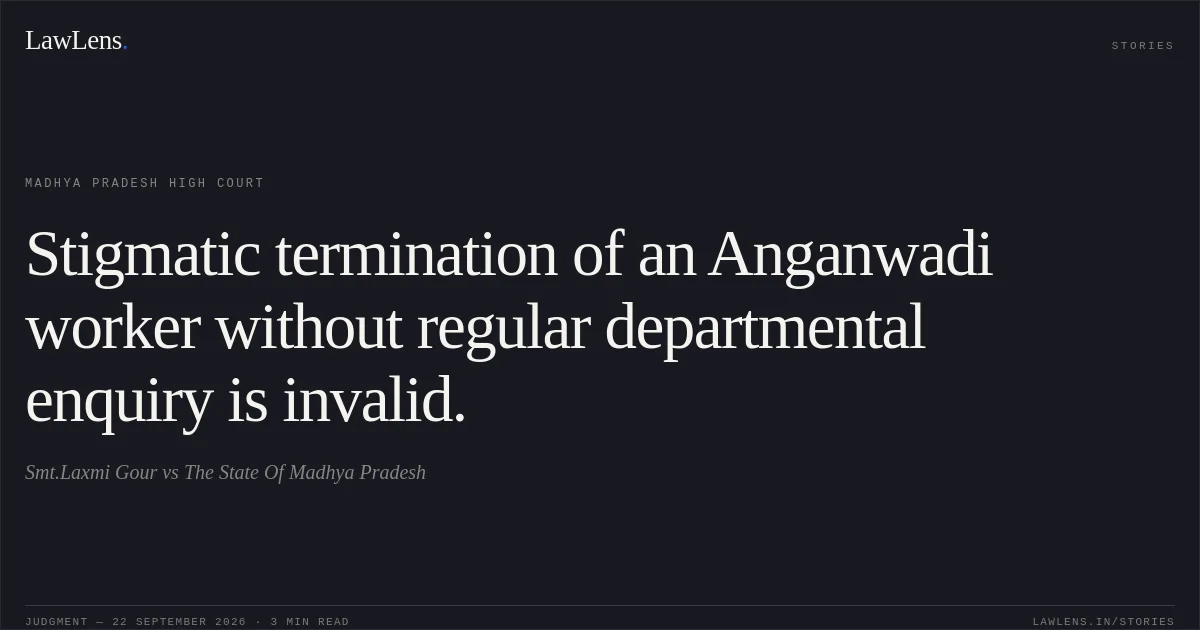
Smt.Laxmi GourvsThe State Of Madhya Pradesh
Click to open original judgment
Original judgment, available to read, download and summarize on LawLens.in