Facts
The petitioner was appointed as an Anganwadi Worker at Mini Anganwadi Centre, Khangwaripura, District Guna.
Source reference: no citationFollowing an inspection alleging that she was absent from the Centre and operating it from her residence, the authorities issued a show-cause notice dated 12 January 2024.
Source reference: no citationThe petitioner submitted a reply, asserting, inter alia, that the Centre premises were encroached upon.
Source reference: no citationAlthough a subsequent revenue inquiry reportedly found no encroachment, the authorities issued a further notice and, treating the petitioner’s explanation as unsatisfactory, terminated her services with immediate effect by order dated 13 February 2024.
Source reference: pp. 2–3, para. 5Her first appeal dated 24 October 2024 and second appeal dated 26 February 2026 were also rejected.
Source reference: p. 9, para. 14The petitioner challenged all three orders under Article 226 of the Constitution, principally on the ground that her stigmatic termination was imposed without a regular departmental inquiry.
Source reference: p. 2, paras. 1–2Issues
Whether the termination order, which attributed absence, operation of the Anganwadi Centre from the petitioner’s residence, and serious negligence in the discharge of duties, was stigmatic in nature?
Source reference: pp. 3–4, paras. 5–8Whether the respondents could terminate the petitioner’s services without issuing a charge-sheet and conducting a regular departmental inquiry, particularly in light of the State policy dated 10 July 2007?
Source reference: pp. 4–8, paras. 8–12Whether the termination order and the subsequent appellate orders were liable to be quashed, with a direction for reinstatement and consequential benefits?
Source reference: p. 9, paras. 13–15Law Applied
The Court applied the principles of natural justice and the settled rule that termination founded on allegations of misconduct or dereliction of duty is stigmatic and cannot ordinarily be imposed without a proper departmental inquiry.
Source reference: pp. 4–6, paras. 6–10It relied on Rahul Tripathi v. Rajeev Gandhi Shiksha Mission, 2001 (3) MPLJ 616; Jitendra v. State of M.P., 2008 (4) MPLJ 670; Malkhan Singh Malviya v. State of M.P., ILR (2018) MP 660; and Rajesh Kumar Rathore v. High Court of M.P., W.P. No. 18657 of 2018, decided on 23 November 2021, which distinguish an innocuous termination from one founded on misconduct and holding that the latter requires notice, opportunity of hearing, and inquiry.
Source reference: pp. 4–6, paras. 6–10The Court also referred to Khem Chand v. Union of India, AIR 1958 SC 300, regarding the components of reasonable opportunity, including notice of charges, opportunity to contest the allegations and cross-examine witnesses, and an opportunity to make a representation against the proposed punishment.
Source reference: pp. 4–5, para. 7In addition, the State Government policy dated 10 July 2007 specifically permits removal of an Anganwadi Worker only after affording an opportunity of hearing and finding the worker guilty in an inquiry.
Source reference: p. 7, para. 12Reasoning
The Court examined the language of the termination order and found that it did not merely discontinue the petitioner’s engagement simpliciter; rather, it recorded specific findings that she had failed to operate the Anganwadi Centre from the departmental premises and had committed serious negligence in performing her duties.
Source reference: pp. 3–4, paras. 5–8These findings amounted to allegations of misconduct and carried adverse consequences for the petitioner’s future prospects, making the order stigmatic.
Source reference: pp. 3–4, paras. 5–8A show-cause notice and consideration of a written reply were insufficient because no charge-sheet was issued and no regular inquiry was conducted in which the petitioner could properly contest the allegations or adduce evidence.
Source reference: no citationThe Court further held that the State’s policy itself contemplated removal only after an inquiry resulting in a finding of guilt.
Source reference: p. 7, para. 12Consequently, the termination violated the principles of natural justice and the applicable policy, notwithstanding the respondents’ contention that the petitioner could be removed without notice.
Source reference: p. 2, para. 3Holding
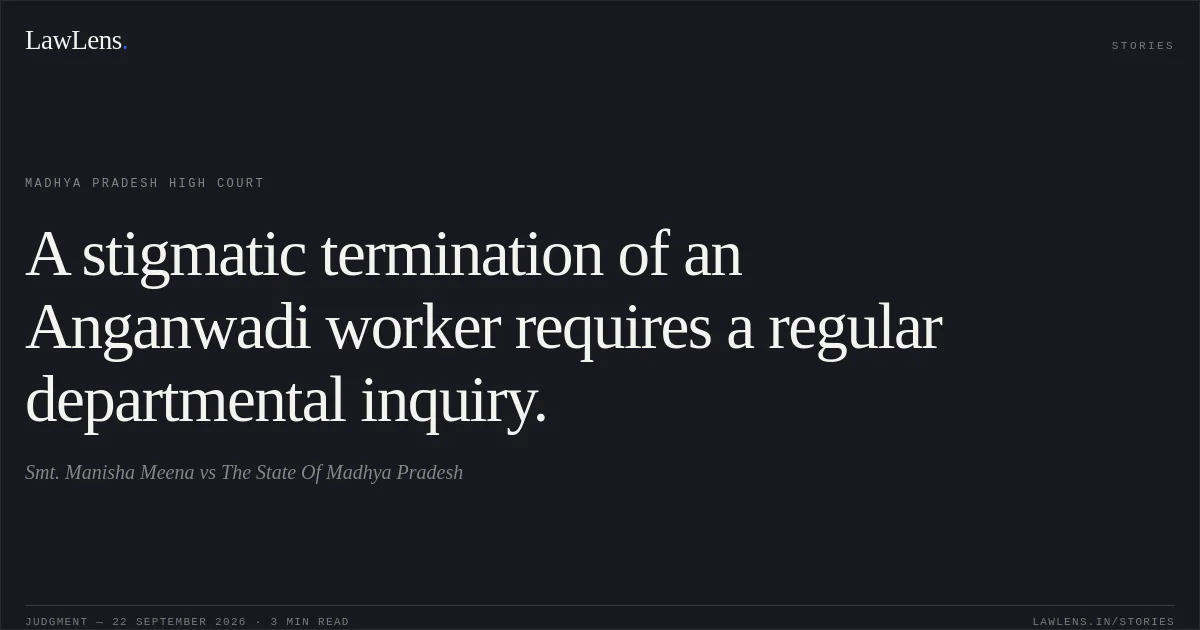
The Court held that the termination order dated 13 February 2024 was stigmatic and illegal because it was passed without a charge-sheet and regular departmental inquiry.
The termination order, the first appellate order dated 24 October 2024, and the second appellate order dated 26 February 2026 were accordingly quashed.
Source reference: p. 9, para. 14The respondents were directed to reinstate the petitioner forthwith with all consequential benefits, but without back wages on the principle of “no work, no pay.”
Source reference: p. 9, paras. 14–15The respondents were granted liberty to initiate fresh proceedings against the petitioner in accordance with law, if so advised.
Source reference: p. 9, paras. 14–15The writ petition was allowed and disposed of.
Source reference: p. 9, paras. 14–15Original Court PDF
Smt. Manisha MeenavsThe State Of Madhya Pradesh
Click to open original judgment
Original judgment, available to read, download and summarize on LawLens.in