Facts
The petitioner, who retired from service on 30 November 2012, filed a writ petition under Article 226 seeking payment of outstanding retiral dues, including house rent allowance (“HRA”) for 1 March 2010 to 30 November 2012, salary for 10 and 11 December 2011, TA bills, GPF, and interest for delayed payment.
Source reference: p.1The State contended that salary for 10 and 11 December 2011 was withheld because those days had subsequently been treated as *dies non* by order dated 16 December 2019, and that HRA was not payable because the petitioner had not produced proof of residing in private accommodation and had stayed for some periods in inspection bungalows/rest houses/guest houses.
Source reference: pp.2–3The State expressed willingness to verify and pay any TA bills found legally admissible under the applicable rules.
Source reference: p.3The petitioner argued that the *dies non* order was imposed after his retirement without a departmental enquiry and that 10 December 2011 was the second Saturday while 11 December 2011 was a Sunday.
Source reference: p.2Issues
1. Whether the respondents could treat 10 and 11 December 2011 as *dies non* and withhold the petitioner’s salary without conducting a regular departmental enquiry.
Source reference: pp.2–4, 8–92. Whether the petitioner was entitled to HRA for the period from 1 March 2010 to 30 November 2012 when no government quarter had been allotted to him, notwithstanding temporary stays in government guest houses/rest houses.
Source reference: pp.2–3, 9–103. Whether the petitioner was entitled to verification and payment of his TA bills if found admissible under the applicable rules.
Source reference: p.3, p.104. Whether interest was payable on the amounts found due to the petitioner.
Source reference: p.10Law Applied
The Court applied Article 226 of the Constitution of India and Rule 10 of the Madhya Pradesh Civil Services (Classification, Control and Appeal) Rules, 1966, which prescribes the penalties that may be imposed on a government servant.
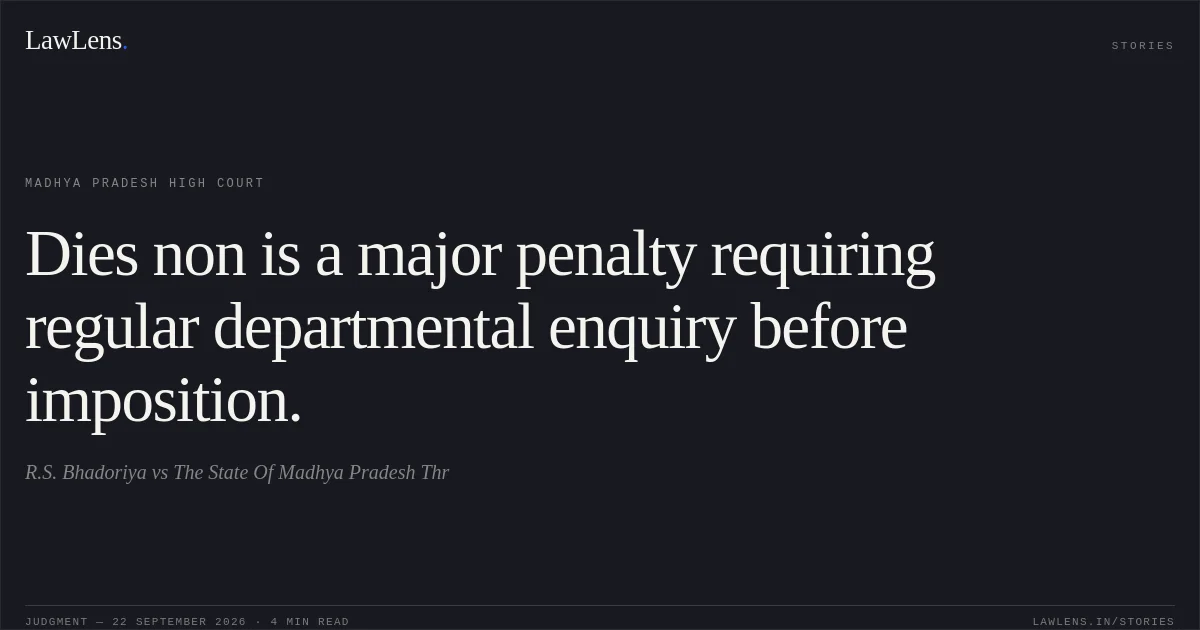
Source reference: pp.6–8It held that an order treating a period as *dies non* is stigmatic and affects salary, increments, leave, qualifying service and pension; consequently, it operates as a major penalty and cannot be imposed without a regular departmental enquiry under Rule 14 of the 1966 Rules.
Source reference: pp.4, 8–9The Court relied on *Dr. Nemi Kochar v. State of M.P.*, 2007 (III) MPJR 41; *Battilal v. Union of India*, 2005 (3) MPHT 32; *Dr. Anil Kumar Varma v. State of M.P.*, 2005 (1) MPHT 24; and *Mahesh Kumar Shrivastava v. State of M.P.*, 2007 (3) MPLJ 525, for the principles governing *dies non*.
Source reference: pp.4–9The Court further applied the principle that a government employee is entitled to HRA where no government quarter has been allotted, and that temporary accommodation in a guest house or inspection bungalow is not equivalent to allotment of a government quarter.
Source reference: pp.9–10Reasoning
The Court found that the petitioner had retired on 30 November 2012, whereas the respondents treated 10 and 11 December 2011 as *dies non* only by order dated 16 December 2019, without conducting a regular departmental enquiry.
Source reference: p.4Since *dies non* affects salary and other service and pensionary benefits and is therefore a major, stigmatic penalty, the order could not legally support withholding the petitioner’s salary.
Source reference: pp.4, 8–9The Court also noted that the two disputed dates were the second Saturday and Sunday, respectively, and therefore directed payment of salary for both days.
Source reference: p.4, p.10With respect to HRA, the respondents did not establish that any government quarter had been allotted to the petitioner during the relevant period.
Source reference: p.9Temporary stays in inspection bungalows, rest houses or guest houses were held to be temporary arrangements and not equivalent to occupation of an allotted government quarter; accordingly, the petitioner was held entitled to HRA for the entire period from 1 March 2010 to 30 November 2012.
Source reference: pp.9–10The TA claim was left subject to verification under the applicable rules.
Source reference: p.10Holding
The petition was allowed and disposed of.
The Court held that the petitioner was entitled to salary for 10 and 11 December 2011 and HRA from 1 March 2010 to 30 November 2012.
Source reference: p.10The respondents were directed to verify the petitioner’s TA bills and pay them if found legally admissible and payable under the applicable rules.
Source reference: p.10The amounts were directed to be paid with 6% annual interest within three months from receipt of the certified order; failing such payment, the entire amount would carry interest at 12% per annum from the date of entitlement until actual payment.
Source reference: p.10Original Court PDF
R.S. BhadoriyavsThe State Of Madhya Pradesh Thr
Click to open original judgment
Original judgment, available to read, download and summarize on LawLens.in