Facts
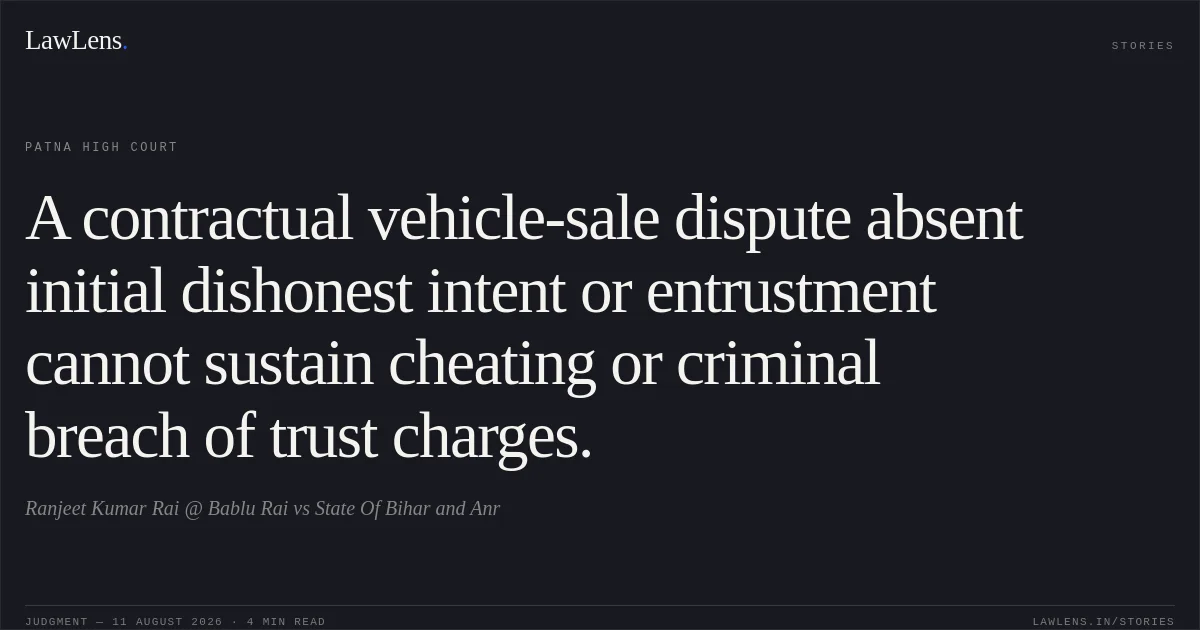
The informant alleged that he agreed to sell his Bolero Pick-up Van to the petitioner for ₹4,21,000. The petitioner allegedly issued a cheque for ₹2,50,000 as part-payment, promised to pay the balance within two weeks, and obtained possession of the vehicle. The cheque was subsequently dishonoured. When the informant demanded payment or return of the vehicle, the petitioner allegedly abused and threatened him and refused to comply.
Source reference: paras. 4–5; pp. 2–4An FIR was registered under Sections 406, 420, 504 and 506 of the Indian Penal Code, 1860 (“IPC”) and Section 138 of the Negotiable Instruments Act, 1881 (“NI Act”). After investigation, a charge-sheet was submitted and the Magistrate took cognizance on 5 March 2018. The petitioner’s discharge application was rejected on 10 September 2018.
Source reference: para. 5; p. 4The petitioner invoked Section 482 of the Code of Criminal Procedure, 1973, contending that the dispute was contractual, that there was no dishonest intention or entrustment, and that the prosecution under Section 138 of the NI Act was procedurally invalid because no statutory demand notice had been issued and the matter had been initiated through an FIR rather than a complaint.
Source reference: paras. 6–7; pp. 4–7The informant opposed the applications, asserting that the cheque had been dishonoured and that the criminal proceeding was supported by the charge-sheet; he also stated that the vehicle loan had subsequently been discharged.
Source reference: para. 8; pp. 7–8Issues
1. Whether the Magistrate’s order dated 5 March 2018 taking cognizance of offences under Sections 406, 420, 504 and 506 IPC and Section 138 of the NI Act suffered from legal infirmity warranting interference under Section 482 Cr.P.C.?
Source reference: para. 10; p. 82. Whether the allegations and materials disclosed the essential ingredients of criminal breach of trust, cheating, intentional insult, criminal intimidation or the offence under Section 138 of the NI Act?
Source reference: paras. 12, 15, 17–18; pp. 9–163. Whether the subsequent order dated 10 September 2018 rejecting the petitioner’s discharge application and the continuation of the criminal proceeding amounted to an abuse of process?
Source reference: paras. 10, 19–20; pp. 8–9, 16–17Law Applied
The Court applied the inherent jurisdiction under Section 482 Cr.P.C., which may be exercised sparingly to prevent abuse of process and secure the ends of justice, including where the allegations, even if accepted at face value, do not constitute an offence or where a civil dispute has been given a criminal colour.
Source reference: para. 11; p. 9For Section 138 of the NI Act, the Court relied on the statutory requirements under Sections 138 and 142: a valid statutory demand notice, failure to pay within fifteen days of service, and cognizance only upon a written complaint by the payee or holder in due course; an FIR cannot substitute the prescribed complaint procedure.
Source reference: paras. 12–14; pp. 9–11Relying on Kaveri Plastics v. Mahdoom Bawa Bahrudeen Noorul, 2025 SCC OnLine 2019, the Court reiterated that a specific demand for payment of the cheque amount and service of notice are mandatory.
Source reference: para. 13; p. 10Relying on Sangeetaben Mahendrabhai Patel v. State of Gujarat, (2012) 7 SCC 621, and A.C. Narayanan v. State of Maharashtra, (2014) 11 SCC 790, it reaffirmed that Section 138 prosecution must comply with Section 142.
Source reference: para. 14; p. 11Sections 406 and 420 IPC were treated as requiring distinct ingredients: entrustment followed by dishonest misappropriation for criminal breach of trust, and deception with dishonest intention at the inception for cheating.
Source reference: paras. 15–17; pp. 11–15The Court also applied the principles in Delhi Race Club (1940) v. State of Uttar Pradesh, (2024) 10 SCC 690, and State of Haryana v. Bhajan Lal, 1992 Supp (1) SCC 335.
Source reference: paras. 16, 19; pp. 11–16Reasoning
The Court held that the FIR and investigation materials contained no allegation of service of a statutory demand notice or payment default within fifteen days thereafter. Further, Section 138 proceedings could not validly be founded on a police FIR, since Section 142 requires a complaint by the payee or holder in due course.
Source reference: paras. 12–14; pp. 9–11The allegations also did not establish entrustment or dishonest misappropriation necessary for Section 406 IPC, nor dishonest intention at the inception of the vehicle transaction necessary for Section 420 IPC. At most, they indicated a contractual dispute concerning payment and possession of the vehicle.
Source reference: paras. 15–17; pp. 11–16The general allegations of abuse and threat, without particulars showing intentional insult intended to provoke breach of peace or a legally sufficient threat, did not satisfy Sections 503, 504 or 506 IPC.
Source reference: para. 18; p. 16Applying the Bhajan Lal principles, the Court found that continuation of the prosecution would constitute abuse of process because the allegations, even taken at face value, did not disclose the alleged offences and the dispute was essentially civil in nature.
Source reference: para. 19; p. 16Holding
The Court answered the issues in favour of the petitioner.
It set aside the cognizance order dated 5 March 2018 and the discharge-rejection order dated 10 September 2018, both passed by the Additional Chief Judicial Magistrate-III, Dalsinghsarai, Samastipur.
Source reference: paras. 20–22; p. 17Consequently, the entire criminal proceeding arising out of Vidyapatinagar P.S. Case No. 118 of 2016 and G.R. No. 739 of 2016 was quashed.
Source reference: paras. 20–22; p. 17Both criminal miscellaneous applications were allowed, and any interim orders were vacated.
Source reference: paras. 20–22; p. 17Acts & Sections Cited
8 provisions across 3 statutes referred to in this judgment. Each provision opens on LawLens.
Code of Criminal Procedure, 19731
Indian Penal Code, 18605
Negotiable Instruments Act, 18812
Original Court PDF
Ranjeet Kumar Rai @ Bablu RaivsState Of Bihar and Anr
Click to open original judgment
Original judgment, available to read, download and summarize on LawLens.in