Facts
Gujarat State Road Transport Corporation (GSRTC) invited tenders for construction of bus bodies on 360 chassis. M/s Paras Motors Industries submitted the lowest bid and was awarded the contract for ₹23.89 crores.
Source reference: pp. 2–3The Letter of Acceptance dated 31 May 2016 and Work Order dated 10 August 2016 required compliance with AIS-052 standards and provided a five-year warranty.
Source reference: pp. 2–3The completed buses were inspected by GSRTC officers, cleared by the RTO, and deployed across Gujarat.
Source reference: pp. 2–4GSRTC accordingly lodged FIR CR No. I-251 of 2018 at Naroda Police Station, Ahmedabad, alleging offences under Sections 406 and 420 of the Indian Penal Code.
Source reference: pp. 4–5The petitioner sought quashing of the FIR under Section 482 of the Code of Criminal Procedure, contending that the dispute was contractual, that the buses had undergone multiple inspections and extensive commercial use, and that the FIR was lodged as a counterblast after GSRTC encashed the bank guarantee and contractual disputes arose.
Source reference: pp. 4–5, 7–8Issues
Whether the allegations in the FIR prima facie constituted the offence of cheating under Section 420 IPC, particularly in the absence of dishonest or fraudulent intention at the inception of the contract?
Source reference: paras. 6, 6.1–6.2; pp. 6–7Whether the contractual dispute concerning alleged defects and warranty obligations constituted criminal breach of trust under Sections 405/406 IPC?
Source reference: para. 6.3; p. 7Whether continuation of the criminal proceedings amounted to an abuse of process because the dispute was essentially contractual and the FIR was allegedly instituted with mala fide intent after the commencement of civil/contractual proceedings?
Source reference: paras. 6.4–6.10; pp. 7–10Law Applied
The Court exercised its inherent jurisdiction under Section 482 CrPC to prevent abuse of process and quashed the FIR where the allegations did not prima facie disclose the alleged offences.
Source reference: para. 1; p. 1For Section 420 IPC, the Court applied the rule that cheating requires fraudulent or dishonest intention at the inception of the transaction; a subsequent failure to perform contractual or warranty obligations does not, by itself, establish cheating.
Source reference: paras. 6.1–6.2; pp. 6–7For Sections 405/406 IPC, criminal breach of trust requires entrustment followed by dishonest misappropriation or conversion; a contractual dispute regarding defective performance, maintenance or warranty liability does not ordinarily satisfy these ingredients.
Source reference: para. 6.3; p. 7Relying on State of Haryana v. Bhajan Lal, the Court applied the principles that proceedings may be quashed where the allegations do not disclose a cognizable offence or where the prosecution is manifestly mala fide and instituted for an ulterior purpose.
Source reference: para. 6.7; p. 8The Court further relied on G. Sagar Suri v. State of U.P., Rajiv Ranjan v. R. Vijaykumar, and Manidersingh Jolly v. State of Gujarat for the propositions that criminal law cannot be used as a shortcut for resolving essentially civil or commercial disputes or as a pressure tactic in pending contractual litigation.
Source reference: paras. 6.8–6.10; pp. 8–10Reasoning
The Court found that the petitioner had submitted a valid tender, passed the prescribed three-stage inspections, obtained RTO clearance and supplied 360 buses, which were operated for more than two years and allegedly travelled approximately three to four lakh kilometres each.
Source reference: para. 6.2; pp. 6–7In these circumstances, the alleged defects and failure to perform warranty-related obligations did not establish that the petitioner possessed dishonest intent when the contract was entered into, which was essential for Section 420 IPC.
Source reference: para. 6.2; pp. 6–7The Court also held that the chassis had been returned as completed buses and that the dispute concerned quality, warranty and maintenance obligations rather than entrustment and dishonest misappropriation necessary for Section 406 IPC.
Source reference: para. 6.3; p. 7The chronology—issuance of contractual claims, encashment of the bank guarantee, initiation of civil proceedings and subsequent registration of the FIR—supported the petitioner’s contention that criminal proceedings were being used to exert pressure in a commercial dispute.
Source reference: paras. 6.4–6.10; pp. 7–10Accordingly, the allegations fell within the Bhajan Lal categories warranting quashing, namely absence of the essential ingredients of the offences and mala fide institution of proceedings.
Source reference: para. 6.7; p. 8Holding
The Court answered the issues in favour of the petitioner.
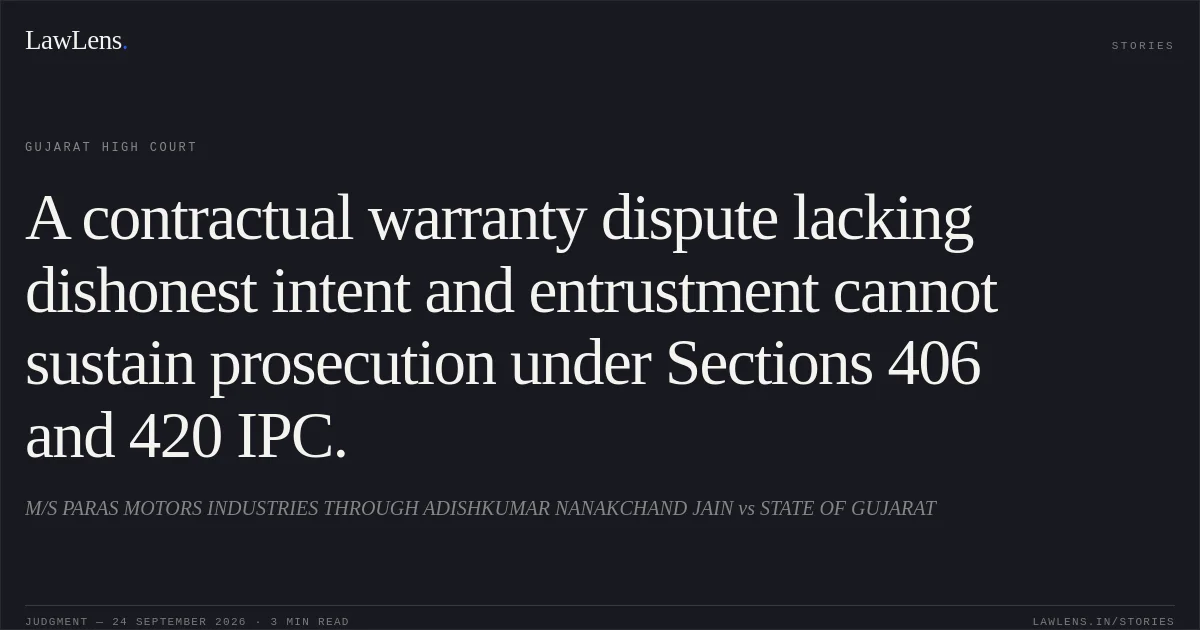
It held that the FIR disclosed, at most, a contractual dispute concerning alleged defects and warranty obligations and did not prima facie establish cheating under Section 420 IPC or criminal breach of trust under Section 406 IPC.
Source reference: paras. 7–8; p. 10Continuation of the prosecution would amount to abuse of the process of law.
Source reference: paras. 7–8; p. 10The petition was allowed, and FIR CR No. I-251 of 2018 registered at Naroda Police Station, Ahmedabad, together with all consequential proceedings, was quashed and set aside qua the petitioner. Rule was made absolute.
Source reference: para. 8; p. 10Acts & Sections Cited
4 provisions across 2 statutes referred to in this judgment. Each provision opens on LawLens.
Code of Criminal Procedure, 19731
Indian Penal Code, 18603
Original Court PDF
M/S PARAS MOTORS INDUSTRIES THROUGH ADISHKUMAR NANAKCHAND JAINvsSTATE OF GUJARAT
Click to open original judgment
Original judgment, available to read, download and summarize on LawLens.in