Facts
The petitioner Society, a registered thrift and credit co-operative society with 9,416 members, challenged (i) the Deputy Registrar’s letter dated 4 November 2025 dissolving the Board of Directors allegedly elected at the Society’s AGM on 26 September 2025 and placing its affairs under a One-Man-Management Committee, and (ii) the Zonal Joint Registrar’s order dated 10 November 2025 declaring that the Board stood automatically dissolved under Section 39 of the Assam Cooperative Societies Act, 2007 and appointing a Senior Inspector/Auditor to perform the Board’s functions and conduct fresh elections
Source reference: pp. 3–4, paras. 1, 3.5–3.7The Society contended that the AGM had been duly convened after the earlier meeting was adjourned for want of quorum, and that the proceedings stood deemed approved under Section 45(1) because the Registrar had not acted within the prescribed period
Source reference: pp. 5–8, paras. 3.2–3.6The respondents alleged that the AGM lacked the statutory quorum, that the electoral rolls and election procedure prescribed under the Act and the Assam Cooperative Societies Election Rules, 2019 had not been followed, and that the writ petition was not maintainable because the CEO lacked authority and locus standi
Source reference: pp. 15–18, paras. 9–12The Court treated maintainability as the preliminary issue
Source reference: p. 19, para. 14Issues
1. Whether the petitioner Society and its Chief Executive Officer had the authority and locus standi to maintain a writ petition challenging the dissolution of the Board and appointment of a One-Man-Management Committee
Source reference: pp. 19–28, paras. 14, 17–202. Whether the CEO could represent the Society or institute proceedings on its behalf in the absence of a valid Board and without authorisation from the One-Man-Management Committee
Source reference: pp. 23–28, paras. 18–203. Whether the Society or the CEO qualified as a “person aggrieved” entitled to invoke the writ jurisdiction under Article 226 of the Constitution
Source reference: pp. 28–31, paras. 21–224. Whether the impugned dissolution, appointment of the One-Man-Management Committee, and alleged violations of Sections 26(3), 34, 39, 41 and 45(1) of the Assam Cooperative Societies Act, 2007 were legally sustainable
Source reference: pp. 10–18, paras. 6–13Law Applied
The Court applied Section 117 of the Assam Cooperative Societies Act, 2007, which recognises a registered co-operative society as a distinct body corporate capable of instituting and defending legal proceedings
Source reference: p. 20, para. 15Under Sections 35 and 49, the management of the Society vests in the Board, while the CEO functions under the general superintendence, direction and control of the Board and may sue or be sued on behalf of the Society only within the authority conferred by law and the Board
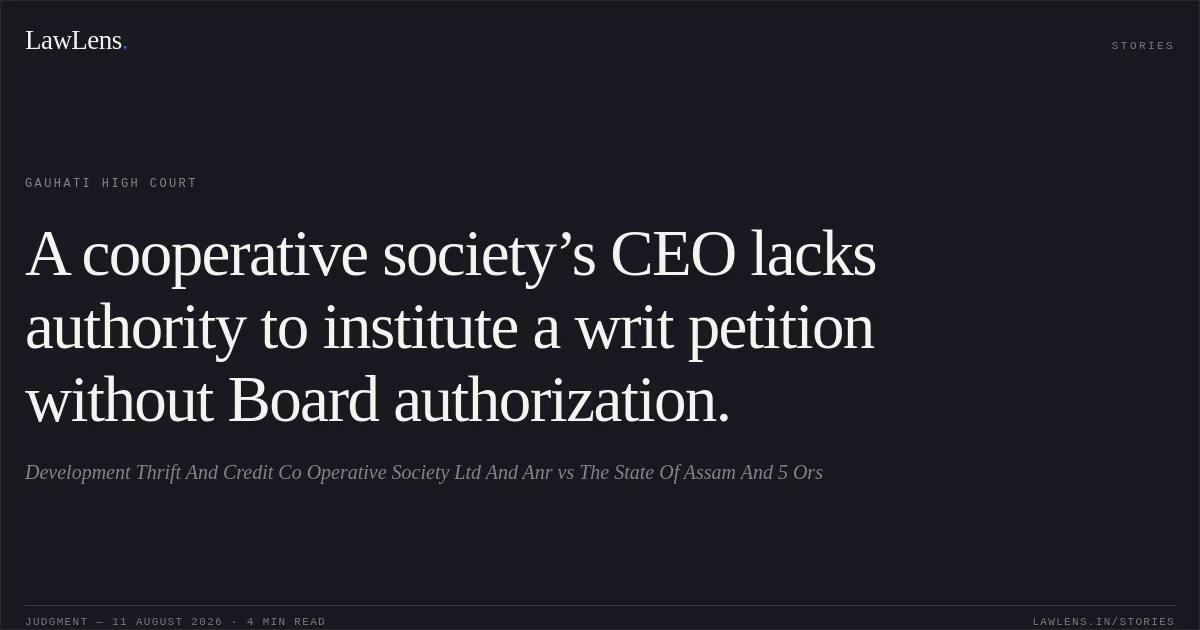
Source reference: pp. 20–26, paras. 16.1, 18–19The Court held that, absent Board authorisation, the CEO has no independent authority to represent the Society in litigation
Source reference: pp. 26–28, paras. 19–20It further applied the principle in Ayaaubkhan Noorkhan Pathan v. State of Maharashtra, (2013) 4 SCC 465, that a writ petition is maintainable only at the instance of a person possessing a judicially enforceable legal right who has suffered legal injury; a person aggrieved must have a right or interest adversely affected, not merely a psychological or imaginary injury
Source reference: pp. 28–31, para. 21The Court also recorded the parties’ competing reliance on Sections 26(3), 34, 39, 41(6) and 45(1) of the Act, concerning electoral rolls, quorum, dissolution of the Board, interim management and deemed approval of AGM proceedings, but did not adjudicate their merits because the petition failed on maintainability
Source reference: pp. 10–18, paras. 6–13, 23–24Reasoning
The Court reasoned that the Society’s Board had already been declared dissolved by the impugned order and that management had been entrusted to the One-Man-Management Committee
Source reference: pp. 27–28, para. 20Since the CEO was appointed to function under the authority and control of the Board, he could not, after the Board’s dissolution, independently institute proceedings on behalf of the Society.
Source reference: p. 28, para. 20The CEO had also not obtained authorisation from the One-Man-Management Committee, which had become the authority managing the Society’s affairs
Source reference: p. 28, para. 20Applying the “person aggrieved” test, the Court held that the direct legal injury, if any, was suffered by the dissolved Directors rather than by the Society or its CEO.
Source reference: pp. 28–32, paras. 21–24Consequently, neither petitioner possessed the requisite locus standi to challenge the impugned actions, and the Court declined to examine the alleged defects concerning quorum, electoral rolls, election procedure, deemed approval, or the statutory basis for dissolution
Source reference: pp. 28–32, paras. 21–24Holding
The writ petition was dismissed on the preliminary ground of maintainability because the Society and its CEO lacked the requisite authority and locus standi to institute the proceedings
The Court did not decide the substantive validity of the dissolution of the Board or the appointment of the One-Man-Management Committee.
Source reference: p. 32, para. 24The interim order dated 12 December 2025 restraining further election steps was vacated, and there was no order as to costs
Source reference: p. 32, paras. 25–26Acts & Sections Cited
12 provisions across 1 statute referred to in this judgment. Each provision opens on LawLens.
Assam Co-operative Societies Act, 2007
Original Court PDF
Development Thrift And Credit Co Operative Society Ltd And AnrvsThe State Of Assam And 5 Ors
Click to open original judgment
Original judgment, available to read, download and summarize on LawLens.in