Facts
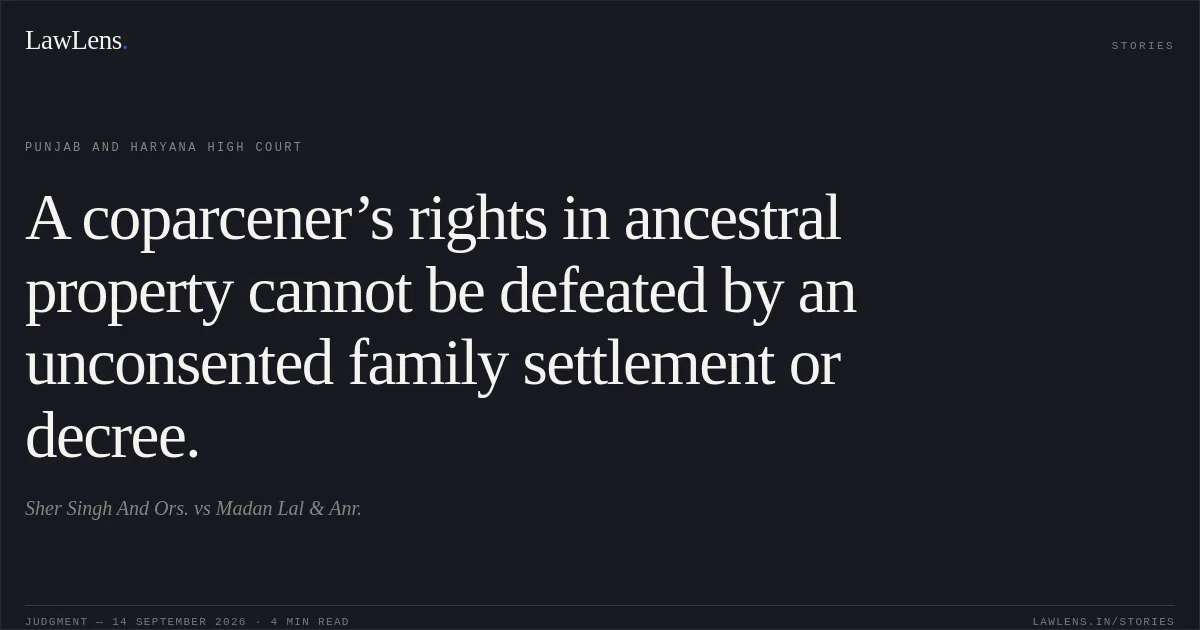
The plaintiff claimed that the suit land was joint Hindu family ancestral/coparcenary property, in which he, as the son of defendant No.1, acquired rights by birth. He challenged two decrees allegedly suffered by defendant No.1 in favour of defendant Nos.2 to 5 in Civil Suit No.388 of 1983 and Civil Suit No.660 of 1991, contending that they were collusive, unregistered, and not binding on his coparcenary rights.
Source reference: paras. 2–3The defendants pleaded that the parties, being Ahirs of Gurgaon District, were governed by agricultural custom under which the concept of joint Hindu family/coparcenary property was inapplicable. They further alleged that the plaintiff had severed his connection with the family and that a family arrangement had been entered into in favour of defendant Nos.2 to 5.
Source reference: para. 3The Trial Court held that a specified portion of the land was ancestral coparcenary property, while the remainder was defendant No.1’s self-acquired property obtained through pre-emption; it declared the impugned decrees illegal and non-operative against the plaintiff.
Source reference: paras. 5–6The First Appellate Court affirmed the decree, holding, inter alia, that the suit was within limitation and that the defendants were bound by their earlier pleadings acknowledging the joint family arrangement.
Source reference: para. 7The defendants then preferred the present regular second appeal.
Source reference: para. 1Issues
1. Whether the specified portion of the suit land was ancestral joint Hindu family/coparcenary property in which the plaintiff acquired rights by birth, while the land acquired by defendant No.1 through pre-emption remained his self-acquired property
Source reference: paras. 4, 9–122. Whether the parties were governed by agricultural custom excluding the concept of joint Hindu family and coparcenary property, and whether defendant No.1 could validly transfer the property in favour of defendant Nos.2 to 5
Source reference: paras. 3–4, 8, 123. Whether the decrees passed in Civil Suit Nos.388 of 1983 and 660 of 1991, and the consequent mutations, were illegal, void, or non-binding upon the plaintiff in the absence of his participation in the alleged family settlement
Source reference: paras. 4–6, 134. Whether the plaintiff had lost or severed his coparcenary rights by residing away from the village and working in the Indian Railways
Source reference: paras. 8, 145. Whether the suit was barred by limitation, particularly whether Article 109 rather than Article 58 of the Limitation Act applied
Source reference: para. 7Law Applied
Under Hindu law, a coparcener acquires an interest in ancestral coparcenary property by birth, and mere residence away from the family or employment outside the village does not extinguish that status; coparcenary rights continue unless terminated by a legally effective partition.
Source reference: para. 14Property inherited by defendant No.1 from his forefathers retained its ancestral character, whereas property acquired by him through pre-emption was treated as his separate/self-acquired property.
Source reference: paras. 9–11A family settlement or partition that excludes an existing coparcener cannot bind that coparcener’s rights.
Source reference: para. 13The defendants were bound by their admissions and earlier pleadings asserting the existence of a joint Hindu family and family settlement, and could not subsequently take an inconsistent plea based on custom.
Source reference: para. 12The Court also upheld the application of Article 109 of the Limitation Act to a suit concerning rights in coparcenary property, with limitation commencing from the plaintiff’s date of knowledge.
Source reference: para. 7The lower courts further held that, since the transferees had no pre-existing rights, the decrees effecting transfer of the property required registration and, being unregistered, were not operative against the plaintiff.
Source reference: para. 5Reasoning
The High Court found that the revenue records, including the Intakhab and historical Jamabandis, established that the specified parcels had devolved upon defendant No.1 from his forefathers and were therefore ancestral coparcenary property. The appellants produced no evidence showing that these parcels had been acquired through pre-emption; only the remaining parcels were shown to have been acquired by defendant No.1 through pre-emption and were consequently treated as self-acquired.
Source reference: paras. 9–12The defendants’ reliance on agricultural custom was rejected because their earlier suits and pleadings proceeded on the basis that a joint Hindu family and family settlement existed; they could not approbate and reprobate by later denying the same legal relationship.
Source reference: para. 12The alleged family settlement was also ineffective against the plaintiff because he was neither a party to it nor a participant in the decrees founded upon it. His employment and residence outside the village did not amount to relinquishment or abandonment of his coparcenary rights.
Source reference: paras. 13–14Since the impugned decrees purported to affect coparcenary property without the plaintiff’s participation, and the transfers were not legally operative against him, the findings of both courts below were neither erroneous nor perverse.
Source reference: paras. 12–14Holding
The High Court dismissed the regular second appeal, holding that the specified parcels were ancestral coparcenary property in which the plaintiff continued to possess rights by birth.
The decrees dated 22.07.1983 and 20.11.1991, passed in Civil Suit Nos.388 of 1983 and 660 of 1991 respectively, together with the consequential mutations, were held illegal, void, and non-operative against the plaintiff’s rights.
Source reference: paras. 6, 15The remaining property acquired by defendant No.1 through pre-emption was treated as his individual property.
Source reference: paras. 6, 14–15The plaintiff was consequently entitled to his share in the ancestral coparcenary property, and the findings and relief granted by the courts below were affirmed.
Source reference: paras. 6, 14–15Original Court PDF
Sher Singh And Ors.vsMadan Lal & Anr.
Click to open original judgment
Original judgment, available to read, download and summarize on LawLens.in