Facts
The petitioner was appointed as Principal and Director of Motilal Nehru School of Sports, Rai, on 19 July 2003, initially for three years, with pay fixed under Rule 7.20 of the Punjab Civil Services Rules, Volume II.
Source reference: p.2His tenure was repeatedly extended—from three years to five years, then ten years or until attaining 60 years, and thereafter by successive one-year extensions.
Source reference: pp.3–4The final extension, granted on 7 August 2014, was for two years up to 30 September 2016; however, it was cancelled with immediate effect on 9 January 2015, and the petitioner handed over charge on 12 January 2015.
Source reference: p.4The petitioner had rendered 11 years, 2 months and 27 days of continuous service, had a service book, accumulated earned leave, regular ACRs and a GPF account with deductions made until cessation of service.
Source reference: pp.4, 15–17His claim for pension, gratuity, leave encashment and other retiral benefits was rejected through non-speaking orders.
Source reference: p.5In an earlier writ petition, the High Court had directed the competent authority to pass a reasoned and speaking order, but the subsequent order dated 12 July 2019 rejected the claim primarily on the basis of the Accounts Officer’s remarks.
Source reference: pp.19–20The petitioner thereafter filed the present writ petition seeking pensionary benefits, gratuity, salary for the unexpired extension period and related reliefs.
Source reference: pp.1, 9–10Issues
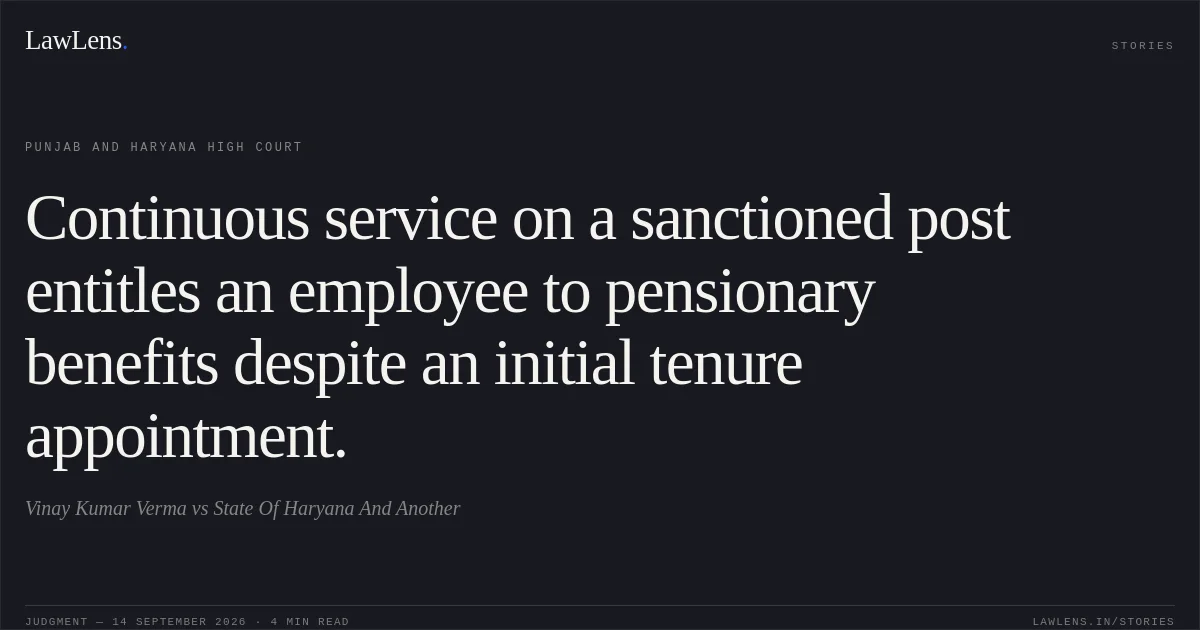
Whether the petitioner’s continuous service of 11 years, 2 months and 27 days, despite the initial tenure-based appointment and subsequent extensions, entitled him to pensionary benefits, including pension and leave encashment, under the applicable service rules.
Source reference: pp.12–19; paras. 19–27Whether the petitioner was entitled to gratuity under Section 4 of the Payment of Gratuity Act, 1972, having completed more than five years of continuous service.
Source reference: pp.20–23; paras. 30–31Whether the order dated 12 July 2019 was invalid for being non-speaking, mechanically passed and contrary to the earlier direction of the High Court requiring a reasoned decision.
Source reference: pp.19–20; paras. 28–29Whether the petitioner was entitled to salary for the period from 12 February 2015 to 30 September 2016, during which he admittedly did not work.
Source reference: pp.10–12, 23; para. 33Law Applied
The Court considered Rule 2.4(a) of the Civil Services Rules, Volume II, under which pension is ordinarily inadmissible where an employee is appointed only for a limited time or specified duty.
Source reference: pp.10–11It also applied Rules 7.19 and 7.20 of the Punjab Civil Services Rules, Volume II, which recognize the independent entitlement to civil-service pension of a person receiving military pension, while permitting adjustment of pay and allowances with reference to the military pension.
Source reference: pp.17–19; paras. 25–27Rule 2 of the Haryana Civil Services (General Provident Fund) Rules, 2016, concerning application of GPF rules to regular Government employees, was relied upon as indicative of the petitioner’s regular status.
Source reference: pp.15–17; para. 23Section 4 of the Payment of Gratuity Act, 1972 provides gratuity upon termination of employment after at least five years of continuous service, subject to the statutory conditions.
Source reference: pp.20–23; paras. 30–31The Court also applied the principles of natural justice and reasoned decision-making, as embodied in the earlier order directing a speaking decision, and the principle of “no work, no pay” to deny salary for the period during which the petitioner did not render service.
Source reference: pp.19–20, 23; paras. 28–29, 33The Court additionally relied upon Justice N.K. Sud (Retd.) v. State of Haryana, CWP-16079-2010, as cited by the petitioner in support of pensionary entitlement.
Source reference: p.9Reasoning
The Court rejected the State’s contention that Rule 2.4(a) barred pension because the petitioner had been appointed for a limited tenure.
Source reference: pp.13–17; paras. 19–24It held that the repeated extensions over more than eleven years, the extension up to the age of 60 years, appointment against a sanctioned and continuing post, regular GPF deductions, maintenance of a service book, recording of ACRs and treatment of the post as pensionable collectively demonstrated that the petitioner had been treated as a regular Government employee.
Source reference: pp.13–17; paras. 19–24The Court further held that Rules 7.19 and 7.20 treated the petitioner’s military and civil pensionary entitlements as independent; the fixation of civil pay after taking military pension into account did not extinguish his right to civil pension.
Source reference: pp.17–19; paras. 25–27The rejection order was also found legally unsustainable because it did not independently consider the petitioner’s claim or comply with the earlier direction to pass a reasoned and speaking order; instead, it relied mechanically on the Accounts Officer’s remarks.
Source reference: pp.19–20; paras. 28–29Since the petitioner had completed more than five years of continuous service, the Court held that he satisfied the statutory threshold for gratuity under Section 4 of the Payment of Gratuity Act.
Source reference: pp.20–23; paras. 30–31However, the Court distinguished the claim for future salary: as the petitioner had handed over charge on 12 January 2015 and had not worked during the claimed period, the principle of “no work, no pay” applied.
Source reference: p.23; para. 33Holding
The writ petition was partly allowed.
The Court quashed the order dated 12 July 2019 rejecting the petitioner’s pensionary claim and directed the respondents to release his pensionary benefits, including pension, leave encashment and gratuity.
Source reference: p.24; para. 34The Court held that the petitioner was entitled to gratuity on account of his continuous service exceeding five years and to civil pensionary benefits despite his prior military pension and the tenure-based description of his appointment.
Source reference: pp.18–23; paras. 27, 30–32The claim for salary from 12 February 2015 to 30 September 2016 was denied because the petitioner had not worked during that period.
Source reference: p.23; para. 33The respondents were directed to complete the necessary exercise within six months of receiving the certified copy of the judgment, failing which the petitioner would be entitled to interest at 6% per annum.
Source reference: p.24; para. 35Acts & Sections Cited
5 provisions across 3 statutes referred to in this judgment. Linked provisions open on LawLens.
PAYMENT OF GRATUITY ACT, 19723
Payment of Gratuity (Amendment) Act, 20101
Act 25 of 1984 (alias, unresolved)1
Original Court PDF
Vinay Kumar VermavsState Of Haryana And Another
Click to open original judgment
Original judgment, available to read, download and summarize on LawLens.in