Facts
The petitioners were Class-III employees of the respondent-Corporation in various posts.
Source reference: para. 2Certain categories, including those of the petitioners, had been classified as Class-III and were receiving the pay scale of Rs. 3120–5160; however, they received grade pay of Rs. 1900, while certain other Corporation employees received grade pay of Rs. 3200.
Source reference: para. 2, para. 6The petitioners sought the higher grade pay from the date of the State Government’s notification dated 27 September 2012.
Source reference: para. 4–5The Corporation opposed the claim, contending that the notification did not list the petitioners’ categories, did not automatically apply to the Corporation, and that the Corporation’s Board had extended revised grade pay only to specified categories.
Source reference: para. 4–5The petition was instituted before the Administrative Tribunal on 29 December 2016.
Source reference: para. 13, para. 23Issues
Whether the Corporation’s denial of grade pay of Rs. 3200 to the petitioners’ categories, despite their Class-III classification and the Corporation’s grant of that grade pay to certain other categories, was arbitrary and discriminatory under Article 14.
Source reference: para. 12, para. 17–18, para. 22Whether delay in bringing the claim barred relief, and, if not, from what date arrears could be granted.
Source reference: para. 13–15, para. 23Law Applied
Article 14 prohibits arbitrary and discriminatory treatment by the State and its instrumentalities.
Source reference: no citationAlthough pay fixation and post-equivalence are generally matters for the executive and expert bodies, judicial review is available where differential treatment is irrational, arbitrary, or unsupported by relevant considerations; the court may intervene where employees are unjustly treated.
Source reference: para. 17The Court also relied on Haryana State Minor Irrigation Tubewells Corporation v. G.S. Uppal, which permits review of pay decisions that are unreasonable, unjust, and prejudicial to a section of employees.
Source reference: para. 19Union of India v. D.G.O.F. Employees Association, which allows correction where entitlement is denied on irrational consideration without proper application of mind.
Source reference: para. 21Under Union of India v. Tarsem Singh, a recurring pay-related wrong may be considered despite delay, but arrears are normally restricted to three years before the filing of the claim.
Source reference: para. 14–15Reasoning
The Court found that the Corporation had classified the petitioners’ categories as Class-III and that the petitioners’ categories received the same pay scale as categories to which the Corporation had granted grade pay of Rs. 3200.
Source reference: para. 11, para. 18, para. 22The Corporation’s sole reason for withholding the benefit—that the petitioners’ categories were not listed in the State Government notification—was insufficient to justify the differential treatment, particularly when the Corporation had extended the revised grade pay to other categories and offered no cogent justification for excluding the petitioners.
Source reference: para. 18, para. 22The Court therefore treated the continuing monthly shortfall as a recurring wrong, but applied Tarsem Singh to limit arrears to three years before the petition was instituted.
Source reference: para. 13–15, para. 23Holding
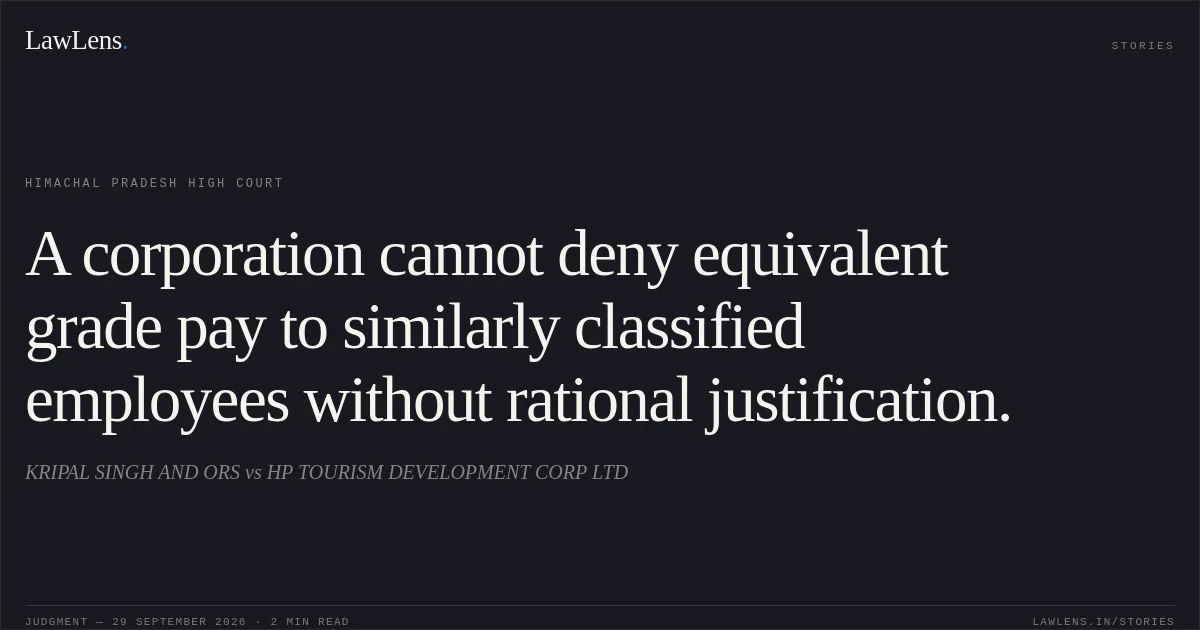
The Court allowed the petition, holding that denial of grade pay of Rs. 3200 to the petitioners’ categories was arbitrary and discriminatory.
It directed the Corporation to grant that grade pay with effect from 1 January 2014, within six months.
Source reference: para. 22–24If the arrears were not paid within that period, the Corporation was directed to pay interest at 6% per annum from 1 January 2014 until payment.
Source reference: para. 22–24No order as to costs.
Source reference: para. 22–24Original Court PDF
KRIPAL SINGH AND ORSvsHP TOURISM DEVELOPMENT CORP LTD
Click to open original judgment
Original judgment, available to read, download and summarize on LawLens.in