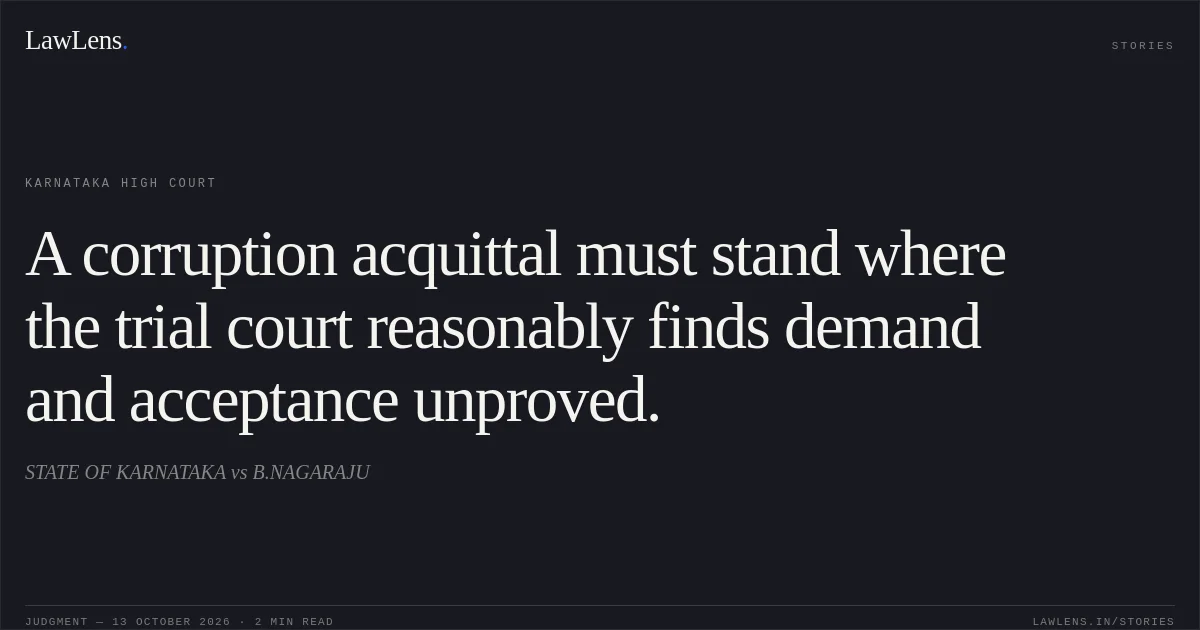
Facts
The prosecution alleged that B. Nagaraju, a Bill Collector at Amble Gram Panchayat, demanded ₹2,000 from the complainant for an assessment extract and construction licence.
Source reference: paras. 3–5, pp. 2–4During a trap on 17 July 2010, the complainant paid ₹2,000 in tainted currency and a further ₹300, which the accused accepted.
Source reference: paras. 3–5, pp. 2–4The accused maintained that the money related to property-tax receipts he had issued in advance, and that the complainant owed ₹2,306 in tax.
Source reference: paras. 7–8, pp. 6–9The Special Court acquitted him of offences under Sections 7, 13(1)(d) and 13(2) of the Prevention of Corruption Act, 1988; the State appealed under Section 378(1) and (3) CrPC.
Source reference: paras. 1, 3–5, pp. 2–4Issues
Whether the prosecution established the alleged demand and acceptance of illegal gratification, rather than payment of the outstanding tax amount.
Source reference: para. 13, pp. 16–26Whether the trial court’s acquittal disclosed a basis for appellate interference under Section 378 CrPC.
Source reference: para. 9, p. 9Law Applied
The appeal was brought under Section 378(1) and (3) of the Code of Criminal Procedure, and the alleged offences were under Sections 7, 13(1)(d) and 13(2) of the Prevention of Corruption Act, 1988.
Source reference: pp. 1–2; para. 3, p. 2Relying on *Constable 907 Surendra Singh v. State of Uttarakhand*, *Babu Sahebgouda Rudragoudar v. State of Karnataka*, *Chandrappa v. State of Karnataka* and *H.D. Sundara v. State of Karnataka*, the Court stated that an appellate court may reappraise evidence in an acquittal appeal, but should not reverse an acquittal where the trial court’s view is a reasonable possible view; interference is warranted where the acquittal is perverse or overlooks material evidence and the evidence permits no reasonable view consistent with innocence.
Source reference: para. 11, pp. 10–11The judgment also affirmed the trial court’s application of the principle that proof of recovery or a positive phenolphthalein test, without proof that the money was demanded and accepted as illegal gratification, is insufficient; the Section 20 presumption cannot arise unless the necessary foundational facts are established.
Source reference: para. 13, pp. 24–26Reasoning
The Court found no legal or factual error in the trial court’s assessment.
Source reference: para. 13, pp. 16–24The recorded conversation and evidence concerning the trap supported the defence that the amount related to tax receipts totalling ₹2,306, rather than the alleged ₹2,000 bribe; the complainant’s payment of an additional ₹300 and the discussion about a remaining ₹6 also contributed to doubt about the prosecution’s account.
Source reference: para. 13, pp. 16–24The shadow witness did not clearly hear the conversation, and the prosecution had not established the recorded voices through sample-voice comparison.
Source reference: para. 13, pp. 18–23In those circumstances, the Court held that the trial court’s conclusion that demand and acceptance of illegal gratification were not proved was a possible view, not one warranting appellate reversal.
Source reference: paras. 13–14, pp. 12–29Holding
The Court answered in the negative the question whether grounds existed to interfere with the acquittal.
It dismissed the State’s appeal, leaving the respondent’s acquittal undisturbed.
Source reference: para. 15, p. 30Acts & Sections Cited
5 provisions across 2 statutes referred to in this judgment. Each provision opens on LawLens.
Code of Criminal Procedure, 19732
Prevention of Corruption Act, 19883
Original Court PDF
STATE OF KARNATAKAvsB.NAGARAJU
Click to open original judgment
Original judgment, available to read, download and summarize on LawLens.in
![Railway pensioners qualify for additional pension only upon completing 80 years of age.. OM PRAKASH MISHRA vs NORTH EASTERN RAILWAY. CAT - ['Allahabad']. LawLens](/stories/thumbnails/railway-pensioners-qualify-for-additional-pension-only-upon-completing-80-years-of-age-e4a0c68f01cd4886b5cdc93e3a4b5e33.webp)