Facts
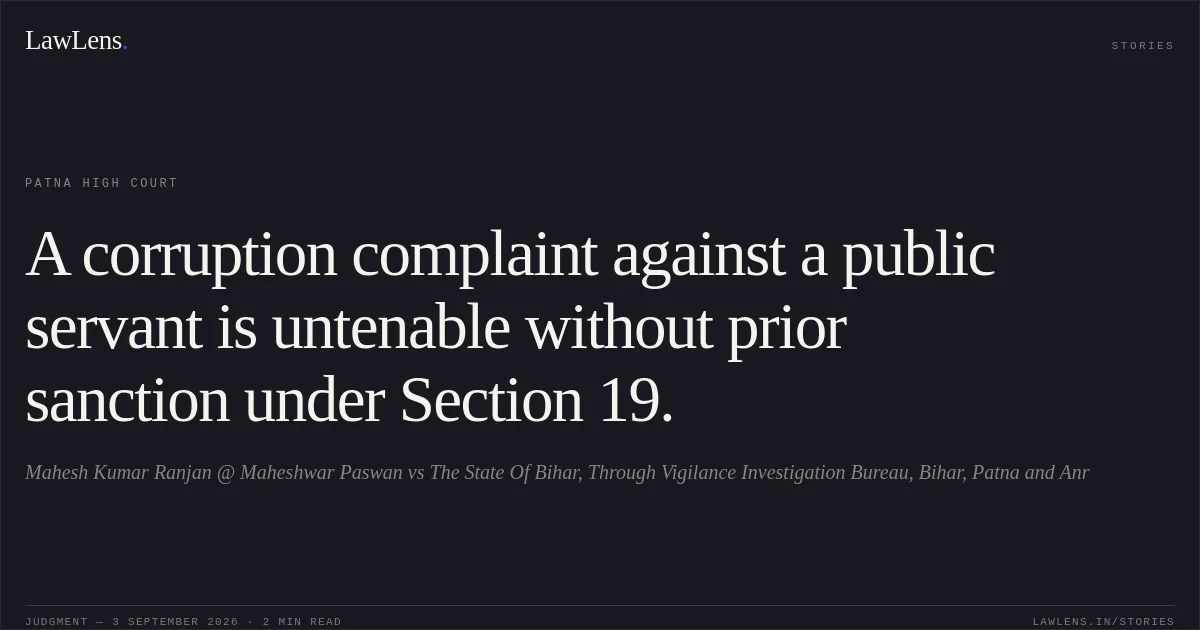
The petitioner challenged the order dated 26 March 2018 passed by the Special Vigilance Court, North Bihar, Muzaffarpur, in Complaint Case No. 89 of 2007, whereby the complaint was rejected.
Source reference: para. 2, p. 1The complaint alleged accumulation of wealth disproportionate to the known sources of income of the concerned public servant(s).
Source reference: para. 3, p. 1The petitioner contended that the Special Judge had forwarded the complaint to the Vigilance authorities for inquiry and registration of an FIR, but no FIR was registered.
Source reference: para. 4–4.1, pp. 1–2The Vigilance Department opposed the application, relying on the statutory requirement of previous sanction under Section 19 of the Prevention of Corruption Act, 1988.
Source reference: para. 5–5.2, pp. 2–4Issues
Whether the complaint could proceed, or an FIR could be directed to be registered, in the absence of the previous sanction contemplated under Section 19 of the Prevention of Corruption Act, 1988.
Source reference: paras. 4–5.1, pp. 1–3Whether the Special Vigilance Court’s order rejecting the complaint warranted interference by the High Court.
Source reference: paras. 2, 6–7, pp. 1, 4Law Applied
The Court applied Section 19(1) of the Prevention of Corruption Act, 1988, which bars a court from taking cognizance of offences punishable under Sections 7, 11, 13 and 15 of the Act, when allegedly committed by a public servant, without previous sanction from the competent authority.
Source reference: para. 5.1, p. 3The Court also considered the proviso to Section 19(1), under which, where sanction is sought by a person other than a police officer or investigating agency, the competent authority must provide the concerned public servant an opportunity of being heard before granting sanction.
Source reference: para. 5.1, p. 3Reasoning
The Court accepted the Vigilance Department’s submission that the statutory requirement of previous sanction was applicable and that the petitioner had not approached the competent authority for such sanction.
Source reference: para. 5.1, p. 3Consequently, the petitioner’s contention that an FIR had to be registered first and sanction could be obtained later was not accepted.
Source reference: para. 5.1, p. 3The Court also noted that the earlier direction concerning registration of the FIR had been withdrawn, with the order stating that the complaint was to be returned if the FIR had not already been registered.
Source reference: para. 5.2, pp. 3–4In view of the statutory bar under Section 19 and the procedural history, the High Court found no legal ground to interfere with the rejection of the complaint.
Source reference: paras. 6–7, p. 4Holding
The High Court held that the application lacked merit because of the statutory bar under Section 19 of the Prevention of Corruption Act, 1988.
The application challenging the order dated 26 March 2018 was accordingly dismissed, and the record of the court below was directed to be sent immediately.
Source reference: para. 7–8, p. 4Acts & Sections Cited
5 provisions across 1 statute referred to in this judgment. Each provision opens on LawLens.
Prevention of Corruption Act, 19885
Original Court PDF
Mahesh Kumar Ranjan @ Maheshwar PaswanvsThe State Of Bihar, Through Vigilance Investigation Bureau, Bihar, Patna and Anr
Click to open original judgment
Original judgment, available to read, download and summarize on LawLens.in