01Facts
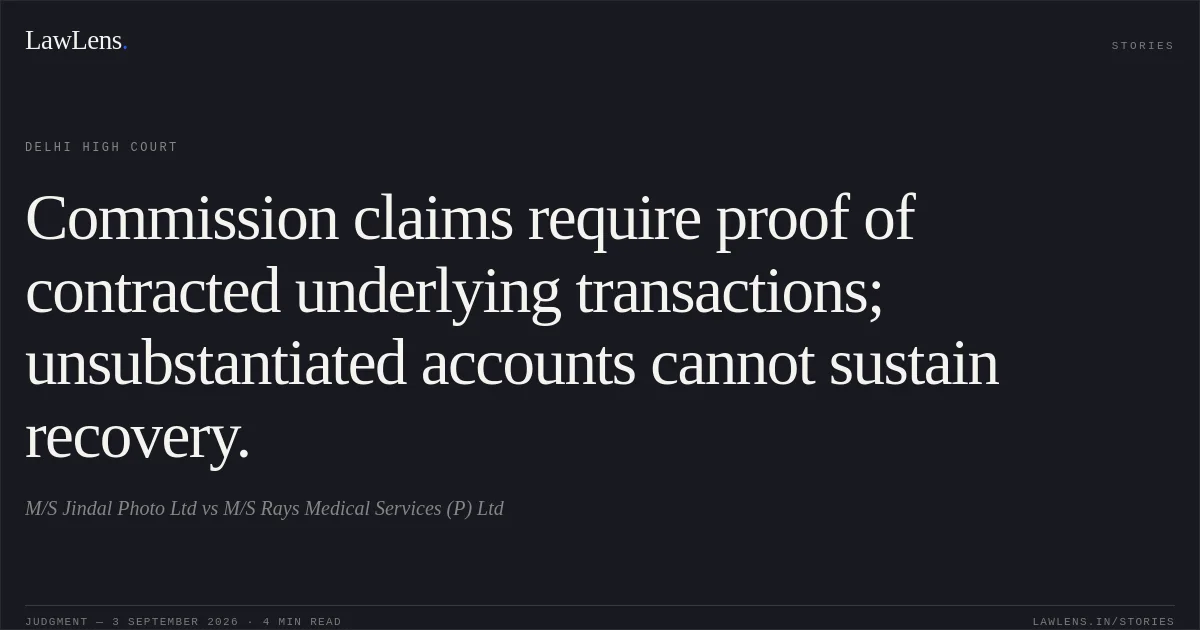
The defendant company, a manufacturer of X-ray films, appointed the plaintiff as its agent for supplying X-ray films to government departments and institutions in Delhi on a commission basis by letter dated 22 May 2003.
¶ 4–5 · p. 2The agency was withheld on 26 March 2004 and restored on 27 September 2004.
¶ 6 · p. 2The plaintiff subsequently claimed commission and refund of security deposit and instituted a recovery suit for Rs. 12,20,000, including interest.
¶ 7–8 · p. 2The defendant denied liability, alleging that the plaintiff had procured goods in the names of government departments and sold them in the open market for personal gain.
¶ 9 · p. 3The Trial Court decreed the suit for Rs. 8,40,982 with interest at 12% per annum.
¶ 13 · p. 4During final arguments, the plaintiff obtained an amendment substituting the defendant company for its former Managing Director as the defendant, subject to costs of Rs. 5,000.
¶ 12 · p. 3 · ¶ 50 · p. 18The defendant appealed under Section 96 CPC.
02Issues
i.Whether the plaintiff proved its entitlement to the claimed commission and refund amount, despite failing to properly produce and prove the relevant statements of account.
¶ 33–43 · pp. 10–15ii.Whether the plaintiff’s alleged failure to establish supply of goods to government departments constituted malpractice disentitling it from commission.
¶ 33–34, 44–47 · pp. 10, 15–18iii.Whether the amendment substituting the defendant company for its former Managing Director was valid and whether it attracted a fresh limitation period under Section 21 of the Limitation Act, 1963.
¶ 48–54 · pp. 18–20iv.Whether the plea of limitation could be raised for the first time at the appellate stage.
¶ 19, 55–56 · pp. 5, 19–2003Law Applied
The Court applied the burden-of-proof principle that a plaintiff claiming a quantified recovery must independently prove the amount due and cannot succeed merely because the defendant’s account is not proved.
¶ 35, 43 · p. 10, 15Order VII Rule 14 CPC requires a plaintiff to file with the plaint documents upon which the claim is founded or on which it relies; documents omitted at that stage require the Court’s leave before being received in evidence.
¶ 37, 41 · pp. 11, 14–15Under Subash Chander v. Bhagwan Yadav, a document may be used during cross-examination for surprise, but it cannot be improperly introduced through an unrelated witness merely to overcome the failure to file it at the proper stage.
¶ 38–39 · pp. 11–14The contractual arrangement governed commission entitlement: commission was payable in respect of business involving supplies to government departments, including a 0.5% commission to the Delhi liaisoning agent for realisation of payment.
¶ 46–47 · pp. 17–18An amendment correcting a mere misdescription of an existing party does not amount to impleadment of a new defendant for purposes of Section 21 of the Limitation Act.
¶ 52–54 · pp. 19–20Although limitation may ordinarily be a pure question of law, the Court declined to consider it for the first time in appeal where it had not been pleaded or made an issue before the Trial Court.
¶ 55–56 · p. 20Provisions in the judgment · 3 · Linked ones open on LawLens
Code of Civil Procedure, 1908 Section 96
Limitation Act, 1963 Section 21Section 1
04Reasoning
The Court held that the plaintiff failed to discharge the primary burden of proving the claimed sum.
¶ 35–39 · pp. 10–14The statement of account referred to in the plaint was not filed with the plaint or with the plaintiff’s evidence; it was instead confronted to the defendant’s witness during cross-examination, although it was an internal document of the plaintiff and was not relevant to that witness.
¶ 35–39 · pp. 10–14Its exhibition and reliance by the Trial Court were therefore erroneous.
¶ 35–39 · pp. 10–14A further, detailed statement of account was introduced only at the stage of final hearing without an application under Order VII Rule 14(3), without leave of the Court, and without giving the defendant an opportunity to respond; it was also not exhibited.
¶ 40–42 · pp. 14–15The defendant’s inability to prove its own account, showing only Rs. 1,914 as payable, did not relieve the plaintiff of its burden.
¶ 43 · p. 15Further, the plaintiff’s witness admitted that he could produce no documentary proof of government payments, delivery of the goods to government departments, or payment of commission.
¶ 44–45 · pp. 15–17Since the contractual commission was linked to supplies to government bodies and realisation of the relevant payments, these admissions undermined the plaintiff’s entitlement.
¶ 46–47 · pp. 17–18The Trial Court had therefore erred in treating restoration of the agency as condonation of the alleged conduct and as establishing a continuing entitlement to commission.
¶ 46–47 · pp. 17–18On the procedural objections, the High Court declined to interfere with the amendment order because the defendant company had not challenged it and the amendment was treated as correction of a misdescription rather than addition of a new party.
¶ 52–54 · pp. 19–20It also declined to adjudicate limitation because the plea had not been raised before the Trial Court and no issue on limitation had been framed.
¶ 55–56 · p. 2005Holding
The appeal was allowed.
¶ 57 · p. 20The High Court set aside the Trial Court’s judgment and decree for Rs. 8,40,982 with interest, holding that the plaintiff had neither proved the amount claimed nor established entitlement to commission in respect of supplies to government departments.
¶ 57 · p. 20The Registry was directed to refund the decretal amount deposited in Court, together with accrued interest, to the appellant company.
¶ 57 · p. 20Original Court PDF
M/S Jindal Photo LtdvsM/S Rays Medical Services (P) Ltd
Click to open original judgment
Original judgment, available to read, download and summarize on LawLens.in