Facts
Respondent No. 1 sued for a perpetual injunction concerning land it claimed to own and possess.
Source reference: para. 2.1–2.8The defendants filed a counter-claim seeking a declaration of ownership and consequential injunction in respect of other, adjoining properties, alleging that the plaintiff’s development activity encroached upon those lands.
Source reference: para. 2.1–2.8The trial court excluded the counter-claim under Order VIII Rule 6-C CPC, reasoning that the suit and counter-claim properties were distinct and had no nexus.
Source reference: para. 2.12–2.15The defendants challenged that order in revision.
Source reference: para. 2.15Issues
1. Whether a counter-claim may be excluded merely because it concerns property different from the suit property or arises from an independent cause of action.
Source reference: para. 15–16, 362. Whether the trial court exercised its discretion under Order VIII Rule 6-C CPC judiciously in excluding the counter-claim.
Source reference: para. 27–29, 36–40Law Applied
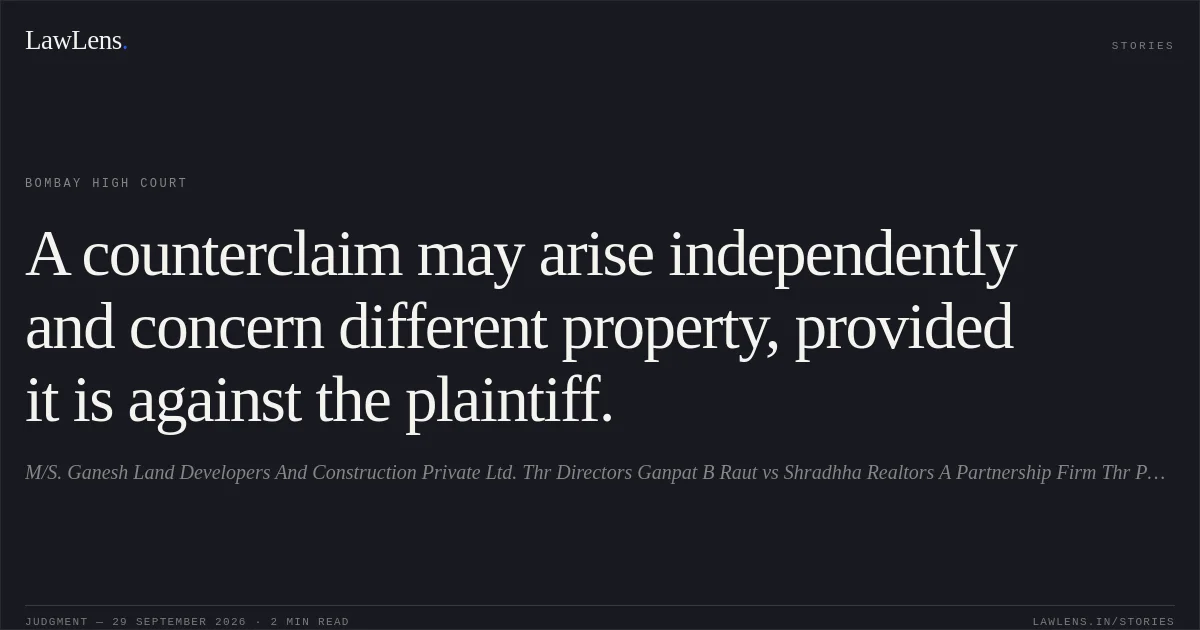
Order VIII Rule 6-A CPC permits a defendant to bring a counter-claim based on any cause of action accruing against the plaintiff within the prescribed time; the counter-claim need not arise from, or be connected with, the plaintiff’s cause of action, and need not concern the same property.
Source reference: para. 14–18A counter-claim is treated as a cross-suit, furthering the objective of avoiding multiplicity of proceedings.
Source reference: para. 14–18Under Order VIII Rule 6-C CPC, a plaintiff may seek exclusion of a counter-claim, but the court retains discretion to decide whether exclusion is appropriate; that discretion must be exercised judicially, having regard to relevant circumstances.
Source reference: para. 27–29, 35In Jag Mohan Chawla v. Dera Radha Swami Satsang, (1996) 4 SCC 699, the Supreme Court held that a counter-claim may rest on an independent cause of action and concern different property.
Source reference: para. 19–22Satyender v. Saroj, (2022) 17 SCC 154, does not displace that rule: exclusion was warranted there because the counter-claim was not against the plaintiffs and concerned property over which they had made no claim.
Source reference: para. 23–26Reasoning
The trial court applied an incorrect legal test by treating the difference between the properties, and the absence of identity between them, as sufficient grounds for exclusion.
Source reference: para. 36In any event, the pleadings showed a factual connection: the plaintiff identified the defendants’ lands as lying along the northern boundary of its property and alleged obstruction by defendants claiming adjoining land.
Source reference: para. 37–38Trying the suit and counter-claim together would permit complete adjudication of the parties’ dispute and reduce the risk of multiple proceedings and conflicting decisions.
Source reference: para. 39The trial court therefore failed to exercise its Rule 6-C discretion judicially.
Source reference: para. 40Holding
The High Court allowed the revision, quashed the order excluding the counter-claim, and restored it to the trial court’s file.
The trial court was requested to decide the suit and counter-claim expeditiously in accordance with law; the Court made clear that it had expressed no opinion on the merits.
Source reference: para. 40–41Original Court PDF
M/S. Ganesh Land Developers And Construction Private Ltd. Thr Directors Ganpat B RautvsShradhha Realtors A Partnership Firm Thr Partners Avinashkumar K Srivastav
Click to open original judgment
Original judgment, available to read, download and summarize on LawLens.in