Facts
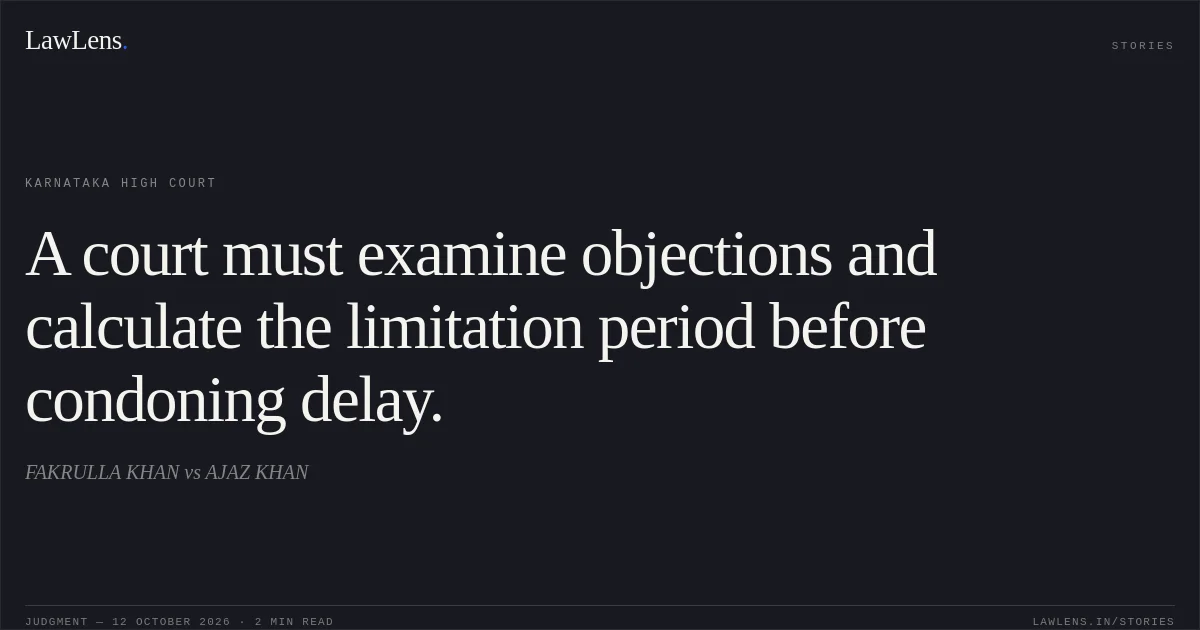
The petitioners challenged the Senior Civil Judge, Bagepalli’s order allowing the respondent’s application to condone delay in filing R.A. No. 104/2021.
Source reference: p. 2The respondent’s appeal was filed on 2 December 2021 to challenge a decree passed in 2017.
Source reference: p. 3The petitioners contended that the delay was approximately four years and seven months, rather than the 11 months and 19 days stated in the condonation application.
Source reference: p. 3The respondent referred to a Miscellaneous Petition filed in 2018 and withdrawn on 25 October 2021.
Source reference: p. 3The application referred to periods of illness and other circumstances, but stated a delay of 11 months and 19 days.
Source reference: pp. 4–5The High Court found that the order allowing condonation did not address the petitioners’ objections or explain the calculation of delay.
Source reference: pp. 5–6Issues
1. Whether the order allowing condonation could stand when it did not address the petitioners’ objection that the delay was substantially longer than the period stated in the application.
Source reference: pp. 5–62. Whether the appellate court was required to reconsider limitation, including the actual period of delay, on the parties’ pleadings.
Source reference: pp. 5–7Law Applied
Section 5 of the Limitation Act, 1963, provides for condonation of delay where sufficient cause is established.
Source reference: no citationSection 14 concerns exclusion of time in specified circumstances; the Court observed that the respondent’s application contained no averment under that provision.
Source reference: p. 5The judgment also referred to the application having been filed under Sections 5 and 13 of the Act, but cited no precedent.
Source reference: p. 5In deciding the challenge, the Court required the appellate court to examine the limitation question afresh, including the parties’ contentions and the relevant dates.
Source reference: pp. 5–7Reasoning
The application asserted a delay of 11 months and 19 days, but the petitioners disputed that calculation, pointing to the 2017 decree and the appeal filed in December 2021.
Source reference: pp. 3, 5–6Although the respondent referred to the intervening Miscellaneous Petition, the impugned order did not address the petitioners’ objections or explain how the stated delay had been calculated.
Source reference: pp. 3, 6Given the discrepancy in the asserted period of delay and the absence of reasoning on limitation, the High Court held that the order could not be sustained and remitted the issue for fresh consideration.
Source reference: pp. 6–7Holding
The petition was allowed, and the order dated 23 November 2024 allowing the respondent’s condonation application was set aside.
The appellate court was directed to reconsider limitation afresh.
Source reference: p. 7The respondent may file a fresh application setting out specific dates, and the petitioners may file objections; the appellate court must then proceed in accordance with law.
Source reference: p. 7Acts & Sections Cited
3 provisions across 1 statute referred to in this judgment. Each provision opens on LawLens.
Limitation Act, 19633
Original Court PDF
FAKRULLA KHANvsAJAZ KHAN
Click to open original judgment
Original judgment, available to read, download and summarize on LawLens.in