Facts
The original plaintiff, whose legal heirs pursued the appeal, brought a suit seeking declarations of title and consequential reliefs concerning land that included Hal Plot No. 3371/4050.
Source reference: para. 3–4After learning of a compromise decree in T.S. No. 105 of 1998, to which he was not a party, he sought to amend the plaint to plead facts concerning that decree and seek a declaration that it was null and void.
Source reference: para. 4.2, 13He stated that he obtained certified copies of the plaint and final decree on 22 June 2020.
Source reference: para. 4.2, 13The trial Court rejected the amendment application, and the High Court declined to interfere. The plaintiff’s legal heirs appealed.
Source reference: para. 5Issues
1. Whether the appellants satisfied the due-diligence requirement in the proviso to Order VI Rule 17 CPC for an amendment sought after commencement of trial.
Source reference: para. 12–132. Whether the proposed amendment fundamentally altered the nature and character of the suit or was otherwise liable to be refused at the amendment stage on limitation, maintainability, or prejudice grounds.
Source reference: para. 14–19Law Applied
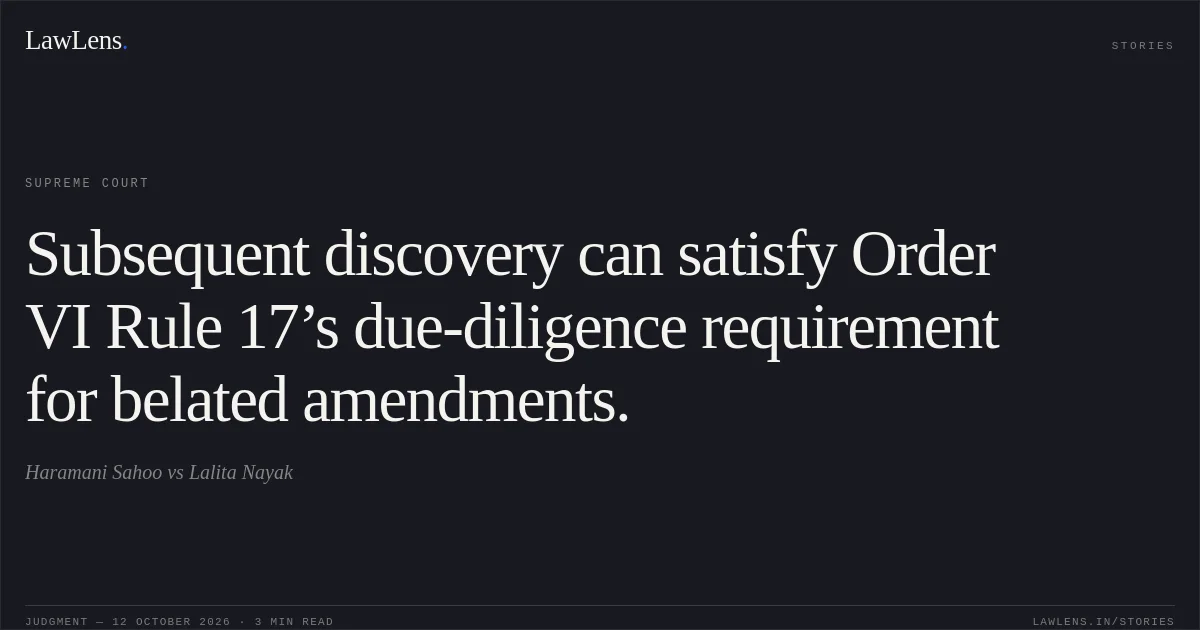
Order VI Rule 17 CPC permits amendments necessary to determine the real questions in controversy; after commencement of trial, the applicant must satisfy the court that despite due diligence the matter could not have been raised earlier.
Source reference: para. 9–10, 12Under A.K. Gupta & Sons Ltd. v. Damodar Valley Corporation, an amendment introducing a new cause of action is generally impermissible, whereas an amendment elaborating or changing the approach to the existing case may be allowed.
Source reference: para. 11The “real controversy” test, prejudice to the opposing party, and whether the amendment changes the basic nature of the suit guide the court’s discretion; a change in relief does not, by itself, alter the suit’s nature.
Source reference: para. 11.1–11.3Life Insurance Corporation of India v. Sanjeev Builders Private Limited further recognises that delay alone is not decisive, and an arguable limitation issue may be left for trial, while a clearly time-barred claim or an amendment changing the suit’s nature may warrant refusal.
Source reference: para. 11.4The Court also referred to Ragu Thilak D. John v. S. Rayappan, Sampat Kumar v. Ayyakannu and Pankaja v. Yellappa on leaving arguable limitation questions open.
Source reference: para. 16.1The Court did not determine the applicability of Order XXIII Rule 3A CPC; it left that issue open.
Source reference: para. 17Reasoning
The proposed pleading concerned a decree allegedly affecting part of the same property already in dispute, rather than an unrelated transaction.
Source reference: para. 13–13.2The asserted later discovery of the decree, the plaintiff’s non-party status, and the date on which certified copies were obtained provided, at the amendment stage, a sufficient explanation for satisfying due diligence.
Source reference: para. 13–13.2Because the amendment had a direct nexus with the existing claims to title and possession, it did not fundamentally change the suit’s nature, even though it enlarged the questions for adjudication.
Source reference: para. 14–14.1The date of knowledge and limitation were disputed matters, so the Court declined to decide them at the amendment stage; it likewise left maintainability, including the Order XXIII Rule 3A objection, for the trial Court.
Source reference: para. 15–17Any prejudice from additional pleadings could be addressed through an additional written statement and costs, while refusal risked fragmented proceedings and inconsistent findings.
Source reference: para. 19–20Holding
The Supreme Court allowed the appeal, set aside the orders of the trial Court and High Court, and allowed the amendment subject to payment of ₹25,000 in costs to the contesting respondents within two weeks.
The appellants were directed to make consequential amendments within four weeks thereafter, and the respondents could file additional written statements within the time fixed by the trial Court.
Source reference: para. 23Limitation, maintainability, Order XXIII Rule 3A, the validity and binding effect of the compromise decree, title, possession, and the merits were expressly left open for determination by the trial Court.
Source reference: para. 18, 23–24Acts & Sections Cited
1 provisions across 1 statute referred to in this judgment. Each provision opens on LawLens.
Code of Civil Procedure, 19081
Original Court PDF
Haramani SahoovsLalita Nayak
Click to open original judgment
Original judgment, available to read, download and summarize on LawLens.in