Facts
The appellant was the Chief Executive Officer and authorised signatory of Darjeeling Organic Tea Estates Private Limited (the Company). The Company and respondent No. 1, proprietor of C.R. Traders, entered into an MoU concerning the Jamguri Tea Estate. Respondent No. 1 transferred ₹40 lakh to the Company’s bank account.
Source reference: p.2–4After disputes arose over performance, the MoU was terminated. Respondent No. 1 then alleged that the appellant had dishonestly induced her to pay by falsely representing that the Tea Estate belonged to the Company, and initiated proceedings under Sections 417 and 420 of the IPC.
Source reference: p.2–4The Magistrate issued summons; the High Court dismissed the appellant’s petition under Section 482 CrPC seeking quashing. The appellant appealed to the Supreme Court.
Source reference: p.2–4Issues
1. Whether the complaint disclosed the essential ingredients of cheating under Sections 417 and 420 IPC, including dishonest intention at the inception of the transaction.
Source reference: p.4–72. Whether the criminal proceedings against the appellant should be quashed under Section 482 CrPC as an abuse of process where the dispute arose from the MoU.
Source reference: p.3–4, 6–7Law Applied
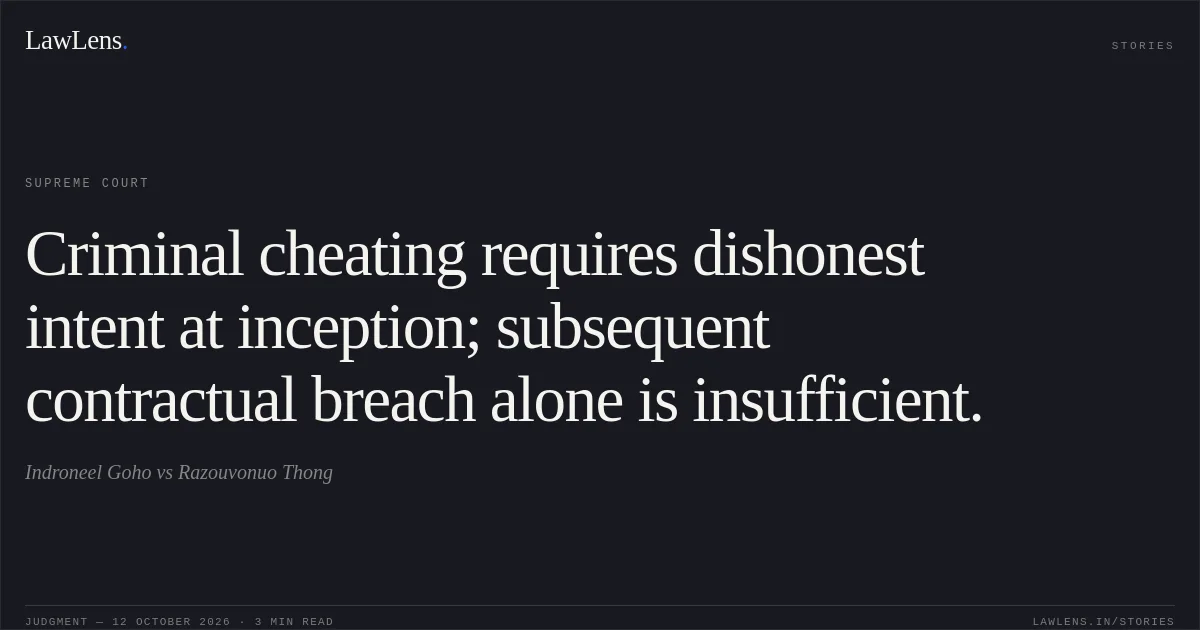
Sections 417 and 420 IPC require fraudulent or dishonest intention at the time the promise or representation is made, which must induce the complainant to part with property; subsequent non-performance of a contractual obligation, by itself, does not establish cheating.
Source reference: p.4The Court relied on G. Saminathan and Another v. State, represented by the Sub-Inspector of Police and Another, 2026 INSC 772, for this principle.
Source reference: p.5Section 482 CrPC empowers the High Court to quash proceedings where the allegations do not disclose the ingredients of the offence and their continuation would amount to abuse of process.
Source reference: p.3–4, 7An arbitration clause does not, by itself, bar criminal proceedings; the allegations must still be assessed against the elements of the alleged offence.
Source reference: p.7Reasoning
The MoU was between respondent No. 1 and the Company, and the appellant signed only as its CEO and authorised signatory. The ₹40 lakh was paid directly to the Company, with no allegation that the appellant received or appropriated any part for personal benefit.
Source reference: p.5Although the complaint alleged that the appellant knew the Tea Estate did not belong to the Company, respondent No. 1 knew before executing the MoU that the estate was mortgaged to UCO Bank; the MoU contemplated clearing the bank’s dues and encumbrances, and the Company was in possession of and operating the estate and had claims concerning it.
Source reference: p.5–6In that context, the bare assertion of knowledge did not establish dishonest intention at the outset.
Source reference: p.5–6The later disagreement over performance and termination of the MoU was contractual in character; the arbitration clause was not determinative, but neither did it supply the missing criminal ingredients.
Source reference: p.6–7Holding
The Supreme Court held that the complaint did not disclose the essential ingredients of cheating under Sections 417 and 420 IPC against the appellant, and that continuing the prosecution would give a predominantly contractual dispute the colour of a criminal case.
It allowed the appeal, set aside the High Court’s judgment, and quashed C.R. Case No. 17 of 2022 and proceedings arising from it insofar as the appellant was concerned, without precluding respondent No. 1 from pursuing civil or contractual remedies.
Source reference: p.7Acts & Sections Cited
3 provisions across 2 statutes referred to in this judgment. Each provision opens on LawLens.
Code of Criminal Procedure, 19731
Indian Penal Code, 18602
Original Court PDF
Indroneel GohovsRazouvonuo Thong
Click to open original judgment
Original judgment, available to read, download and summarize on LawLens.in