Facts
The appellants— the deceased woman’s husband and mother-in-law—were convicted by the Additional Sessions Judge, Fast Track Court, Sadar, Cooch Behar, in Sessions Case No. 82 of 2014 arising from Dinhata Police Station Case No. 314 of 2013, for offences under Sections 498A and 306 of the Indian Penal Code.
Source reference: paras. 1, 3; pp. 2–5The deceased had married within one year before the incident and sustained extensive burn injuries after pouring kerosene oil on herself and setting herself on fire. She subsequently died from those injuries.
Source reference: paras. 1, 3, 12; pp. 2–5, 8–9The prosecution relied principally on a dying declaration recorded by PW-14, Dr. Indrajit Das, in which the deceased alleged persistent physical and mental cruelty by her husband and mother-in-law, including assault, abuse, dowry-related harassment, and threats concerning remarriage.
Source reference: paras. 3, 12; pp. 2–5, 8–9The declaration stated that she had herself set fire to her body.
Source reference: para. 12; pp. 8–9The appellants challenged the conviction, contending that the dying declaration was unreliable because relatives were present when it was recorded, that no separate medical fitness certificate was issued, that its contents were not read over to the deceased, that dowry demand and abetment were not proved, and that the husband had suffered burn injuries while attempting to rescue the deceased.
Source reference: para. 4; p. 5Issues
Whether the dying declaration was reliable and could form the sole basis of conviction despite the presence of relatives, absence of a separate medical fitness certificate, and failure to certify that its contents were read over to the deceased.
Source reference: paras. 5–11, 17; pp. 6–13Whether the evidence established “cruelty” within the meaning of Section 498A IPC, even in the absence of consistent evidence of a specific dowry demand.
Source reference: paras. 18, 20–21; pp. 13–14Whether the statutory presumption under Section 113A of the Indian Evidence Act applied so as to support the charge of abetment of suicide under Section 306 IPC.
Source reference: paras. 19, 21; pp. 13–14Whether the appellants’ defence that the husband was seriously injured while attempting to save the deceased created reasonable doubt regarding the prosecution case.
Source reference: para. 22; pp. 14–15Law Applied
The Court applied Section 498A IPC, under which “cruelty” includes wilful conduct likely to drive a woman to commit suicide or cause grave injury to her physical or mental health, as well as harassment connected with an unlawful demand for property or valuable security.
Source reference: para. 18; p. 13Section 113A of the Indian Evidence Act permits the Court to presume, having regard to the circumstances, that a married woman’s suicide within seven years of marriage was abetted by her husband or his relative where cruelty is proved.
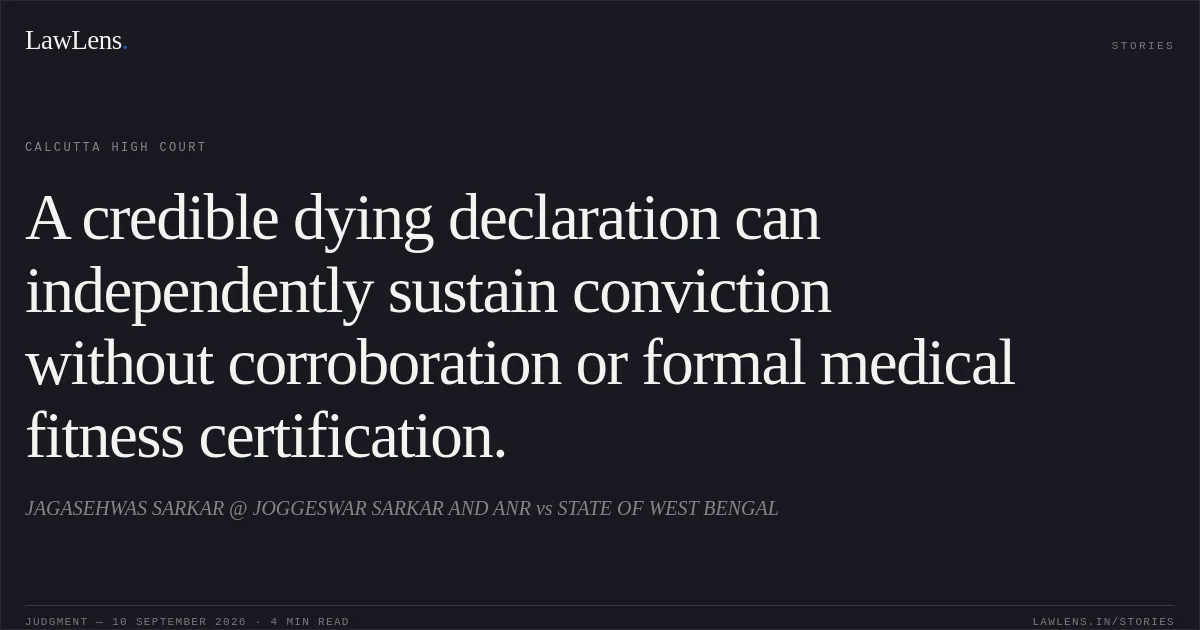
Source reference: para. 19; p. 13On dying declarations, the Court relied on Khushal Rao v. State of Bombay, Atbir v. Government of NCT of Delhi, Naeem v. State of Uttar Pradesh, and Neeraj Kumar alias Neeraj Yadav v. State of Uttar Pradesh, reiterating that a truthful, voluntary, coherent, and reliable dying declaration may by itself sustain a conviction; medical certification and corroboration are matters of prudence rather than inflexible legal requirements.
Source reference: paras. 13–16; pp. 9–12Reasoning
The Court found the dying declaration credible because it was recorded by a doctor in the presence of two staff nurses and relatives, and the defence did not put any specific suggestion to the doctor, nurses, or relative that the deceased had been tutored. The mere presence of relatives therefore did not invalidate the declaration.
Source reference: paras. 6–7; pp. 6–7Although the doctor had not issued a separate fitness certificate or certified that the statement was read over to the deceased, he recorded that she was mentally and physically alert. This was corroborated by the bed-head tickets recording that she was conscious, oriented, and alert, and by the evidence of the medical staff and relatives.
Source reference: paras. 8–11, 17; pp. 7–8, 12–13The declaration was particularly persuasive because, contrary to the FIR allegation that the appellants had set her on fire, the deceased stated that she had herself poured kerosene and set herself ablaze, indicating that the statement was not a tutored reproduction of the prosecution case.
Source reference: paras. 6, 17; pp. 6, 12–13The contents of the declaration established sustained physical and mental cruelty, including assault, humiliating abuse, threats of remarriage, disparagement based on complexion, and harassment concerning money brought from her parental home. The Court also relied on the evidence of PW-6 regarding dowry demands.
Source reference: paras. 12, 20–21; pp. 8–9, 14Since the suicide occurred within one year of marriage and cruelty was proved, the Court held that Section 113A was attracted and that the appellants had failed to rebut the resulting presumption of abetment.
Source reference: para. 21; p. 14The husband’s alleged 47-day hospitalisation was rejected for want of medical records or other reliable documentary proof.
Source reference: para. 22; pp. 14–15Holding
The Court held that the dying declaration was truthful, voluntary, medically and circumstantially supported, and sufficient by itself to sustain the conviction.
The evidence proved cruelty under Section 498A IPC, and the presumption under Section 113A of the Evidence Act supported the finding of abetment of suicide under Section 306 IPC.
Source reference: paras. 23–24; p. 15The appeal was dismissed, and the judgment and orders of conviction and sentence dated 17 and 18 May 2022 were affirmed.
Source reference: para. 24; p. 15The appellants’ bail bonds were cancelled, and they were directed to surrender before the Trial Court within 30 days to serve the remainder of their sentences; failing surrender, warrants of arrest were directed to be issued.
Source reference: paras. 24–26; p. 15Acts & Sections Cited
2 provisions across 1 statute referred to in this judgment. Each provision opens on LawLens.
Indian Penal Code, 18602
Original Court PDF
JAGASEHWAS SARKAR @ JOGGESWAR SARKAR AND ANRvsSTATE OF WEST BENGAL
Click to open original judgment
Original judgment, available to read, download and summarize on LawLens.in