Facts
On 24 September 2003, Bahadur, aged about 17 years, was allegedly attacked outside his house in village Ismaila by Mahender Singh @ Pissu, Sanjay and Sunder @ Kala. According to the prosecution, Sunder fired shots at Bahadur with a pistol, while Mahender and Sanjay assaulted him with gandasis. The occurrence was allegedly witnessed by Bahadur’s mother, Bhanmati. Bahadur was taken to PGIMS, Rohtak, where he was initially declared unfit to make a statement. Bhanmati’s statement was recorded and an FIR under Sections 307/34 IPC and Section 25 of the Arms Act was registered at 1:30 a.m. on 25 September 2003
Source reference: pp. 2–4After Bahadur was declared fit by a doctor, the investigating officer recorded his statement under Section 161 Cr.P.C. on 25 September 2003. Mahender and Sanjay were arrested on 28 September 2003, and gandasis were allegedly recovered pursuant to their disclosure statements. Bahadur died on 30 September 2003, following which the offence was converted to Section 302 IPC. Post-mortem examination revealed firearm and blunt-force injuries, including a fatal bullet injury to the cervical spinal cord
Source reference: pp. 4–6, 20–21Mahender and Sanjay were convicted under Section 302 read with Section 34 IPC and sentenced to life imprisonment by the trial Court on 21 September 2005. Sunder, who had earlier been declared a proclaimed offender and was arrested subsequently, was convicted on the same basis by judgment dated 8 February 2013 and sentenced to life imprisonment. The present appeals challenged both convictions.
Source reference: pp. 2, 7–9Issues
1. Whether the testimony of Bhanmati, the deceased’s mother and the sole eyewitness, was natural, credible and sufficient to sustain the appellants’ convictions under Sections 302/34 IPC?
Source reference: pp. 10–192. Whether the alleged inconsistencies between the ocular testimony and medical/FSL evidence, particularly regarding the use of gandasis and firearm injuries, created a reasonable doubt in favour of the appellants?
Source reference: pp. 10–12, 20–223. Whether Bahadur’s statement recorded by the police under Section 161 Cr.P.C. could be treated as a dying declaration under Section 32(1) of the Evidence Act?
Source reference: pp. 22–264. Whether the delay in forwarding the FIR to the jurisdictional Magistrate rendered the FIR suspect or established ante-timing or fabrication?
Source reference: pp. 27–315. Whether the failure to scientifically connect the firearm recovered from Sunder, or the alleged deficiencies in weapon recovery, was fatal to the prosecution case?
Source reference: pp. 31–32Law Applied
The Court applied Section 302 read with Section 34 IPC, relating to murder committed in furtherance of common intention.
Source reference: pp. 2, 32It reiterated that a conviction may rest on the testimony of a single witness if that testimony is natural, cogent, consistent and trustworthy; the law requires the quality, not the quantity, of evidence, as affirmed in Vadivelu Thevar v. State of Madras, AIR 1957 SC 614, and Shahaja alias Shahajan Ismail Mohd. Shaikh v. State of Maharashtra, 2023 (12) SCC 558.
Source reference: pp. 15–18Under Section 32(1) of the Evidence Act, a statement by a deceased person concerning the cause of death or circumstances of the transaction resulting in death is relevant; Section 162(2) Cr.P.C. preserves the admissibility of such statements recorded under Section 161 Cr.P.C. The Court relied on Dharmendra Kumar v. State of M.P., 2024 (8) SCC 60, and the principles in Laxman v. State of Maharashtra, (2002) 6 SCC 710, that a dying declaration need not invariably be recorded by a Magistrate or be supported by a doctor’s certification.
Source reference: pp. 22–24Under Section 157 Cr.P.C., prompt transmission of the FIR to the Magistrate is an important safeguard, but delay is not automatically fatal unless, cumulatively assessed with surrounding circumstances, it indicates manipulation or ante-timing; the Court relied on Pala Singh v. State of Punjab, (1972) 2 SCC 640, and Jafarudheen v. State of Kerala, 2022 (8) SCC 440.
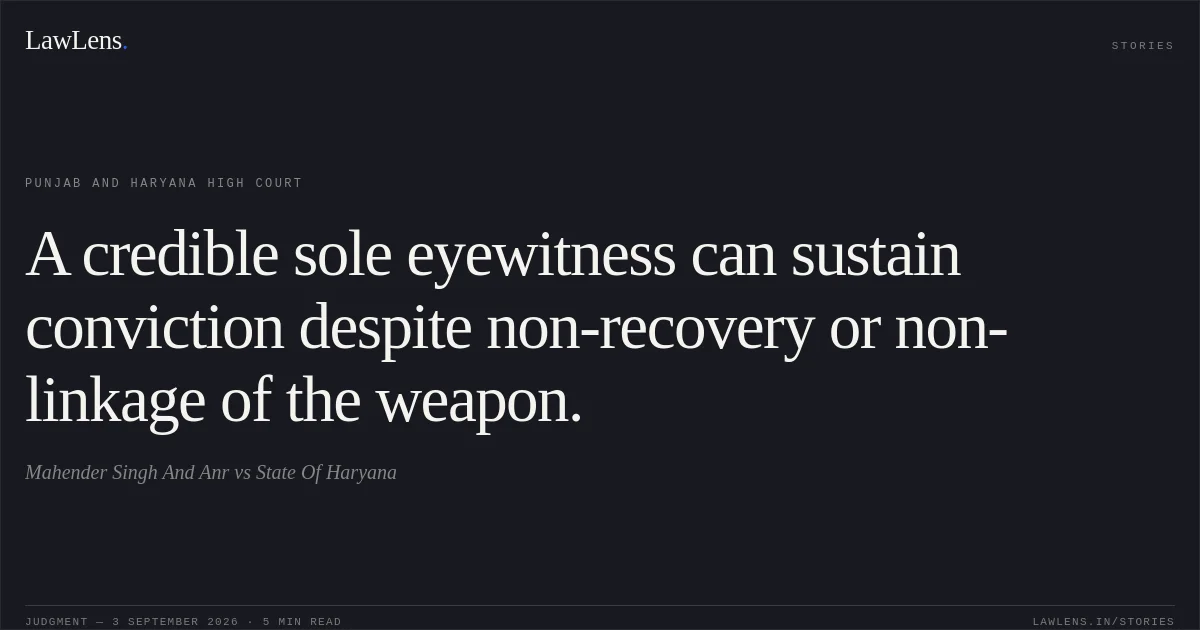
Source reference: pp. 28–30Recovery of the weapon of offence is not a sine qua non for conviction where reliable direct evidence independently establishes guilt.
Source reference: p. 32Reasoning
The Court found Bhanmati’s presence outside her own house to be natural and her account of the participation of all three appellants to be consistent and unshaken in cross-examination.
Source reference: pp. 13–19Her testimony was corroborated by the prompt medical examination, which recorded multiple firearm and blunt-force injuries consistent with the prosecution’s account, and by the post-mortem evidence confirming that a firearm injury to the cervical spinal cord caused death.
Source reference: pp. 20–21The presence of blood on the blades of the recovered gandasis did not contradict Bhanmati’s statement that the blows were delivered from the blunt side, since blood could naturally have come into contact with the blades during the assault.
Source reference: pp. 21–22Bahadur’s statement was recorded after medical opinion that he was fit to make it. Since it concerned the occurrence and the circumstances leading to his death, the Court treated it as admissible under Section 32(1) of the Evidence Act notwithstanding its recording under Section 161 Cr.P.C. and the absence of a Magistrate-recorded declaration.
Source reference: pp. 22–26The five-day interval between the statement and Bahadur’s death did not affect its admissibility because the law does not require the declarant to be under an immediate expectation of death when the statement is made.
Source reference: pp. 24–26The FIR was registered promptly after Bhanmati’s statement, and the investigating officer was not cross-examined regarding any alleged delay or ante-timing. Although the special report reached the Magistrate on 26 September 2003, the Court held that this delay, considered in the absence of other circumstances suggesting fabrication, did not discredit the prosecution case.
Source reference: pp. 27–31Finally, deficiencies in linking the firearm recovered from Sunder with the bullet found in Bahadur’s body, and the absence of conclusive weapon-recovery evidence, were held immaterial because the reliable eyewitness account independently established the appellants’ participation.
Source reference: pp. 31–32Holding
The Court answered all issues against the appellants. It held that Bhanmati’s credible and natural eyewitness testimony, supported by the medical evidence and Bahadur’s admissible statement, proved beyond reasonable doubt that Mahender Singh @ Pissu, Sanjay and Sunder @ Kala, acting in furtherance of their common intention, caused Bahadur’s death.
Both appeals were dismissed, and the convictions under Section 302 read with Section 34 IPC and sentences of life imprisonment were affirmed.
Source reference: p. 32Mahender Singh @ Pissu and Sanjay, who were on bail, were directed to be re-arrested through the concerned Chief Judicial Magistrate to undergo the remaining sentence.
Source reference: p. 33Pending miscellaneous applications, if any, were disposed of.
Source reference: p. 33Acts & Sections Cited
14 provisions across 3 statutes referred to in this judgment. Each provision opens on LawLens.
Indian Penal Code, 18605
Arms Act, 19591
Code of Criminal Procedure, 19738
Original Court PDF
Mahender Singh And AnrvsState Of Haryana
Click to open original judgment
Original judgment, available to read, download and summarize on LawLens.in