Facts
The respondent/complainant instituted a complaint under the Negotiable Instruments Act concerning a dishonoured cheque allegedly issued by the petitioner/accused.
Source reference: pp. 2–6, paras. 2–4After the complainant concluded his evidence and the petitioner’s statement under Section 313 Cr.P.C. was recorded, the matter was fixed for defence evidence.
Source reference: pp. 2–6, paras. 2–4The petitioner remained absent on several consecutive dates, resulting in the issuance of non-bailable warrants on more than one occasion.
Source reference: pp. 2–6, paras. 2–4On 18.03.2025, the defence evidence was closed after the petitioner’s counsel made a submission to that effect.
Source reference: pp. 2–6, paras. 2–4The petitioner subsequently engaged new counsel and sought recall of the closure order, stating that the earlier counsel had acted without instructions and that he should be permitted to examine himself as a defence witness.
Source reference: pp. 2–6, paras. 2–4The Magistrate rejected the application on 23.03.2026, finding that the petitioner had deliberately delayed the proceedings and had been given sufficient opportunities.
Source reference: pp. 2–6, paras. 2–4The petitioner challenged that order in revision before the Gauhati High Court.
Source reference: p. 2, para. 2Issues
1. Whether the learned Magistrate was justified in refusing to permit the petitioner to adduce defence evidence after the defence evidence had been closed due to his repeated absence.
Source reference: pp. 6, 13–15, paras. 5–152. Whether the criminal court could grant such relief under Section 311 Cr.P.C., notwithstanding the objection that recalling the closure order would amount to an impermissible review of its earlier order.
Source reference: pp. 6–7, 13–15, paras. 7, 13–143. Whether, in the interests of a fair trial, the petitioner should be granted one final opportunity to present his defence subject to conditions.
Source reference: pp. 13–16, paras. 10–17Law Applied
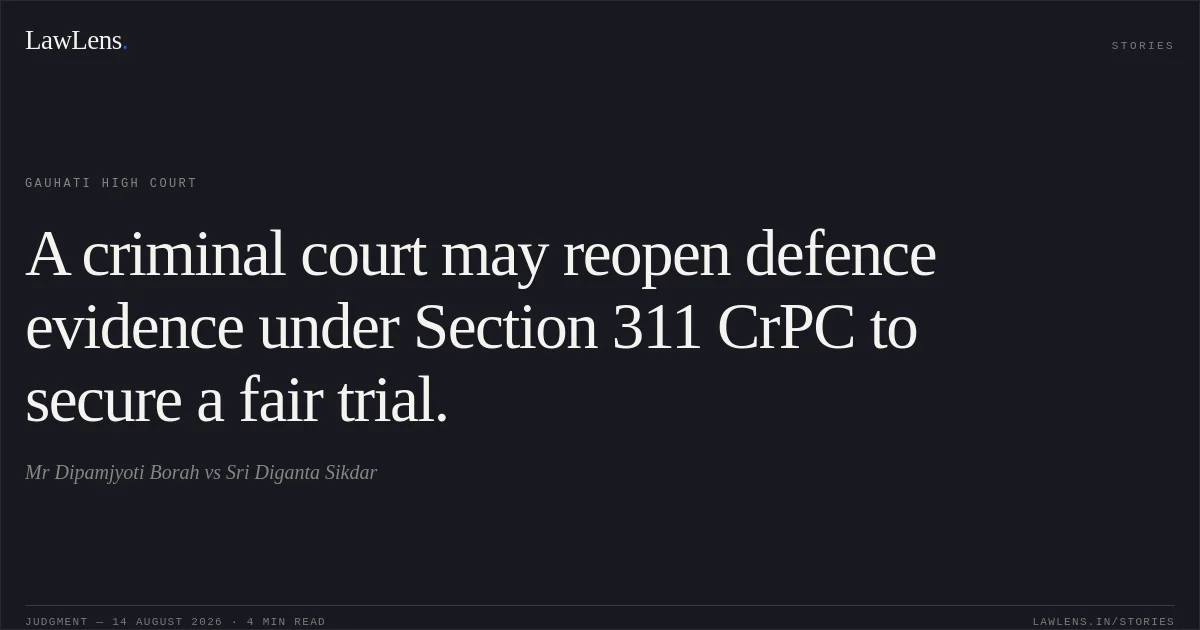
Section 311 Cr.P.C. confers a wide power on the criminal court, at any stage of an inquiry or trial, to summon, examine, recall or re-examine a person where the evidence appears essential to the just decision of the case.
Source reference: pp. 7–13, para. 9This power must be exercised judicially, with care and caution, and primarily to discover the truth and ensure a just decision.
Source reference: pp. 7–13, para. 9The Supreme Court’s decisions in Rajaram Prasad Yadav v. State of Bihar, (2013) 14 SCC 461, Jamatraj Kewalji Govani v. State of Maharashtra, AIR 1968 SC 178, Mohanlal Shamji Soni v. Union of India, 1991 Supp (1) SCC 271, Raj Deo Sharma (II) v. State of Bihar, (1999) 7 SCC 604, U.T. of Dadra and Nagar Haveli v. Fatehsinh Mohansinh Chauhan, (2006) 7 SCC 529, Iddar v. Aabida, AIR 2007 SC 3029, and P. Sanjeeva Rao v. State of A.P., AIR 2012 SC 2242, establish that Section 311 remains available even after closure of evidence and that a fair opportunity to defend is a central requirement of a criminal trial.
Source reference: pp. 7–13, para. 9The court also relied on the principle that, in a prosecution under the Negotiable Instruments Act, defence evidence may be particularly significant because the complainant’s case is supported by statutory presumptions.
Source reference: p. 14, para. 10Reasoning
The High Court acknowledged that the petitioner had been seriously negligent: he had repeatedly remained absent, appeared only after issuance of non-bailable warrants, and contributed substantially to the delay in the trial.
Source reference: pp. 13–14, para. 11Nevertheless, the court held that completely denying the petitioner an opportunity to adduce defence evidence would effectively result in a “walkover” for the complainant and would undermine the fairness of the trial, particularly in a cheque dishonour case involving statutory presumptions.
Source reference: p. 14, para. 11The court further observed that, if the earlier counsel had no instructions, the proper course was to withdraw rather than seek closure of the petitioner’s defence evidence on an issue of such grave consequence.
Source reference: pp. 14–15, para. 12Although the application before the Magistrate was not expressly framed under Section 311 Cr.P.C., the absence of a specific statutory reference could not defeat relief where the court possessed the substantive power to summon or examine essential defence witnesses.
Source reference: p. 15, para. 13Exercising Section 311 was not a review of the earlier order but an independent statutory power directed toward a just decision.
Source reference: p. 15, paras. 13–14Balancing the petitioner’s right to a fair trial against the complainant’s prejudice caused by delay, the court granted one final, strictly time-bound opportunity subject to costs.
Source reference: p. 16, paras. 15–17Holding
The revision was allowed.
The Gauhati High Court set aside the Magistrate’s order dated 23.03.2026 and directed that the petitioner’s defence evidence be recorded, subject to payment of ₹10,000 as costs to the complainant before such evidence was recorded.
Source reference: p. 16, para. 15Both parties were directed to appear before the trial court within seven days, and the defence evidence was to be completed within fourteen days from their appearance.
Source reference: p. 16, para. 16No further opportunity was to be granted to the petitioner beyond that period; any adjournment sought by the complainant was to be considered on its merits.
Source reference: p. 17, para. 17The revision was accordingly disposed of.
Source reference: p. 17, para. 18Acts & Sections Cited
2 provisions across 1 statute referred to in this judgment. Each provision opens on LawLens.
Code of Criminal Procedure, 19732
Original Court PDF
Mr Dipamjyoti BorahvsSri Diganta Sikdar
Click to open original judgment
Original judgment, available to read, download and summarize on LawLens.in