Facts
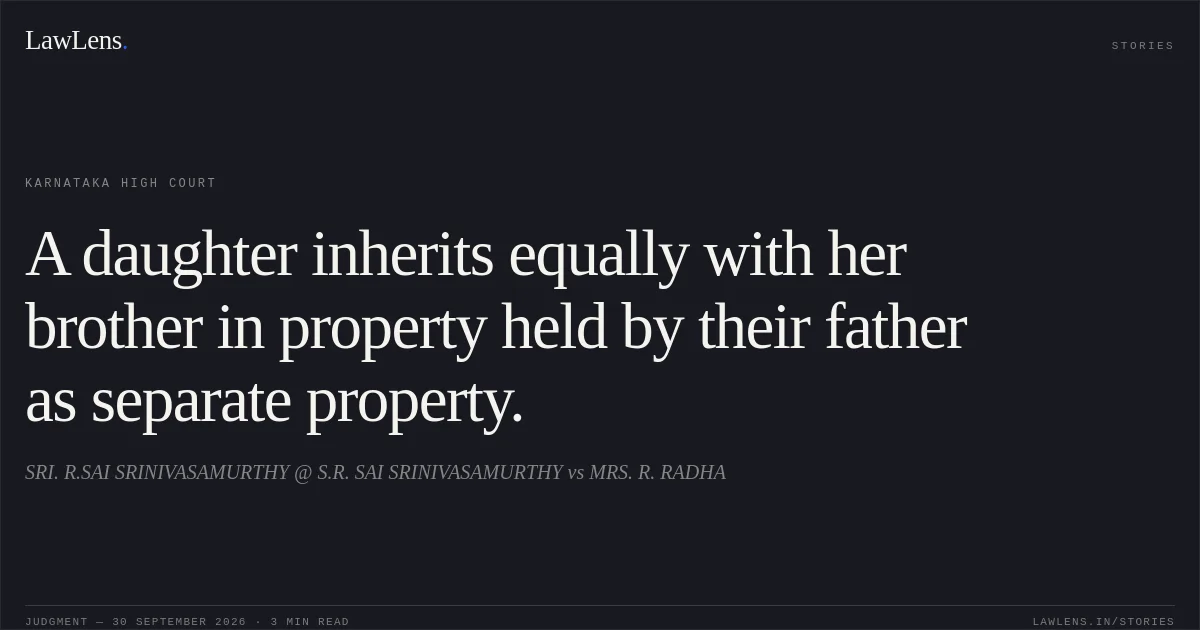
The plaintiff, R. Radha, sued her brother and purchasers of two properties for partition and separate possession, claiming that she and her brother inherited equal shares from their father, who had received the properties under their great-grandfather’s registered settlement deed dated 28 June 1939.
Source reference: paras. 4–7The brother had sold Item No. 1 to defendant No. 2; he and his children had sold Item No. 2 to defendant No. 3.
Source reference: paras. 4–7The trial court awarded the plaintiff half of Item No. 2, but only one-quarter of Item No. 1, treating the latter as ancestral property; it awarded defendant No. 2 the remaining three-quarters of Item No. 1.
Source reference: paras. 10–11The plaintiff, defendant No. 2, and defendant No. 3 each appealed. Defendant No. 3 had previously appealed the decree concerning Item No. 2, unsuccessfully.
Source reference: paras. 19–23Issues
1. Whether defendant No. 3’s appeal was maintainable and survived for consideration, given the prior dismissal of his appeal concerning Item No. 2.
Source reference: para. 18(i)2. Whether Item No. 1 was ancestral property or the father’s separate property, and whether the trial court correctly determined the parties’ shares.
Source reference: para. 18(ii)3. Whether the plaintiff had amended and valued the plaint as required under Section 35(1) of the Karnataka Court Fees and Suits Valuation Act.
Source reference: para. 18(iii)4. Whether the plaintiff was required to seek a declaration that the sales made by her brother were not binding on her.
Source reference: para. 18(iv)5. Whether the partition suit was barred by limitation.
Source reference: para. 18(v)Law Applied
Section 35 of the Karnataka Court Fees and Suits Valuation Act governs court fees in partition suits: the applicable provision depends on the plaint’s averments, and a suit pleaded as one involving joint possession cannot be reclassified under Section 35(1) based on evidence unless the plaint is amended; if joint possession is not established, the plaintiff risks refusal of relief (*B.S. Malleshappa v. Koratagigere B. Shivalingappa*).
Source reference: paras. 35–36A plaintiff who amends the plaint to seek possession and pays the requisite fee may proceed under Section 35(1).
Source reference: paras. 37–38A non-executant seeking a deed’s annulment ordinarily seeks a declaration rather than cancellation (*Suhrid Singh alias Sardool Singh v. Randhir Singh*); however, a non-alienating family member’s pre-existing share is not lost merely because the member does not seek a formal declaration that an alienation is not binding (*Munithayamma v. Byanna*; *Ahalya H. Shetty v. Vathsala S. Shetty*).
Source reference: paras. 39, 41–43No limitation period is prescribed for a co-sharer’s partition suit, subject to a possible defence of adverse possession (*Vidya Devi alias Vidya Vati v. Prem Prakash*).
Source reference: paras. 45–46A property received by a person under a disposition or partition is held as that person’s separate property for the purposes relevant here.
Source reference: paras. 30–33Reasoning
The court held that defendant No. 3’s appeal could not reopen the decree concerning Item No. 2, because his earlier appeal against the decree awarding the plaintiff a half share had been dismissed and that decree had become final.
Source reference: paras. 19–23As to Item No. 1, the great-grandfather’s properties were found to be his self-acquired properties, and the registered settlement in favour of the plaintiff’s father did not make them ancestral in the father’s hands; accordingly, the plaintiff and her brother each held a half share.
Source reference: paras. 27–34The plaintiff had amended the plaint to provide for possession and filed a valuation memo paying court fee under Section 35(1), so the challenge to valuation failed.
Source reference: paras. 37–38The plaintiff had pleaded that the sales were without her consent and not binding on her; given her independent share, a formal declaration was not essential to maintain the partition suit.
Source reference: para. 43The suit sought partition, for which no limitation period was prescribed, and the court found no basis to treat it as time-barred merely because the sale of Item No. 1 occurred in 1998.
Source reference: paras. 45–46Holding
The court dismissed defendant No. 2’s appeal and defendant No. 3’s appeal, and allowed the plaintiff’s appeal.
It modified the decree to award the plaintiff and defendant No. 2 half shares each in Item No. 1, with separate possession; it maintained the plaintiff’s and defendant No. 3’s respective half shares in Item No. 2, consistent with the decree affirmed in the earlier appeal.
Source reference: para. 48Acts & Sections Cited
7 provisions across 5 statutes referred to in this judgment. Each provision opens on LawLens.
Code of Civil Procedure, 19081
KARNATAKA COURT-FEE AND SUITS VALUATION ACT, 1958.3
Limitation Act, 19631
Indian Stamp Act, 18991
Specific Relief Act, 19631
Original Court PDF
SRI. R.SAI SRINIVASAMURTHY @ S.R. SAI SRINIVASAMURTHYvsMRS. R. RADHA
Click to open original judgment
Original judgment, available to read, download and summarize on LawLens.in
![Similarly situated casual labourers must be considered for regularisation on parity with beneficiaries.. INDRAJEET SINGH vs M/o Finance. CAT - ['Delhi']. LawLens](/stories/thumbnails/similarly-situated-casual-labourers-must-be-considered-for-regularisation-on-parity-with-b-bcfe1ffb4e9344278d0f2bd89d85f372.webp)
![Repeated representations cannot revive limitation for concluded promotion orders.. Dr Sunil R Vaidya vs HEALTH RESEARCH. CAT - ['Delhi']. LawLens](/stories/thumbnails/repeated-representations-cannot-revive-limitation-for-concluded-promotion-orders-f58d520a3163410490a0146c3b4dc38b.webp)
![Railways must freshly consider compassionate appointees’ OPS claims under subsequent pension instructions.. Radhey Shyam Pal vs NORTHERN RAILWAY. CAT - ['Delhi']. LawLens](/stories/thumbnails/railways-must-freshly-consider-compassionate-appointees-ops-claims-under-subsequent-pensio-569f43cf483a4104888f071e77fdc30e.webp)