Facts
The original plaintiff, Dulara Bai, and appellant Dular were sister and brother. Their father, Nanku Sahu, had held the suit land in his name and died on 15 September 1980.
Source reference: para. 2Dulara Bai sued for declaration, partition and separate possession, claiming a share in the property; Dular resisted, asserting that she had relinquished her rights after receiving ornaments and that he had acquired title by adverse possession.
Source reference: paras. 2–6The trial court rejected those defences and decreed her claim to one-half of the suit land; the first appellate court affirmed. Dular and another appealed under Section 100 of the Code of Civil Procedure, 1908 (CPC).
Source reference: paras. 2–6The judgment records the father’s death as 15 September 1980, although the substantial questions as framed refer to 15 January 1980.
Source reference: paras. 2, 7Issues
Whether the courts below erred in applying amended Section 6 of the Hindu Succession Act, 1956, when succession had opened on the father’s death before the 2005 amendment.
Source reference: para. 7Whether the courts below erred by not applying Section 6 as it stood before the 2005 amendment, in determining the plaintiff’s claim to a share.
Source reference: para. 7Law Applied
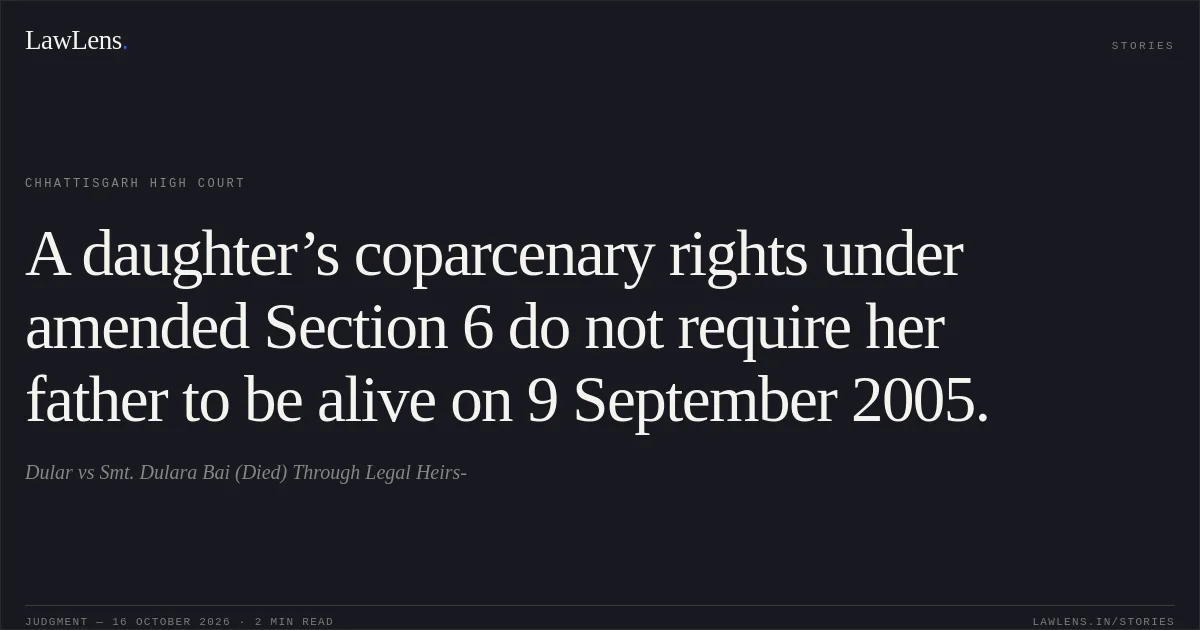
The substituted Section 6 of the Hindu Succession Act, 1956, confers coparcenary status on a daughter by birth in the same manner as a son, irrespective of whether she was born before or after the amendment; the father need not have been alive on 9 September 2005 for the daughter to claim that status.
Source reference: paras. 14–15Under Section 6(5), a partition said to have occurred before 20 December 2004 must meet the statutory requirements; an asserted oral partition ordinarily requires cogent and convincing evidence.
Source reference: paras. 14–15In a second appeal under Section 100 CPC, concurrent findings of fact are not disturbed merely because another view of the evidence is possible; interference requires a substantial question of law.
Source reference: para. 16A co-owner’s possession is ordinarily treated as possession on behalf of all co-owners unless clear and unequivocal ouster is established; adverse possession must be proved by the party asserting it.
Source reference: para. 12Reasoning
The appellants’ contention that the father’s death before the 2005 amendment necessarily defeated the daughter’s claim was inconsistent with Vineeta Sharma, which makes the father’s survival until the amendment unnecessary for the daughter to claim coparcenary status.
Source reference: paras. 13–15The courts below had also rejected the alleged relinquishment and adverse-possession defences, and the High Court found no basis under Section 100 CPC to disturb those concurrent factual findings.
Source reference: paras. 12, 16The Court therefore declined to accept the appellants’ legal challenge.
Source reference: para. 15Holding
The High Court answered both substantial questions of law in the negative and dismissed the second appeal.
It affirmed the judgments and decrees granting the plaintiff partition and separate possession of one-half of the suit land; no order as to costs was made.
Source reference: para. 17Acts & Sections Cited
3 provisions across 2 statutes referred to in this judgment. Each provision opens on LawLens.
Code of Civil Procedure, 19082
Hindu Succession Act, 19561
Original Court PDF
DularvsSmt. Dulara Bai (Died) Through Legal Heirs-
Click to open original judgment
Original judgment, available to read, download and summarize on LawLens.in