Facts
The petitioner society’s representative lodged a complaint at Halasuru Police Station on 6 September 2012, alleging offences under Sections 417, 466, 468, 469, 471, 474 and 120B IPC.
Source reference: p.3, para. 3.1–3.2After investigation, the police filed a charge sheet only under Sections 469 and 120B read with Section 34 IPC.
Source reference: p.3, para. 3.1–3.2The petitioner challenged the omission of the other alleged offences and sought to set aside the Magistrate’s order dated 7 June 2024 and have its application under Section 190 read with Section 173(8) CrPC allowed.
Source reference: pp. 3–4, paras. 2–4The petitioner also relied on its protest petition, which the Magistrate had dismissed as not maintainable for want of locus.
Source reference: p.4, para. 5Issues
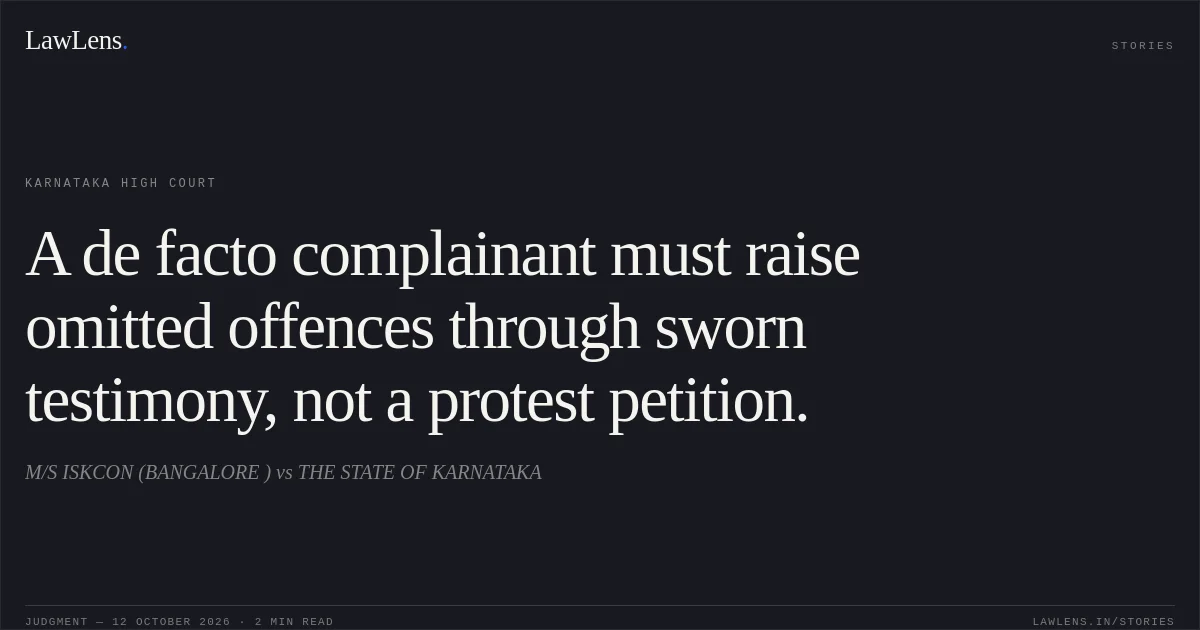
Whether the de facto complainant could pursue a protest petition to challenge the police’s allegedly inadequate charge sheet.
Source reference: pp. 4–5, paras. 5–6, 9–10Whether the petitioner had other remedies before the trial court concerning omitted offences, evidence, witnesses or accused persons.
Source reference: pp. 5–6, paras. 11–14Law Applied
The Court considered Articles 226 and 227 of the Constitution and Section 482 CrPC in addressing the challenge to the Magistrate’s order, and referred to Sections 190 and 173(8) CrPC as the provisions invoked in the petitioner’s application.
Source reference: p.3, para. 2It held that a protest petition challenging an allegedly improper charge sheet could not be entertained in the circumstances.
Source reference: p.5, para. 10The Court stated that the de facto complainant could depose before the trial court on oath regarding the ingredients of omitted offences; the prosecution could then seek additional charges under Section 216 CrPC. It also identified Section 91 CrPC as a route, through the prosecution, to request production of relevant articles or things; the complainant could identify witnesses for possible examination; and Section 319 CrPC could be invoked if evidence disclosed the involvement of an unarraigned person.
Source reference: pp. 5–6, paras. 11–14Reasoning
The Court treated the petitioner’s grievance as one concerning the sufficiency of the charge sheet and the available means of raising omitted offences before the trial court.
Source reference: pp. 5–6, paras. 10–14It upheld the view that the protest petition could not be entertained, but concluded that dismissal did not foreclose the petitioner from bringing relevant matters to the trial court’s attention through the procedures it identified: sworn deposition, requests concerning additional charges, evidence or witnesses, and proceedings against any further accused disclosed by the material.
Source reference: pp. 5–6, paras. 10–14Holding
The Court dismissed the writ petition and did not grant the requested relief of setting aside the Magistrate’s order or allowing the petitioner’s application.
It reserved the petitioner’s liberty to pursue the remedies described before the trial court.
Source reference: pp. 5–7, paras. 11–15Acts & Sections Cited
8 provisions across 2 statutes referred to in this judgment. Each provision opens on LawLens.
Code of Criminal Procedure, 19736
Indian Penal Code, 18602
Original Court PDF
M/S ISKCON (BANGALORE )vsTHE STATE OF KARNATAKA
Click to open original judgment
Original judgment, available to read, download and summarize on LawLens.in