Facts
The petitioner, a Grade II Police Constable, was on deputation with the Railway Police, Villupuram.
Source reference: p. 2Following a custodial death on 7 May 2014, he was suspended.
Source reference: pp. 2–3In the CBCID investigation, he was cited as a witness, not an accused.
Source reference: pp. 2–3, 6–7A CBCID communication dated 15 June 2016 stated that he had no direct or indirect role in the case; his suspension was later revoked, and the suspension period was treated as duty for pay purposes.
Source reference: pp. 2–3, 6–7On 28 May 2024, approximately ten years after the incident, the respondent issued the challenged charge memorandum.
Source reference: pp. 2, 4–5The petitioner sought its quashing, relying on delay and the respondent’s earlier assessment that he had no involvement.
Source reference: pp. 2, 4–5Issues
Whether the charge memorandum could be quashed on account of the delay in initiating disciplinary proceedings, in the circumstances of this case.
Source reference: pp. 4–5, 8–9Whether the charge memorandum could stand when the respondent had earlier concluded that the petitioner had no direct or indirect role in the incident.
Source reference: pp. 6–8Law Applied
Under Article 226 of the Constitution, the High Court may review disciplinary proceedings; delay alone does not automatically warrant their quashing, and each case must be assessed on its facts.
Source reference: pp. 6–7In Government of A.P. v. V. Appala Swamy, (2007) 14 SCC 49, the Supreme Court identified, among relevant considerations, whether the employer had condoned the alleged lapse and whether the delay prejudiced the employee.
Source reference: pp. 6–7The Court also relied on State of M.P. v. Bani Singh, 1990 Supp SCC 738, and P.V. Mahadevan v. MD, Tamil Nadu Housing Board, (2005) 6 SCC 636, concerning unexplained delay; M.V. Bijlani v. Union of India, (2006) 5 SCC 88, concerning prejudice; UCO Bank v. Rajendra Shankar Shukla, (2018) 14 SCC 92, concerning unreasonable delay in deciding to initiate proceedings; and The Secretary to Government v. N. Ponniah, 2007 Writ L.R. 903, concerning the consequences of inaction by the disciplinary authority.
Source reference: pp. 3, 5Reasoning
The Court accepted that delay by itself is not decisive, but found that the respondent had offered no adequate explanation for the delay, beyond describing it as insubstantial or incidental.
Source reference: pp. 4–5More significantly, the record showed that the respondent had previously acted on the CBCID’s assessment that the petitioner had no direct or indirect role, revoked his suspension, and treated the suspension period as duty.
Source reference: pp. 6–7The petitioner was also a witness, not an accused, in the criminal case.
Source reference: p. 7In these circumstances, permitting a charge memorandum issued a decade after the incident to proceed, based on a later contrary view, would be inconsistent with the respondent’s earlier position and would reward departmental inaction.
Source reference: pp. 7–8Holding
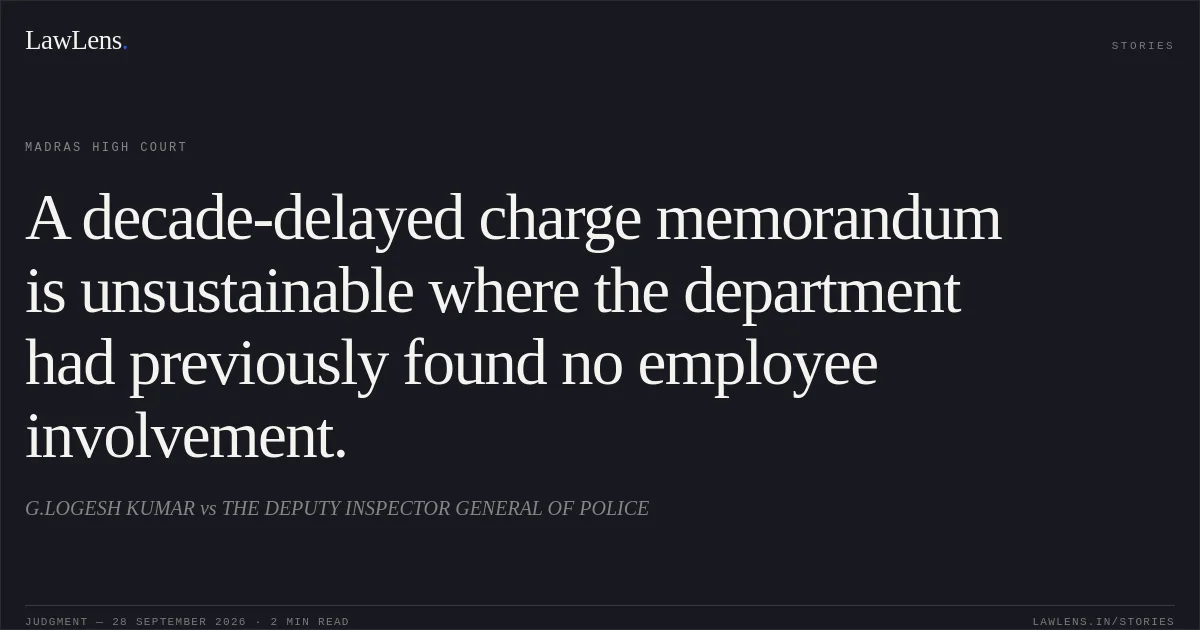
The High Court held that the unexplained delay, together with the respondent’s earlier conclusion that the petitioner had no involvement, provided sufficient grounds to interfere with the charge memorandum.
It quashed the impugned order dated 28 May 2024, allowed the writ petition, closed the connected miscellaneous petitions, and made no order as to costs.
Source reference: p. 9Acts & Sections Cited
1 provisions across 1 statute referred to in this judgment. Linked provisions open on LawLens.
the Act (alias, unresolved)1
Original Court PDF
G.LOGESH KUMARvsTHE DEPUTY INSPECTOR GENERAL OF POLICE
Click to open original judgment
Original judgment, available to read, download and summarize on LawLens.in