Facts
The petitioner, a registered transport employees’ union, sought implementation of Clause 32 of the 12(3) Settlement dated 6 February 2008, alleging that drivers’ and conductors’ duties were not allotted rotationally and that Routes 40C, 41B and 44B had been excluded to favour certain union representatives.
Source reference: p. 3, paras. 1–3; p. 11, para. 10The Transport Corporation produced a draft rotational schedule, stating that it had been submitted to the first respondent for approval.
Source reference: p. 3, para. 4; p. 11, para. 10The Court referred to earlier directions concerning rotational duty postings and, during these proceedings, suo motu impleaded the Secretary to Government, Transport Department.
Source reference: pp. 9–11, paras. 9–11Issues
1. Whether the Transport Corporation was required to allot drivers’ and conductors’ duties on a rotational basis under Clause 32 of the 12(3) Settlement dated 6 February 2008
Source reference: pp. 3–4, paras. 3, 6–72. Whether the State Government should be directed to ensure compliance with the Settlement and prevent favouritism in duty allotments
Source reference: pp. 10–12, paras. 9–11Law Applied
Clause 32 of the 12(3) Settlement dated 6 February 2008, made under Section 12(3) of the Industrial Disputes Act, 1947, was treated by the Court as requiring rotational duty postings for drivers and conductors.
Source reference: pp. 4, 9, paras. 6–7The Court referred to Sections 29 and 34 of the Industrial Disputes Act: breach of a binding settlement may attract the penalty under Section 29, and prosecution for that offence requires a complaint in accordance with Section 34.
Source reference: p. 9, para. 8; pp. 9–10, para. 9It also referred to Clause 13 of the Second Schedule and Section 86 of the Industrial Relations Code, 2020, concerning unfair labour practices and their penalty.
Source reference: p. 10, para. 10In W.P. No. 225 of 2010 and W.P.(MD) No. 9647 of 2011, the Court had previously addressed rotational postings and the need to prevent preferential route allocations.
Source reference: pp. 4–9, paras. 7, 9Reasoning
The Court considered the repeated earlier directions, the draft schedule submitted for approval, and the allegation that specified routes remained outside the rotational list, which the Corporation had not denied.
Source reference: pp. 9–11, paras. 9–10It concluded that the Settlement had not been implemented strictly and that the existing practice risked favouritism.
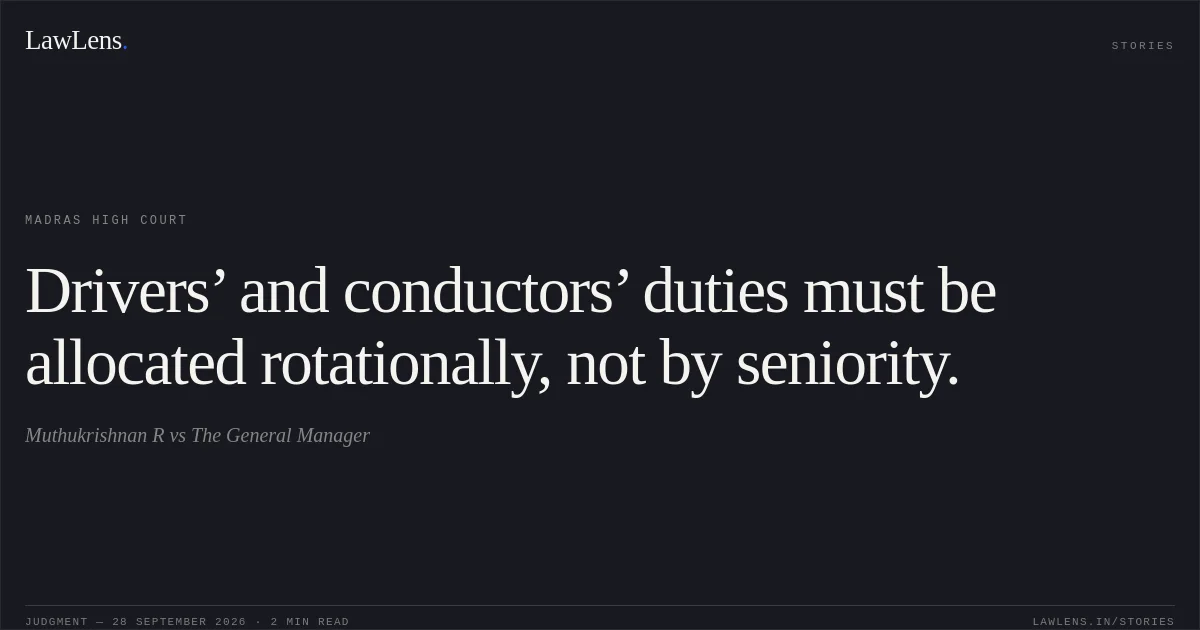
Source reference: pp. 10–12, paras. 9–11Given the history of prior directions and the continuing nature of the alleged non-compliance, the Court directed the Government to ensure that Transport Corporations made duty allotments rotationally under the Settlement, rather than by seniority, and without favouritism.
Source reference: pp. 10–12, paras. 9–11Holding
The writ petition was disposed of with a continuing mandamus directing the Secretary to Government, Transport Department, to instruct the Transport Corporations to allot drivers’ and conductors’ duties only on a rotational basis under the 12(3) Settlement dated 6 February 2008, not on the basis of seniority, and to ensure that no favouritism is shown.
No costs were ordered.
Source reference: p. 12, para. 12Acts & Sections Cited
2 provisions across 1 statute referred to in this judgment. Each provision opens on LawLens.
Industrial Relations Code, 20202
Original Court PDF
Muthukrishnan RvsThe General Manager
Click to open original judgment
Original judgment, available to read, download and summarize on LawLens.in
![Two promotions before 20 years trigger third MACP after 10 years from the second promotion, whichever is earlier.. VENKATESHACHAR vs DC HANDICRAFTS. CAT - ['Bangalore']. LawLens](/stories/thumbnails/two-promotions-before-20-years-trigger-third-macp-after-10-years-from-the-second-promotion-38ad1689b02c48a28e6b6d82628be9c5.webp)