Facts
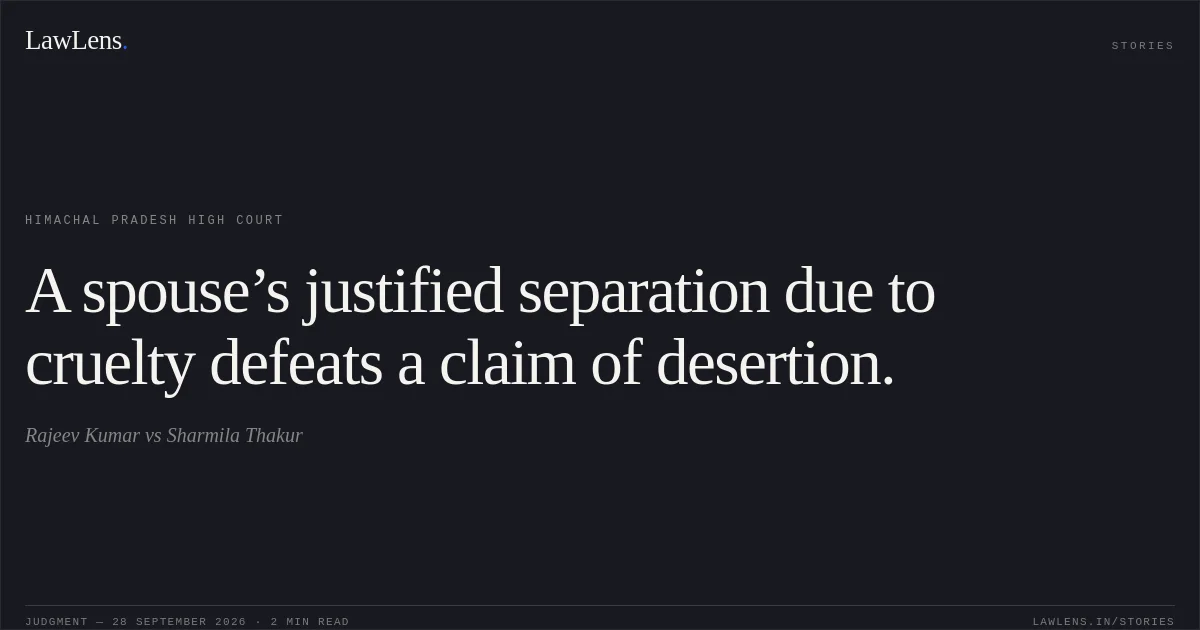
The husband appealed the Family Court’s dismissal of his petition for divorce under Sections 13(1)(i-a) and 13(1)(i-b) of the Hindu Marriage Act, 1955, alleging cruelty and desertion.
Source reference: para. 1The parties married in 2015 and had one child. The husband alleged that the wife refused to live with him and had deserted him; the wife said that his cruel treatment and beatings had compelled her to leave the matrimonial home.
Source reference: paras. 2–4The husband relied, among other things, on the wife’s proceedings under Section 125 Cr.P.C. and the Domestic Violence Act. The Family Court dismissed the petition, and the husband appealed.
Source reference: paras. 6–8Issues
1. Whether the husband proved cruelty by the wife sufficient to warrant divorce under Section 13(1)(i-a) of the Hindu Marriage Act.
Source reference: paras. 10–192. Whether the wife deserted the husband, without reasonable cause and with the intention to end cohabitation, so as to warrant divorce under Section 13(1)(i-b).
Source reference: paras. 20–21Law Applied
Section 13(1)(i-a) of the Hindu Marriage Act permits divorce for cruelty; applying Dr. N.G. Dastane v. Mrs. S. Dastane, AIR 1975 SC 1534, and V. Bhagat v. Mrs. D. Bhagat, AIR 1994 SC 710, the Court stated that cruelty must cause such mental pain and suffering as to make continued cohabitation impossible, and must be grave rather than ordinary marital discord.
Source reference: para. 10The Hindu Marriage and Divorce (Himachal Pradesh) Rules, 1982 require allegations of cruelty to specify the acts with sufficient particularity, including their time, place and circumstances.
Source reference: para. 11Desertion under Section 13(1)(i-b) requires continuous separation for at least two years immediately before presentation of the petition and an intention permanently to end cohabitation (animus deserendi), without reasonable cause and without the other spouse’s consent or against that spouse’s wish.
Source reference: para. 20Reasoning
The husband’s allegations that the wife quarrelled and behaved intolerably were general and lacked particular incidents, dates or circumstances; his testimony and neighbour’s evidence did not substantiate cruelty.
Source reference: paras. 12–15The Court considered the husband’s allegations that the wife’s legal proceedings were false, but noted that no merits-based dismissal of the Section 125 Cr.P.C. application was produced and that the Domestic Violence Act proceedings had resulted in an order granting the wife relief. Her use of statutory remedies therefore did not establish cruelty by her.
Source reference: paras. 18–19As to desertion, although the parties had lived separately since December 2016, the Court found that the wife had reasonable cause to live apart due to the husband’s treatment and that the husband had made no genuine effort to bring her back; the required animus deserendi was therefore not proved.
Source reference: paras. 21–22Holding
The Court held that the husband failed to prove either cruelty or desertion.
It dismissed the appeal and affirmed the Family Court’s judgment and decree dated 9 August 2021; any pending applications were also disposed of.
Source reference: paras. 22–23Acts & Sections Cited
4 provisions across 3 statutes referred to in this judgment. Each provision opens on LawLens.
Hindu Marriage Act, 19552
Code of Criminal Procedure, 19731
Protection of Women from Domestic Violence Act, 20051
Original Court PDF
Rajeev KumarvsSharmila Thakur
Click to open original judgment
Original judgment, available to read, download and summarize on LawLens.in